What's New Podcast - Canada's Arctic at Home: Rights, Everyday Realities, and Preparedness
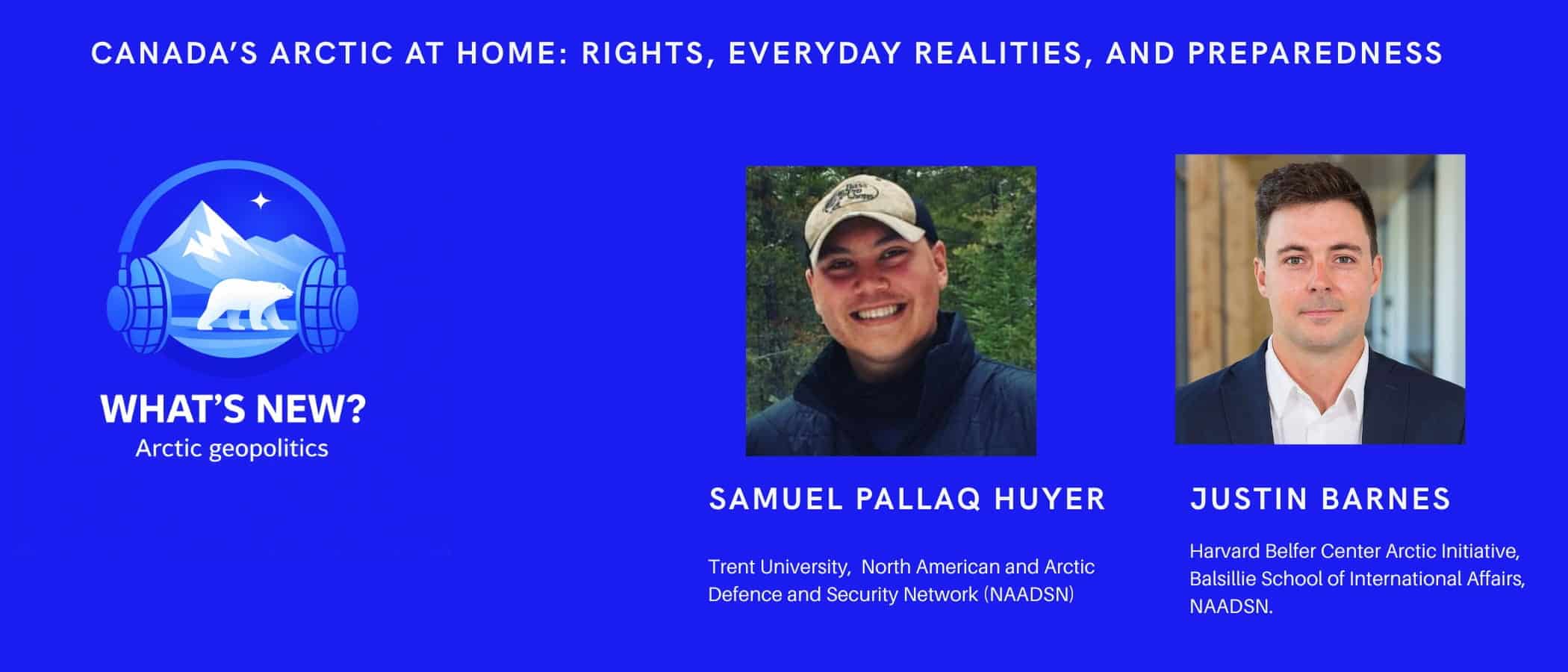
In this What’s New Episode, Serafima Andreeva, Samuel Pallaq Huyer and Justin Barnes explores Canada’s Arctic from a local and Indigenous perspective. Photo: Serafima Andreeva
What’s New? is a podcast on Arctic geopolitics, governance, and security. Created and hosted by Serafima Andreeva, and supported by The Arctic Institute and the Fridtjof Nansen Institute. The podcast brings together leading experts from various fields of Arctic geopolitics and many Arctic and non-Arctic states to unpack key developments, challenge common misconceptions, and discuss the current dynamics of todays changing Arctic.
Canada’s Arctic at Home: Rights, Everyday Realities, and Preparedness
In this episode of What’s New? Arctic Geopolitics, host Serafima Andreeva explores Canada’s Arctic from a local and Indigenous perspective. Recorded in Ottawa together with Samuel Pallaq Huyer (Trent University, North American and Arctic Defence and Security Network) and Justin Barnes (Harvard Arctic Initiative, NAADSN).
They unpack what Arctic governance looks like on the ground in Nunavut, the Northwest Territories, and Yukon—regions that make up 40% of Canada’s territory but are home to less than 0.3% of its population. The discussion challenges common misconceptions by emphasizing that Indigenous peoples in the Arctic are not merely stakeholders, but rights holders under domestic and international law, with formal roles through land claims agreements and institutions such as the Inuit Circumpolar Council and the Arctic Council.
The episode highlights the most pressing practical concerns facing northern communities today: housing shortages, food insecurity, mental health, access to infrastructure and services, climate impacts on livelihoods, and emergency preparedness in remote regions. Rather than framing Arctic security purely in military terms, the conversation reframes security as human security—rooted in community wellness, food sovereignty, housing, and the ability of Arctic peoples to exercise real agency in decision-making.
The episode concludes with concrete policy recommendations, calling for Indigenous-centred policymaking, stronger mechanisms for co-development and co-management, and sustained efforts toward reconciliation. Together, the guests argue that a sustainable Canadian Arctic policy must start at home—by listening to, empowering, and investing in the people who live there.