Iceland's EU Accession Debate: Domestic Drivers over Geopolitical Concerns
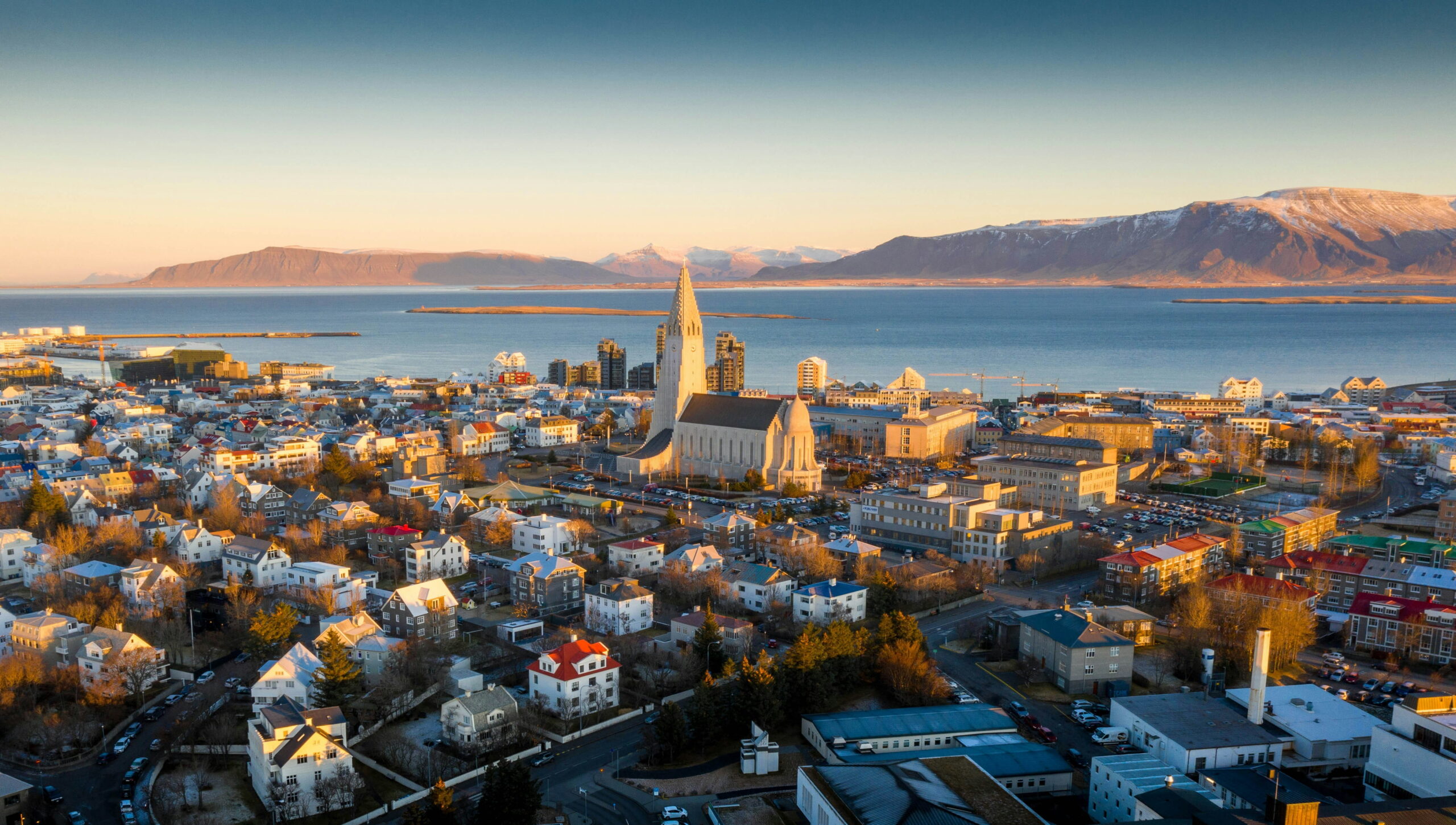
Aerial view of Reykjavik, the capital of Iceland. Photo: Einar H. Reynis
As Iceland prepares to hold a referendum on 29 August 2026 on whether to restart its European Union (EU) accession negotiations,1) international media coverage has largely framed the vote in terms of rising geopolitical tensions in the Arctic, particularly the renewed US posture toward Greenland. US President Donald Trump first mentioned the idea of buying Greenland in 2019, which Danish Prime Minister Mette Frederiksen rejected as absurd. By January 2026, Trump escalated the idea by saying the US should annex Greenland, which is no further than 300 km away from Iceland, by any means necessary.
Reporting by major international news outlets suggests that Iceland’s movement toward the referendum is a direct response to these tensions, portraying accession as part of a broader geopolitical realignment in Northern Europe. Politico, for example, writes that “Iceland looks to fast-track” the referendum following “threats by US President Donald Trump to annex Greenland.”2) In reality, Iceland’s coalition agreement from December 2024 already included that a referendum would be held “no later than 2027”. Similarly, the suggestion that the referendum follows the Greenlandic threats risks oversimplifying a far more complex political reality and is not based on any statements by the Icelandic government that would confirm this connection.
Against this backdrop, this article argues that Iceland’s EU accession debate is, at its core, a domestic story – one that is shaped by party politics and enduring economic disputes over fisheries and agriculture -, and that the international framing of the debate as a response to Arctic geopolitical tensions, particularly the crisis over Greenland, obscures more than it reveals.
The EU’s Geopolitical Enlargement
Understanding Iceland’s current position requires situating it within the country’s longer history of engagement with the European Union. Iceland formally applied for EU membership in 2009, in the aftermath of the global financial crisis, but negotiations were put on hold in 2013 after a new Eurosceptic center-right government took office and paused the process, citing concerns over national sovereignty and fisheries control. The country has maintained close integration with the EU through the European Economic Area (EEA), allowing it to access many benefits of membership without full political integration.3) More recently in March 2026, the EU and Iceland signed a Security and Defence Partnership thereby demonstrating growing cooperation in security matters.4)
From both the Icelandic and EU perspectives, the current moment can be seen as genuinely distinct. This is not simply because of Greenland, but also because several broader dynamics have converged: Arctic insecurity, shifting US behaviour, and the EU’s evolving ‘geopolitical enlargement’ logic. As Frank Schimmelfennig argues, EU enlargement since Russia’s invasion of Ukraine has increasingly been framed as a strategic geopolitical instrument for European security, rather than purely a normative or technocratic process.5) This is what the EU has referred to as enlargement as a “geopolitical imperative”.6)
Within this framework, the Arctic has emerged as another space where the EU’s role as a geopolitical actor is being tested, with Iceland positioned within a wider northern security perimeter. Trump’s rhetoric could have, in this context, acted as a catalyst. His repeated claims that the United States needs Greenland and his tendency to confuse Greenland with Iceland have not gone unnoticed in the country.7) In a sense, this dynamic is best captured in a recent statement by the EU’s Enlargement Commissioner Marta Kos according to whom “the geopolitical context is fundamentally different today than when Iceland first applied for membership.”8)
Some link these developments to a broader reopening of the EU debate. Eiríkur Bergmann notes that Trump’s Greenland remarks are “fueling the EU accession debate in Iceland,” as he assesses that the strategic arguments Trump uses to justify taking Greenland could also be used against Iceland.9) In addition, former Icelandic Prime Minister Þorsteinn Pálsson cites the US’s 15% tariffs on Iceland as evidence that EU accession “is hardly avoidable if we intend to defend our interests in the long term.”10)
On the EU side, a 2026 European Parliament brief on EU-Iceland relations considered Iceland as a major factor in the Union’s geopolitical role in the Arctic and underlined that any renewed accession process would now be read through the lens of security as much as economics.11)
However, these developments must also be understood in light of Iceland’s long-standing security position. As Bailes et al. note, Iceland remains unique among Nordic states: it has no standing army, relies heavily on the United States and NATO for defence, and has historically used arrangements such as the EEA and Schengen as functional substitutes for EU membership.12) Silja Ómarsdóttir shows that Icelanders have become noticeably more positive about institutional cooperation since Russia’s full-scale invasion of Ukraine: by 2023 the percentage of voters who thought Iceland should emphasise closer security cooperation with Europe/EU had risen to 36.4 percent, higher than the figure for the United States and NATO.13) Taken together, this could point to a more favourable context for revisiting EU accession than in the past.
Limited Impact of Greenland on the Accession Debate
While several analyses do provide a convincing argument of a link between Iceland’s position on EU accession and the Greenland crisis, in reality, this link is not strongly reflected in political discourses or public opinion. On the 9th, 10th, and 16th of March, 2026, Alþingi, Iceland’s Parliament, discussed the proposal to hold a referendum on the 29th of August, 2026, on continuing accession negotiations. During the three debates lasting five and a half, nine and a half, and six and a half hours, respectively, Trump’s threat against Greenland was only mentioned in four interventions. In contrast, issues revolving fisheries, agriculture, energy, and the Euro dominated the debate over security or defense concerns. Greenland was only mentioned by two governing parties.In each of these instances, it was invoked to illustrate the EU’s collective response to the crisis and its support for Denmark.Social Democrat MP Dagur B. Eggertsson, for example, argued: “These are dangerous times for small countries. This uncertainty and this tariff war can easily lead to individual countries, without being part of a customs union, being vulnerable.”14)
Nevertheless, the responses from several opposition parties were critical, arguing that Iceland’s security still falls within the framework of NATO and not the EU, as stated by largest opposition ‘Independence’ party member Jens Garðar Helgason: “We are in NATO. We have a bilateral defense agreement with the United States, the most powerful military power in the world, and Iceland’s main deterrent lies in this defense agreement.”15)
One could even argue that there might be a negative correlation between EU accession and the Greenland crisis. Guðrún Hafsteinsdóttir, Chairwoman of the Independence Party, suggested in a parliamentary session regarding President Trump’s military threats against Greenland that in a time when Iceland “should be emphasizing issues that unite the nation” the country should not “rush into action” on a divisive EU accession.16) Additionally, a Gallup poll conducted at the end of January 2026, a week after Trump’s threats against Greenland, showed 42% of Icelandic people being in favor of EU accession and 42% percent opposing, a slight decrease from the 44% in favor in 2025.17) While this decline cannot be directly attributed to the Greenland crisis, it undercuts the notion that Trump’s threats pushed Icelanders toward EU accession; if anything, support moved in the opposite direction. Meanwhile, support for NATO did grow, from 71% to 78%, which, similarly to what can be seen in parliament, shows that the tensions around Greenland have had a bigger influence on NATO perception than EU perception.18)
What Actually Shapes the Accession Discussion?
To actually understand what drives this new interest in EU accession, one needs to look at domestic political dynamics rather than external security concerns as the primary driver. In particular, the internal positioning of political parties, most notably the Liberal Reform Party, Viðreisn, plays a decisive role. Though Trump had previously made similar threats in the first term of his presidency, the push to revisit EU accession predates the recent crisis around Greenland.19) Viðreisn had already made renewed EU accession negotiations a central priority and successfully secured a commitment in the coalition agreement concluded on 21 December 2024: Iceland would hold a referendum on accession “no later than 2027”.20) Clearly, the commitment to reconsider EU accession was formalized before any geopolitical escalation.
This is not the first time that Iceland’s accession process is shaped by fragile political dynamics as this pattern closely resembles Iceland’s EU accession process between 2009 and 2013. At that time, accession was largely a project of the Social Democratic Alliance, Samfylkingin, falling well short of a broad societal or political consensus.21) In reality, the decision to apply in 2009 rested on fragile political foundations and a narrow parliamentary majority. The coalition itself lacked a clear vision. While Samfylkingin supported accession, its coalition partner, the Left-Green Movement, remained fundamentally opposed, which significantly complicated the negotiation process. Ultimately, when the Independence Party won the 2013 parliamentary elections and formed a coalition with the Progressive Party, both being highly sceptical of accession, negotiations were suspended. Once political power shifted, the process quickly lost momentum, showing its dependence on specific parties rather than broad societal commitment. Either way, Iceland’s accession negotiations never actually reached the most controversial topics: chapter 11 on agriculture and rural development and chapter 13 on fisheries, which are still the main issues shaping the accession debate today.
This is not to say geopolitics plays no role at all. Rather, it appears to operate as a form of geopolitical opportunism. Minister of Foreign Affairs Þorgerður Katrín Gunnarsdóttir has argued that the current international climate places Iceland in a stronger negotiating position, with the EU more open to accommodating exceptions or special circumstances for Iceland. Indeed, the EU’s Commissioner for Fisheries, Costa Kadis, has stated that there is “definitely room for flexibility” on fisheries. However, it remains unclear whether that flexibility would go far enough to satisfy Iceland’s prominent fishing industry, and whether Member States would allow it in the first place. According to Gunnarsdóttir, “the nation has a unique opportunity to control the process itself and assess its interests in these times and this is (…) an opportunity which we would not obtain again for a long time.”22) Even so, this affects how Iceland might negotiate accession rather than whether Icelanders would ultimately vote to join the EU.
Conclusion: Accession Remains Far from Guaranteed
Although geopolitical tensions surrounding Greenland have shaped international narratives about Iceland’s EU accession debate, they have only had a limited impact in Iceland. Domestic political discourse and public opinion show little evidence that the Greenland crisis has significantly altered priorities. Just like during the 2009–2013 accession negotiations, Iceland’s approach to EU membership remains primarily determined by internal party politics and major economic questions like fisheries and agriculture, rather than external security pressures. While Arctic tensions and shifting US behaviour provide a new strategic backdrop for Iceland, the Icelandic government and the public do not seem to view EU accession as the way to act on this. Looking ahead, even if the outcome of Iceland’s 2026 referendum is positive, there is no evidence that geopolitical imperatives will cause Iceland to ignore its long-standing concerns about the EU, making the likelihood of accession uncertain.
Arno Minasian is a recent graduate from the College of Europe with an MA in EU International Relations and Diplomacy Studies and an MA in European Affairs from Sciences Po Paris.
References