The Arctic Institute's 2026 Korea Series: An Introduction
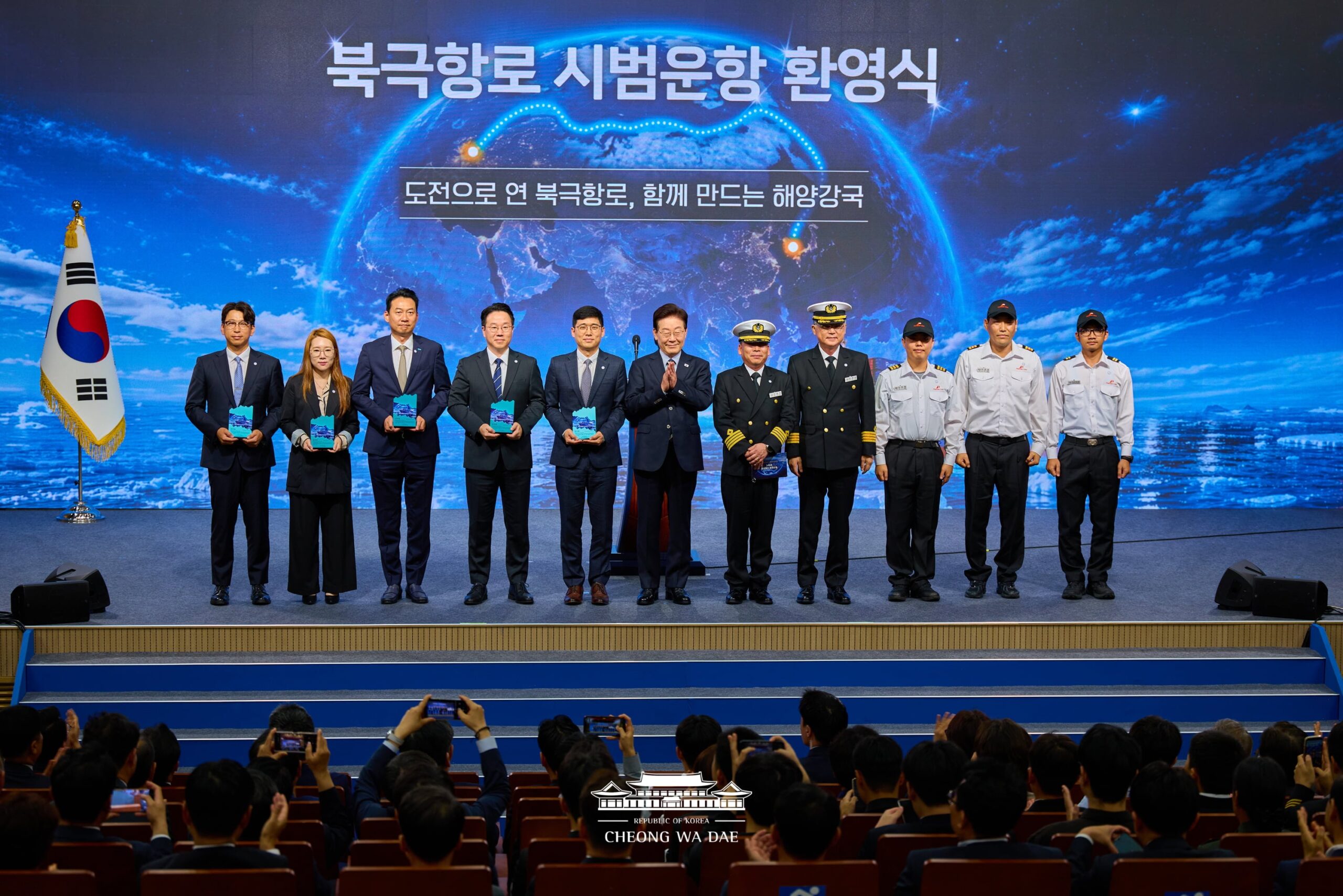
South Korean President Lee Jae Myung in a group photo with government representatives, maritime industry leaders, and shipping professionals in Busan. Photo: Office of the President
The Arctic Institute Korea Series 2026
In August 2026, the Panstar Acro, a 2,758-TEU container ship, departed Busan for Rotterdam via Russia’s Northern Sea Route (NSR). Unsurprisingly, its passage attracted, and in many ways continues to, considerable attention. Travelling at an average speed of around 15 knots, the vessel reportedly completed the Arctic leg of its voyage in approximately six days and ten hours; a remarkable achievement even though its cargo volume was well below its nominal capacity. The voyage, above all, demonstrated Seoul’s ability to successfully navigate the route but it did not demonstrate that a regular service would be commercially viable just yet.
That distinction between operational possibility and commercial viability matters a great deal because it lies at the heart of South Korea’s emerging Arctic strategy. For more than two decades, Korea’s engagement with the region followed a patient and cumulative logic: the establishment of a research station on Svalbard in 2002, the commissioning of the icebreaker Araon in 2009, the attainment of observer status at the Arctic Council in 2013, successive national master plans, and the enactment of the Polar Activities Promotion Act in 2021. As a non-Arctic state with no territorial claim to the region, Korea built its standing through scientific research, technical expertise, and sustained diplomacy seeking to gradually establish itself as a recognised and credible participant in Arctic affairs.
That incremental approach has now given way to a more visible and, some may argue, strategically assertive agenda. Climatically, the retreat and thinning of Arctic sea ice have created new, yet by no means risk-free, seasonal opportunities for navigation. Geopolitically, Russia’s full-scale invasion of Ukraine has fractured the cooperative arrangements on which much of Korea’s Arctic diplomacy had been built. As such, Seoul has had to reconsider how it engages with a more ‘accessible’ region where institutional cooperation has weakened and geopolitical competition has intensified.
Domestic politics has provided a further, and more substantive, impetus. The martial-law crisis and subsequent snap election, the new President’s political emphasis on Busan, and the promise of an Arctic shipping route have helped transform what was once a specialist policy interest into a national development priority. The relocation of the Ministry of Oceans and Fisheries to Busan, the Arctic Sea Route Special Act due to enter into force in December 2026, and the 2026 trial voyage all reflect this shift. Yet the voyage has also exposed a central contradiction; that is, Korea’s Arctic ambitions remain partially dependent, at least for now, on Russian permits and infrastructure even as Seoul deepens its security and industrial relationships with its Western partners. Further complicating the picture, Korean shipbuilders, defence companies, scientific institutions, and regulators – its Arctic stakeholders in other words – appear to be articulating their own interests in the Arctic through disjointed and/or independent initiatives rather than as part of a coherent national strategy. The result is not a single, fully formed Arctic policy but a collection of interconnected projects whose ambitions, institutional sponsors and timelines do not always align.
The series examines this emerging policy landscape through eight core contributions by Korean, Russian and international scholars and practitioners working across maritime affairs, international relations, science, defence, and law. A companion essay on North Korea offers an additional perspective on the ways in which states can position themselves for future opportunities in the Arctic even when their immediate capacity to exploit them remains limited.
The eight core contributions begin with Jihoon Jeong’s examination of the political origins of Korea’s Arctic Sea Route initiative. Jeong argues that the push has been driven less by changing Arctic conditions than by Busan’s demographic decline and the search for a new economic and political mission for the city. Danbi Kim and Bongchul Kim then broaden the discussion to the governance environment in which Korea must operate. Drawing on middle-power diplomacy and network theory, they examine the consequences of institutional fragmentation and propose a more flexible and phased approach to Korean engagement. Emilia Kyung Jin turns to the scientific foundations of any credible Arctic strategy, explaining how the Korea Polar Research Institute’s use of satellite, drone and in-situ observation can be translated into reliable decision-support data for safer navigation.
The industrial and security dimensions are explored in two further contributions. Magnus de Witt and Jihoon Jeong examine how Korea’s shipbuilding industry could use its expertise in green technologies and ice-class vessels to develop opportunities in allied Arctic markets. Seokjin Yun and Chan Mo Ku extend this discussion to defence and trace how Korean exports of howitzers, rocket systems and icebreakers have helped establish Seoul as an increasingly significant security partner to Nordic countries. Roman Zhilin offers a perspective less commonly represented in English-language discussions; a Russian assessment of why deeper Arctic cooperation between Seoul and Moscow remains structurally constrained in spite of their shared interests and continued, albeit restrained, commercial interaction.
The series then turns to Brian Park’s article in which he addresses a newer and less obvious source of potential friction by tapping into the international implications of Korea’s AI Basic Act. As Korean institutions become more involved in multinational Arctic research, Park argues, the Act may intersect with Indigenous data-sovereignty principles and the data-localisation requirements of Arctic states. This, in turn, could complicate Seoul’s current and future scientific endeavours in the Arctic. The series concludes with Umji Kim’s wider strategic assessment in which she makes the case that Korea ought to move beyond the narrow question of whether Arctic shipping routes can be commercially exploited and instead develop the range of capabilities and partnerships that would enable it to act as a “strategic connector” across an increasingly contested North.
Last but certainly not least, the companion essay by Tyler Lissy, which sits outside the series’ central examination of South Korean policy, adds a further, and in many ways critical, perspective. By categorising North Korea’s 2016 accession to the Svalbard Treaty as a form of “anticipatory lawfare”, Lissy offers a useful reminder that non-Arctic states engagement with the region is not necessarily driven by immediate commercial and/or geopolitical considerations. Rather, it can also involve the deliberate positioning of states for opportunities that may emerge only over the longer term.
Considered as a whole, these contributions trace Korea’s broader Arctic trajectory. They examine the domestic political forces driving its ambitions, the diplomatic, scientific, industrial, and security capabilities it is assembling, and the geopolitical and regulatory frictions that accompany its growing involvement. Together, they raise the fundamental question of what kind of Arctic actor a non-Arctic middle power like South Korea can realistically become. While the answer varies depending on one’s perspective, it is certainly unlikely to be found in shipping routes, or the maritime domain more broadly, alone.
Nima Khorrami is a Senior Associate at The Arctic Institute.