The Arctic Institute's 2026 Korea Series: An Introduction
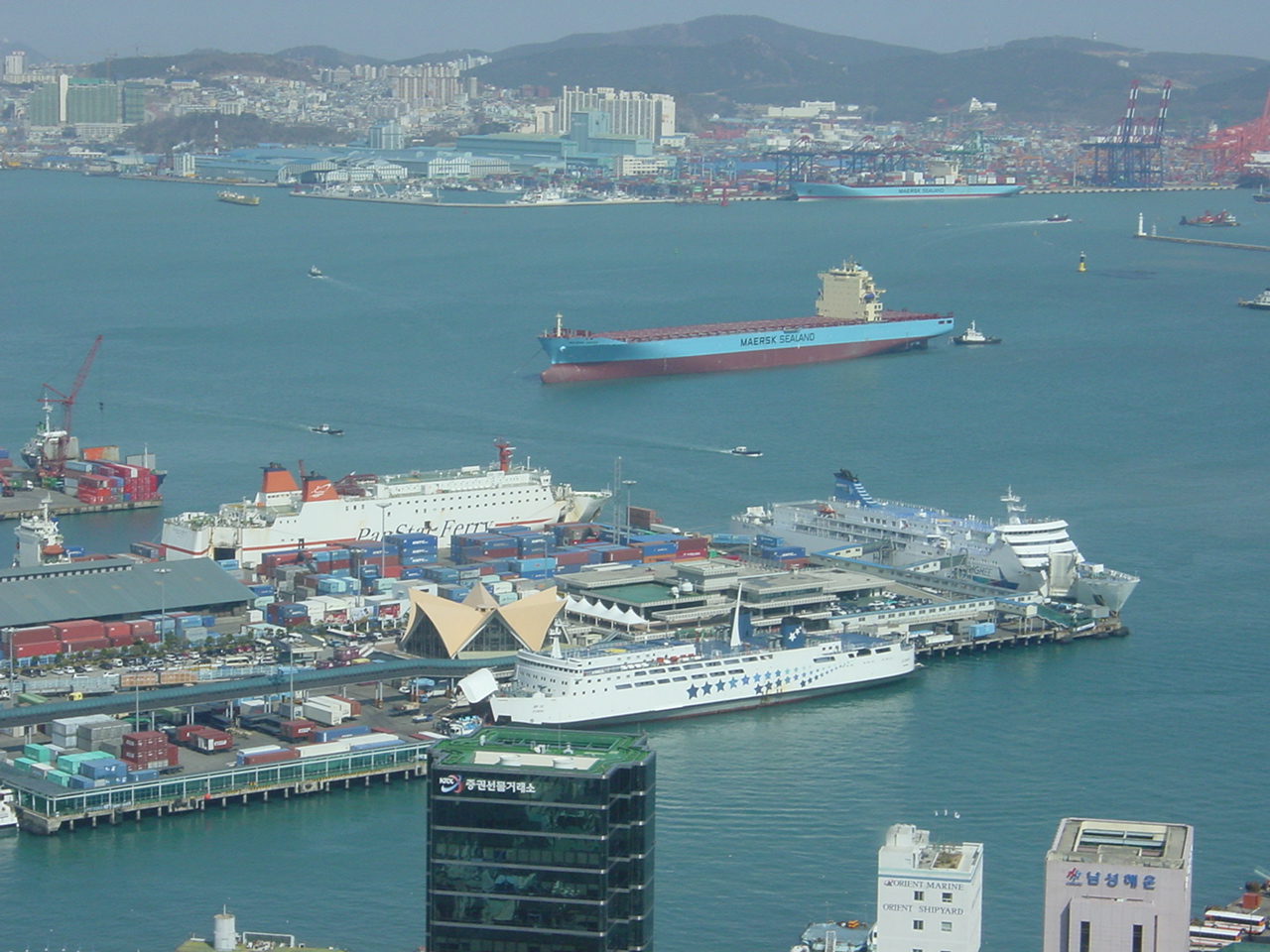
Busan port seen from Busan tower. Photo: Bergmann
The Arctic Institute Korea Series 2026
In August 2026, a 2,758-container vessel named the Panstar Acro slipped out of Busan, bound not for Shanghai but for Rotterdam, by way of the top of the world. Its passage along the Northern Sea Route made headlines. But as several contributors to this series show, the voyage’s real significance lies less in what it proved commercially than in what it revealed politically: a Korean Arctic strategy assembling itself faster, and for more complicated reasons, than most outside observers have noticed.
For more than two decades, South Korea’s relationship with the Arctic followed a quiet, cumulative logic: a research station on Svalbard in 2002, the icebreaker Araon in 2009, observer status at the Arctic Council in 2013, a sequence of master plans and, in 2021, a Polar Activities Promotion Act. As a non-Arctic state with no territorial claim to the region, Korea built its standing the only way available to it; through science and patient diplomacy rather than material power or geography. Recognised presence was the goal, and it was earned slowly.
That patient posture has, in barely two years, given way to something more assertive. Arctic sea ice is thinner, younger, and more unpredictable than at any point in the observational record — the oldest, thickest ice has retreated by more than 95 percent since the 1980s — turning the old question of whether the region will open into the harder question of how to operate in it safely. Russia’s invasion of Ukraine fractured the cooperative order that Korea’s Arctic Council membership was built around, forcing Seoul to rethink its diplomatic footing almost from scratch. At home, a martial-law crisis, a snap election, and a new president who carried Busan on a platform that featured the Arctic route turned a specialist policy niche into a national agenda item — complete with a relocated ministry, a special act, and this year’s trial voyage, which relied on Russian permits and drew quiet concern from Seoul’s partners in the West. Meanwhile Korea’s shipbuilders, its AI regulators, and its arms exporters have each, almost independently, discovered an Arctic dimension to their work.
No single article can capture a moment defined by that much simultaneous change across that many domains. The Arctic Institute’s 2026 Korea Series brings together eight contributions — from Korean, Russian, and international scholars and practitioners spanning maritime policy, international relations, science, industry, and law — to examine South Korea’s Arctic turn from the angles that, together, explain it.
The series opens with Jihoon Jeong’s account of where the current Arctic Sea Route push actually came from — not, he argues, Arctic conditions, but Busan’s demographic decline and the political opportunity it created. Danbi Kim and Bongchul Kim then widen the lens to the governance order Korea must now navigate, drawing on middle-power and network-diplomacy theories to propose a three-pillar strategy for operating amid a weakened Arctic Council and a defunct Barents Euro-Arctic Council. Emilia Kyung Jin turns to the scientific foundations beneath any such strategy, describing KOPRI’s effort to convert satellite, drone, and in-situ observation into the kind of decision-support data that safe navigation actually requires. Magnus de Witt and Jihoon Jeong — who returns here as co-author — examine the industrial side of the same problem, tracing how Korea’s shipbuilders and a less-visible second ministry are positioning the country’s green-shipbuilding expertise for allied, rather than Russian, Arctic markets. Seokjin Yun and Chan Mo Ku extend that industrial story into defense, showing how Korean howitzers, rocket systems, and icebreaker exports have quietly made Seoul a security partner to Nordic states; a trajectory that might very well get replicated in the context of Seoul-Ottawa bilateral relations. Roman Zhilin then supplies a vantage point rare in English-language coverage: a Russian scholar’s assessment of why, despite visible Korean interest, deeper Arctic cooperation with Moscow remains structurally constrained. Brian Park turns to a newer and less obvious complication, showing how Korea’s landmark AI Basic Act — promoted as the world’s first comprehensive AI law — reaches into multinational Arctic research and collides with Indigenous data-sovereignty and state data-localisation regimes across the region. The series closes with Umji Kim’s synthesis, which argues that Korea should stop asking whether to use Arctic shipping routes and instead build the diversified capabilities and partnerships that let it act as a “strategic connector” across an increasingly contested North.
Read in this order, the eight articles trace a single arc: from the domestic politics that set Korea’s Arctic turn in motion, through the diplomatic, scientific, industrial, and security capabilities it is now assembling, to the frictions — with Russia, and with new regulatory questions — that this expanded engagement is generating, and finally to a proposed strategic identity for the years ahead. Taken together, they offer the clearest picture yet of a middle power non-Arctic nation learning, in real time, what it actually means to have an Arctic policy.
Nima Khorrami is a Senior Associate at The Arctic Institute.