The Arctic Institute's 2026 Connecting the Cryosphere Series: Conclusion
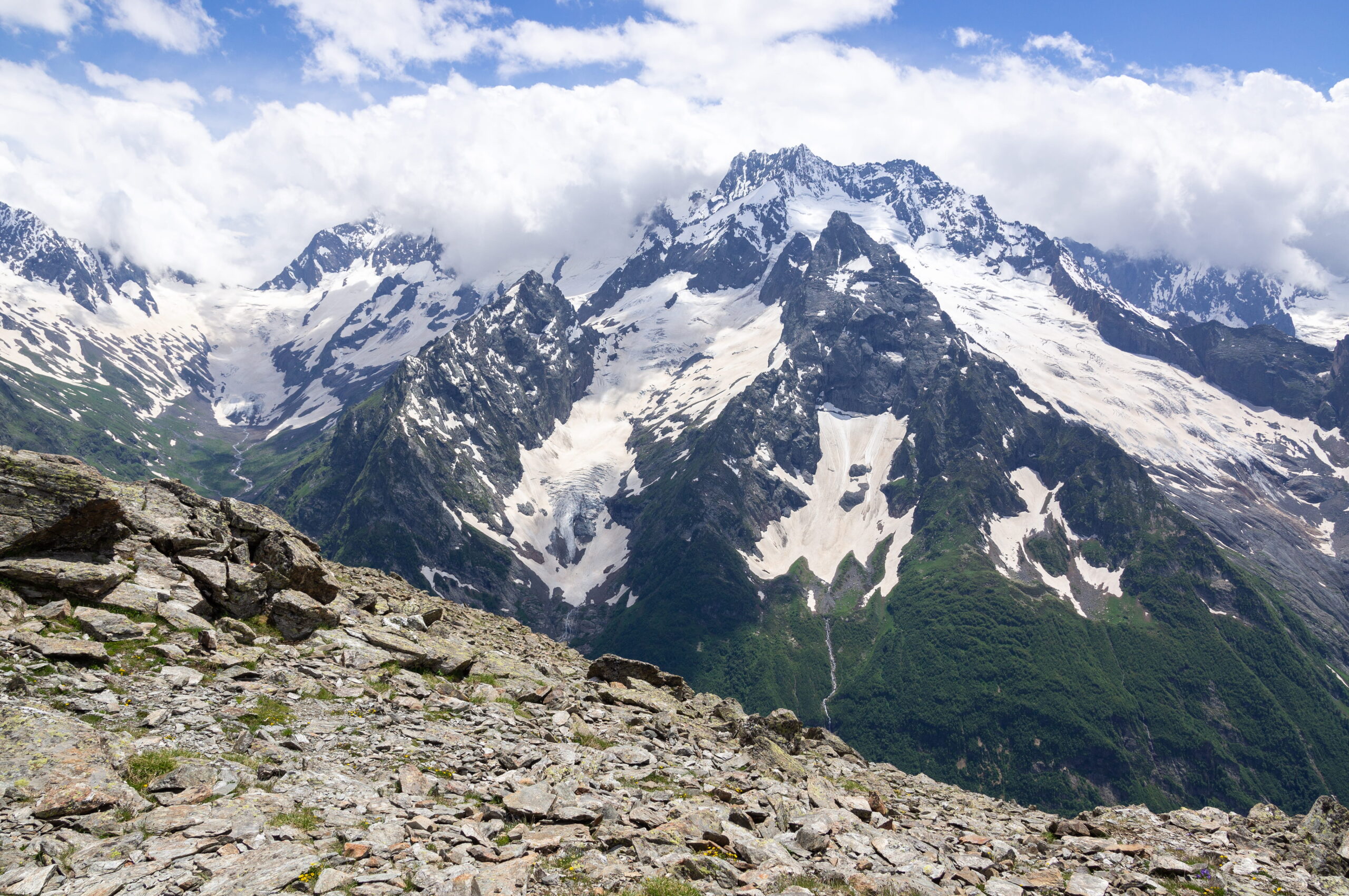
Dzhuguturlyuchat massif and glacier. Caucasus Mountains. Dombay, Karachay-Cherkessia. Photo: Vyacheslav Argenberg
The Arctic Institute’s 2026 Connecting the Cryosphere Series opened with Rainsford’s map of the Arctic Ocean with multi-coloured lines representing cryospheric projections, shipping lanes, linguistic zones, infrastructure and wildlife migration that invited us to look at the Arctic through a multidisciplinary and oceanic lens that captures the region ‘in flux.’ Readers were then encouraged to continue on this trajectory by focusing on the liminality and legal elusiveness of sea ice in relation to Chuffart’s, Tsiouvalas’ and Tugend’s proposed Rights of Nature qua Solidarity which, instead of probing how sea ice fits into law, interrogates how law can address ‘the entanglements in which we already find ourselves.’ Gehrmann and colleagues liken water to collaboration in their discussion of the ‘ecologies’ of art-science collaboration, that is, ‘forming through contact, pressure, and patience, and reshaping everything it touches.’
Moving from marine environments to the terrestrial, Craney and Maisch address the cultural, political and physical mechanisms that have brought changes to C’ulc’ena’ Łuu’ / Gulkana Glacier. Through art and writing, they seek to counter its imperial histories with creativity and community. In extension, the intersection of glaciers and wearable art were interrogated in Beausoleil’s piece, which used similes to compare glaciers, art and the human body (‘[t]he plastic behaves in a brittle manner, just as ice fractures’, ‘I draw parallels between how glaciers preserve history and knowledge within their bodies of ice, just as I do’). In his travelogue, Henderson recalls the synchronicity between the glacier and himself (‘[t]he glacier, the hut, and I were alive and well and “becoming,” in essence, growing. Healthy!’, ‘the glacier and I were thriving’ and increasing grief in relation to glacial melt).
This series aimed to facilitate connections across the cryosphere, both geographically and thematically. A throughline emerged as several of the articles touched on colonialism and the marine and terrestrial cryosphere. By weaving together legal rights for sea ice, artistic representations of glacial melt, and Indigenous environmental stewardship, the contributors demonstrate how cryospheric geographies cannot be reduced to static, frozen landscapes but are deeply entangled socioecological systems. Establishing solidarity across these environments requires recognising how local cryospheric changes are bound up in the broader histories of imperial governance, extraction and relational care, as well as the incorporation of research and policy frameworks that integrate the liminality of ice and counter colonial narratives.
Looking ahead towards an expansive understanding of cryospheric geographies will enable us to cultivate environmental imaginaries rooted in bidirectional responsibilities across diverse land and seascapes. As conversations around outer space expansionism and extraction develop, these Earth-bound lessons of solidarity across the cryosphere can guide meaningful multiplanetary ethics that are cognisant of environmental protection, Indigenous engagements and the frozen more-than-human.
Seira Duncan is a postdoctoral researcher at the Center for Ainu and Indigenous Studies at Hokkaido University and an associate at the Harvard University Asia Center. Mariel Kieval is a doctoral researcher at the Norwegian University of Life Sciences and a Research Associate with The Arctic Institute.