Advisory Parameters for Arctic Climate Intervention Assessments Report 2026
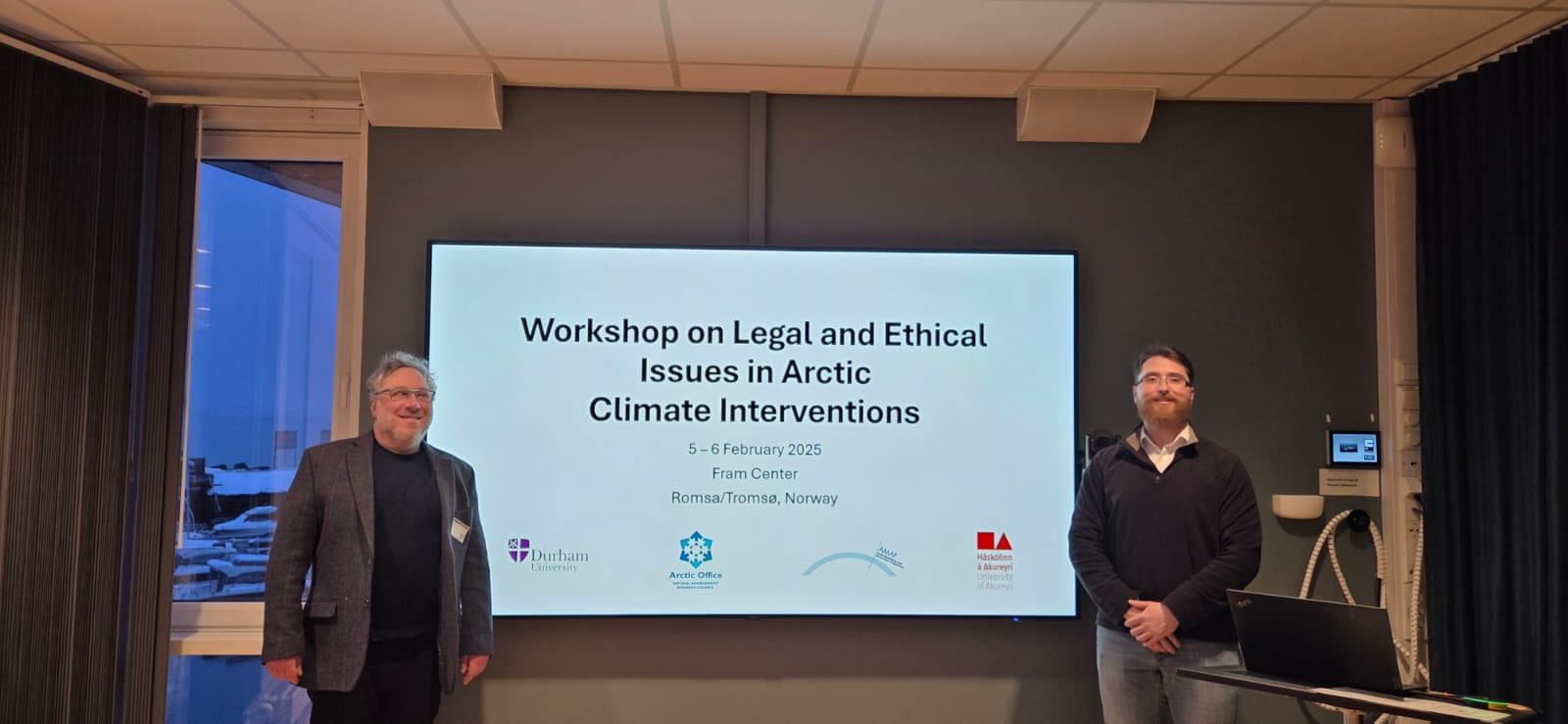
Prof. Philip Steinberg (left) and Dr. Romain Chuffart at the Fram Center in Romsa/Tromsø in February 2026. Photo: Romain Chuffart
Proposals to intervene in the Arctic climate have multiplied in recent years and the scientific literature on their feasibility is now substantial. Questions of who should evaluate Arctic climate interventions, against what standards, and with whose consent, remain however largely unanswered.
Existing international instruments address these activities only partially and often ambiguously. The UN Human Rights Council’s 2023 report on new technologies intended for climate protection treated climate interventions as potentially incompatible with human rights and called for compliance with the United Nations Declaration on the Rights of Indigenous Peoples, including the right to Free, Prior and Informed Consent. Yet the ethical protocols developed by Arctic Indigenous organisations are rarely integrated into governance analysis, despite the direct implications that modifying the Arctic environment carries for Indigenous territories, cultures and livelihoods.
This report sets out parameters for designing an assessment instrument. While it is not intended as a toolkit, it can serve as a bridge between the statements of geoengineering principles that have accumulated since 2009 and the practicable assessment tools that will eventually be needed. The parameters are organised around three sets of questions:
- First-order questions delimit the scope of what is to be considered in the assessment of a climate intervention. What are the bounds of ‘climate’? At what spatial, temporal and technological scales should an intervention be assessed? What is the appropriate object of governance: a space, a technology, a substance, an actor, an outcome? At what point in a long and non-linear development trajectory should assessment begin?
- Second-order questions concern procedure. How are relevant constituencies identified, and how do they exercise substantive rather than merely formal authority? How is risk defined, and by whom? Which institutions can implement ethical and legal decisions? How can remediation be funded when liability is difficult to assign?
- Third-order questions concern substance and deal with questions of effectiveness, environmental impact, societal impact and justice, economic viability and reversibility across the life cycle, and what happens when consensus fails or the process is captured.
The Advisory Parameters for Arctic Climate Intervention for Assessments document was produced with funding from the UK Arctic Office under its Supporting Impactful UK Arctic Science Engagement 2025/2026 scheme to support impactful research aligned with the priorities and objectives of the Arctic Council, its working groups, and the Kingdom of Denmark’s chairship. It draws on a two-day workshop held at the Fram Centre in Tromsø, Norway on 5-6 February 2026. Drafts were reviewed by workshop participants and by an external expert (all contributors listed in Appendix 2).The document is not a workshop report, and no participant, other than the named authors, should be assumed to endorse its content in its entirety.
Philip Steinberg is Professor of Geography at Durham University. Romain Chuffart is Managing Director of The Arctic Institute and Nansen Professor in Arctic Studies at the University of Akureyri.