The European Union and its 2026 Arctic Strategy: Three Questions Worth Asking
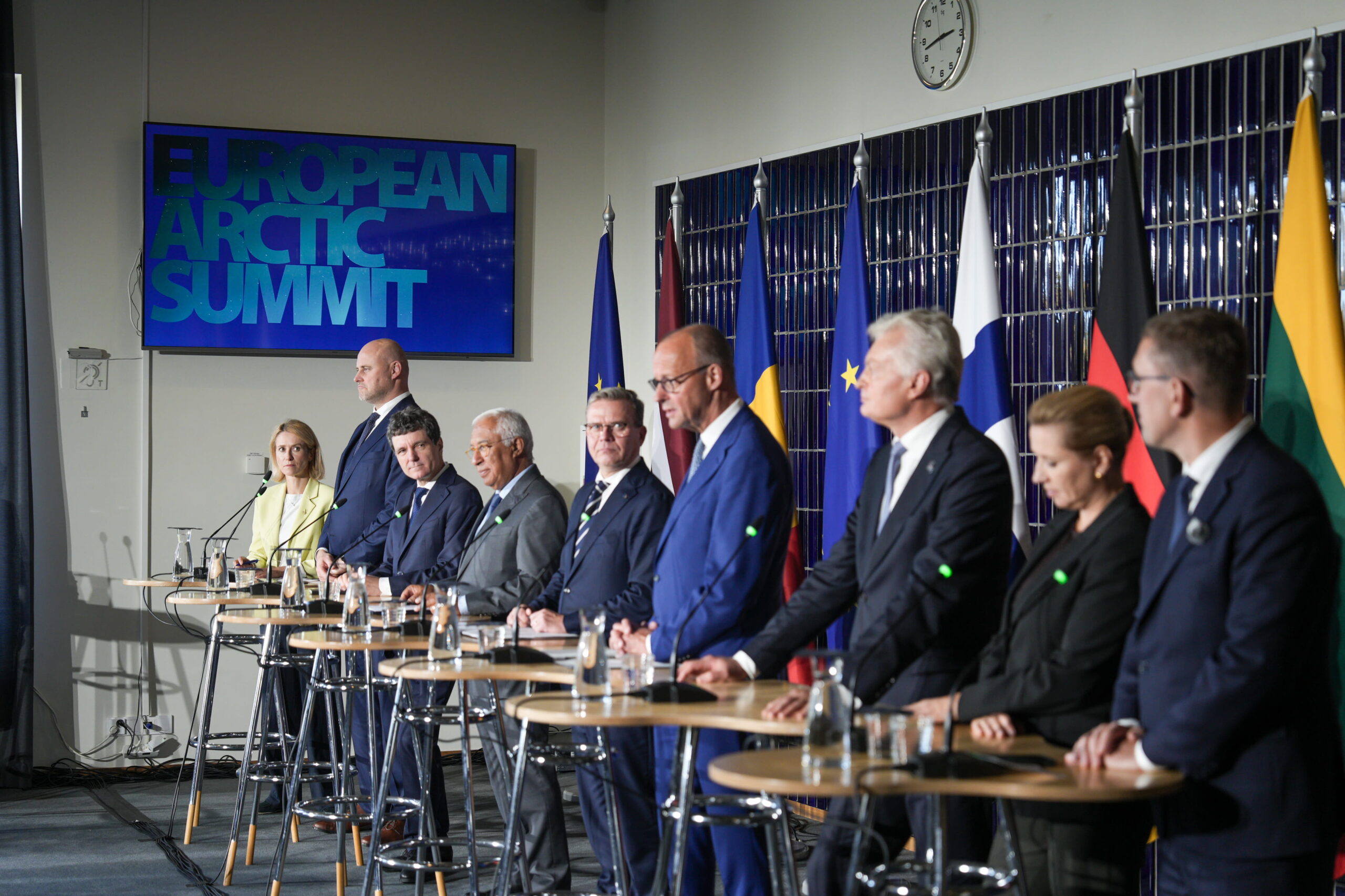
Kaja Kallas and Jozef Síkela during a press conference at the European Arctic Summit 2026 in Rovaniemi, Finland. Photo: EC – Audiovisual Service
The European Commission and the High Representative have just launched a new Arctic Joint Communication – this time presented as a “strategy”: Europe’s Northern Neighbourhood: A New Strategy for the Arctic. What follows is not an academic assessment of its content. Rather, it is an effort to examine the document from a more strategic perspective, focusing on three questions that warrant honest answers; questions that go beyond what the document says and address the more consequential issue of whether any of it will ultimately matter.
Does the EU even need an Arctic policy?
This should actually be an intellectually stimulating question because it moves the focus away from why the EU has a policy and towards what, precisely, that policy contains and/or means to achieve. And the answer is straightforward: yes, it should have a policy simply because the primary function of any Joint Communication has always been more communicative than strategic, directed simultaneously at Arctic decisionmakers and stakeholders, the European public, as well as EU institutions and services.
The EU has communicated so for nearly twenty years. Since 2008, four successive (Joint) Communications have retained the same three founding pillars: protecting the environment, promoting sustainable resource use, and contributing to Arctic governance. And the EU is far more of an Arctic power than, say, China. Its direct investments and regulatory reach – from Horizon-funded Arctic research to environmental law, fisheries standards, and satellite connectivity frameworks – shape Arctic realities more directly than any Arctic policy statement indicating “near-Arctic” status. With three Arctic Member States (Denmark, Finland, and Sweden), two EEA partners (Iceland and Norway), and a special relationship with Greenland, the Arctic is not simply a matter of foreign policy for the EU; it is domestic policy wearing a diplomatic coat.
The 2026 Joint Communication is unusually direct on this point. Its introduction declares that “Europe’s strategic autonomy is inseparable from the Arctic” – the clearest formulation yet of why a policy exists. More strikingly, it explicitly frames this as a rupture with 2021, stating that this new policy – now a strategy – “redefines what the Arctic means for Europe and what Europe means for the Arctic.” That self-conscious break is itself analytically significant: it is not about updating a policy anymore but claiming that the terms of engagement have changed.
So the real question is not whether the EU needs an Arctic policy. It has had one since 2008, and communicating its Arctic presence has been its primary function. Yet communicating presence is not the same as directing action. The “Arctic” has never held a dedicated budget line in the Multiannual Financial Framework while the EU regulations that profoundly impact the region are routinely drafted with no Arctic impact assessment attached. Moreover, the very complexity of the Arctic – a broad space that spans distinct regional varieties – has always led to a mismatch whereby the policy umbrella has grown wider with each update, but the strategic coherence of the EU’s Arctic posture has not.
And this brings us to today and to a document that, for the first time, labels itself a strategy.
Which Arctic?
The 2026 strategy brings one genuinely new move; that is, it introduces a Northern Neighbourhood concept that reframes the Arctic as a proximate political space for the European Union. This is more consequential than it may sound. The title itself signals the shift: placing “Northern Neighbourhood” before “Arctic” already tells you where the new gravity lies – not the more distant circumpolar space, but a political space the EU considers proximate, connected, and integral to its own future.
For almost two decades, the EU’s Arctic policy sought to simultaneously ‘speak’ to a myriad of actors including Arctic Ocean coastal states, its own Member States and EEA partners, Indigenous communities, global governance forums, and European citizens. The result has been a policy framework capable of accommodating almost anything with a northern geographical connection at the cost of committing to very little in particular. In other words, its breadth has come at the expense of specificity, leaving the EU’s Arctic policy simultaneously expansive in scope and limited in substantive commitment.
Seen this way, naming a Northern Neighbourhood corrects course – but not by drawing a clearer geographical boundary. Rather, it introduces the idea of a political architecture: a structured framework for cooperation with like-minded partners, defined by shared values and strategic interests rather than by proximity. It acknowledges what the termination of the Northern Dimension and, more importantly, the collapse of the Barents cooperation has left behind: a structural gap that once provided an umbrella for local and regional actors across the European Arctic to meet and connect – and that no other broader effort has since filled. And filling that gap is, arguably, what the EU does best; in fact, it is what it was built to do. From its very founding logic, the Union’s strength has been its capacity to create frameworks that bring diverse actors together around shared problems, making joint solutions not just possible but structurally inevitable. Applying that logic to its own northern neighbourhood is, perhaps, the most EUropean thing the new strategy could do.
The question now is whether a rebranding exercise becomes a real reorientation. The Arctic Urban and Regional Cooperation initiative, for example, and although with a broader circumpolar Arctic effort, already represents exactly this kind of co-ownership in practice, now being carried forward through the Arctic Mayors’ Forum. It is an important EU contribution to sub-national cooperation at precisely the moment when many regional frameworks have been discontinued or are in crisis. However, co-ownership requires institutional architecture and sustained resources, not just goodwill.
One analytical caveat is worth flagging here. The 2026 introduction defines the Northern Neighbourhood as “a shared political, economic and strategic framework” – a definition that is functional rather than cartographic. Equally telling is the verb it uses: the strategy describes itself as “moving towards” an integrated Northern Neighbourhood, acknowledging that the concept is a direction of travel, not an achieved fact. The framework is described as “open to all like-minded partners who would like to participate,” and the final section names Japan and the Republic of Korea as partners alongside Norway and Iceland, and of course the “associated friend” Canada. That openness is deliberate and arguably sensible but it means the concept cannot do the work a framework based on geographic delimitation does: it does not tell you who is presumptively included, and it leaves open questions about which third-country interests the framework must accommodate. The EU has named the neighbourhood without drawing it; whether strategic coherence can substitute for geographical clarity remains to be seen.
What is the strategy?
In Rovaniemi in September 2026, some Member States called on the EU to take a more strategic and proactive role in the European Arctic with adequate resources and in line with evolving geopolitical realities. That call has now carried further. In its Conclusions of 15–16 October 2026, the European Council – EU Heads of State or Government – also underlined “the strategic importance of the Arctic region for European and global security and prosperity’. Both are welcome signals. Yet political endorsement and strategic delivery are not the same thing: branding a Joint Communication as a strategy does not make it one. A strategy is not simply a statement of intent; it is the process for achieving defined objectives. It requires specifying what the EU’s actual interests are, how to pursue them, and what the potential trade-offs are.
What distinguishes the Joint Communication from earlier iterations is its attempt to supply that plan through a single overarching strategic move: the reframing of the EU’s engagement through the concept of a “Northern Neighbourhood”. Rather than listing Arctic commitments across disparate policy silos, the document proposes a shared political, economic and strategic framework anchored in three mutually reinforcing pillars – security integration, a partnership architecture with Greenland, Norway, Iceland and transatlantic partners, and resource and connectivity flows repositioned as economic security instruments. This is, analytically, a meaningful step. From its very founding, the EU’s comparative advantage has not been military weight or raw economic coercion, but its ability to build frameworks that make cooperation the rational choice. The Northern Neighbourhood concept applies that same institutional logic to a geopolitically contested space. EU strategic culture is not shifting linearly from normative to realist, but consolidating a hybrid configuration in which geopolitical framing is layered onto – rather than replacing – the Union’s normative architecture. The 2026 Joint Communication fits that pattern precisely.
The question, however, is whether the Northern Neighbourhood amounts to a strategy or to a rebranding of the EU’s longstanding composite umbrella challenge under a geopolitically resonant label. The document itself is careful: it frames the neighbourhood as something the EU is “moving towards”, not something already in place. That aspirational framing is honest, but it also defers the hardest work. Strategy, ultimately, is a process: it requires specifying how the three pillars interact when they pull in different directions, how institutional authority and cross-service coordination will be secured, and what trade-offs the Union is prepared to accept. A strategy document need not resolve all of those tensions in advance, but it should signal that they are now a stated priority – and on that, the Joint remains thinner than the ambition it announces; notably so on the structural question of the Union’s internal knowledge and institutional leadership on the Arctic, which may also extend into future budget politics (#MFF 2028-2034). In the EU’s architecture, naming something a neighbourhood is not a neutral act: the concept carries political weight and, historically, budgetary consequences. It has to be seen though whether this new designation also translates into something more than a rebranding of what the EU was already doing.
Conclusion
The EU’s 2026 Arctic policy has just been published, and for the first time, it carries the word “strategy” in its framing. However, a strategy is not a document; it is a direction, backed by resources, institutional ownership, prioritisation, and a willingness to make choices. Put differently, it is one thing to have a strategy document (or naming it a “strategy”); it is an entirely different endeavour to implement it, which requires, amongst other things, the allocation of adequate resources, efforts, and time for it to materialise. The EU’s comparative advantage has never been military weight or raw economic coercion but its ability to build frameworks that make cooperation the rational choice, and its Northern neighbourhood presents an opportunity to demonstrate that this model still works. Stated bluntly, the EU has spent nearly twenty years explaining why it is in the Arctic. The test of this new strategy is whether it finally makes clear what it intends to do there – and whether it is willing to match its institutional architecture and resources to the ambition it has now declared.
Andreas Raspotnik is the Director of the High North Center for Business and Governance, Nord University (Bodø, Norway) & Senior Researcher at the Fridtjof Nansen Institute (Oslo, Norway), as well as a Senior Fellow and Leadership Group Member at The Arctic Institute.