Do not forget the Other Side of the Arctic: A Growing Security Challenge in the Bering Sea
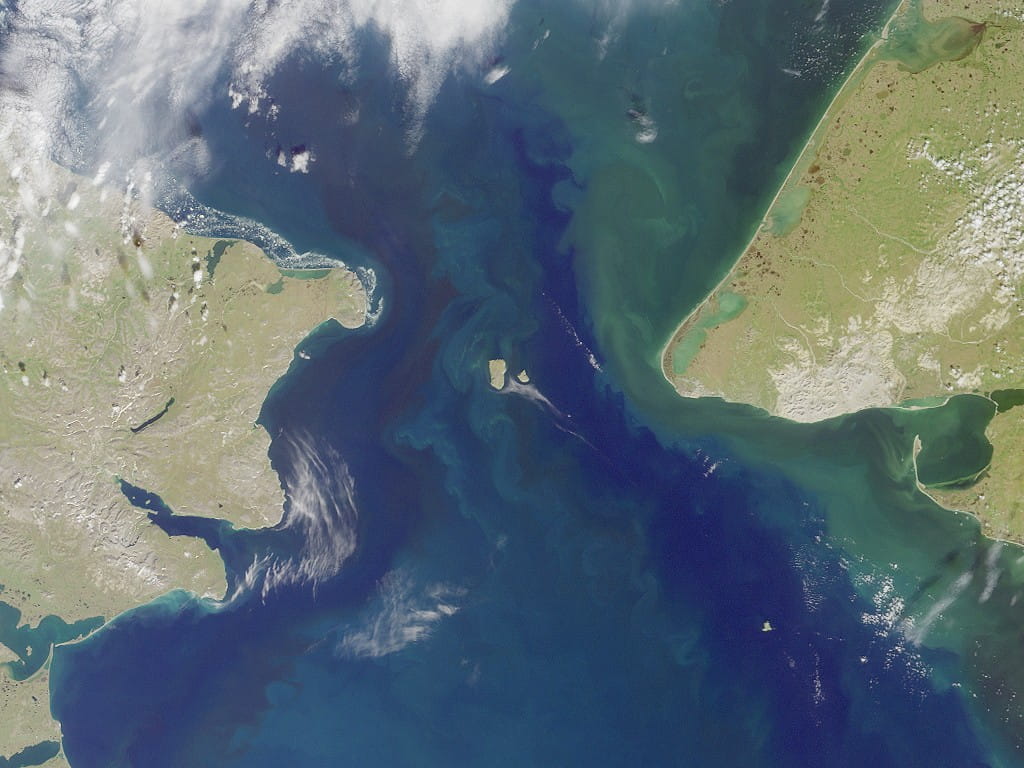
Bering Strait image taken by MISR satellite. Photo: NASA/GSFC/JPL/MISR-Team
In recent months, Greenland has been at the center of Arctic attention. The September trilateral agreement between the United States, Denmark, and Greenland marked a new phase for Transatlantic and wider circumpolar security.
On the other side of the Arctic, the Bering Sea region is another geopolitical focal point at the intersection of North Pacific security and North American defense. A new report by the authors establishes that Beringia is increasingly contested by Russia’s force projection, China’s regional ambitions, and growing bilateral military signaling that now extends to Alaska, the Aleutian Islands, and the Bering Strait.
Russia’s access to and from the region largely depends on Pacific Fleet military installations on the Kamchatka Peninsula and in the Sea of Okhotsk, near Japan and South Korea. As in other parts of the Arctic, Moscow’s military priorities focus on denying the presence of foreign military assets and increasing defense in depth in the far-sea zone.
China has been cautious about deploying military assets in the Arctic on its own, not least to avoid antagonizing the Kremlin. Indeed, Beijing has only indirect access to the region: it has no territorial claims in the Arctic. China’s activities in the region blend “scientific research” with military intelligence-gathering and domain awareness operations as part of its civil-military fusion model.
However, joint Chinese-Russian activities, including resource projects and military activities, add complexity. Both countries have conducted patrols and joint exercises at the fringes of the Pacific Arctic for over a decade. These joint demonstrations of presence and military signaling increase regional tension and amplify signaling and deterrence against the U.S. and its allies.
Perhaps most immediately concerning, the Pacific Arctic faces heightened risks of miscalculation due to sub-threshold and low-intensity warfare activities by Russia and China, lawfare over longstanding maritime border issues, and the disruption of critical undersea infrastructure (CUI).
However, their ability to cooperate militarily in the Arctic is hampered by friction points and constraints that also shape the broader bilateral relationship. Yet both countries will likely seek to conduct a joint military exercise in the Pacific Arctic in the near future, notably in the Bering Sea and the Chukchi Sea, as a form of political signaling. The signaling effects of joint military activities, whatever their sophistication, are the primary effect. It is no surprise that these signals coincide with a US weak point: the practical nadir of US polar icebreaking capabilities.
Considering these activities, the Bering Sea and the Pacific Arctic must increasingly be seen as a contested space and a military chokepoint, especially around the Bering Strait, the Aleutian Islands, and the Kuril Islands/Northern Territories.
This situation should push the United States and its regional allies to rethink their approach to Bering Sea security through increased deterrence and domain awareness.
Specific actions could include a feasibility assessment of reutilizing the naval facility on Adak Island, which features a deep-water port and one of the largest bulk fuel storage facilities in the U.S., as well as a potential upgrade to Eareckson Air Station on Shemya, which hosts a radar station, airframe refueling, and a radar system for ballistic missile launch tracking. Located near the tip of the Aleutian Island chain in the Bering Sea, Shemya is a forward point supporting access and presence across the Indo-Pacific region. Continuing the Nome deep-draft port project will also help protect sea lines of communication in the North Pacific and reduce pressure on Dutch Harbor.
A final aspect concerns investments in polar-specific technology and capabilities that increase overall domain awareness for threat detection, tracking, and remote sensing across all domains. This should include polar-specific uncrewed platforms and autonomous systems (notably UAVs and UUVs), as they offer a cost-effective way to extend intelligence, surveillance, and reconnaissance operations.
More streamlined intelligence sharing is also needed, notably through data fusion and interagency cooperation among the United States and Quad countries Canada, Japan, and South Korea.
While the North Atlantic has drawn attention recently, the North Pacific and Bering Sea deserve close scrutiny as a potential flashpoint in U.S.-Russia-China relations. Ongoing adversarial activities suggest they see weaknesses in the U.S. posture that must be corrected. Risks abound, and the U.S. must remain vigilant to avoid potential escalatory scenarios, whether intentional or unintentional.
Mathieu Boulègue is a Non-resident Senior Fellow with the Transatlantic Defense and Security Program at CEPA and an Associate Fellow with the Russia and Eurasia Programme at Chatham House – The Royal Institute of International Affairs. Rebecca Pincus is a Senior Fellow at the German Marshall Fund, a Senior Fellow at the Foreign Policy Research Institute, and a Research Fellow at the Wilson Center.