The Greenland Deal should instigate a new Arctic Military Architecture
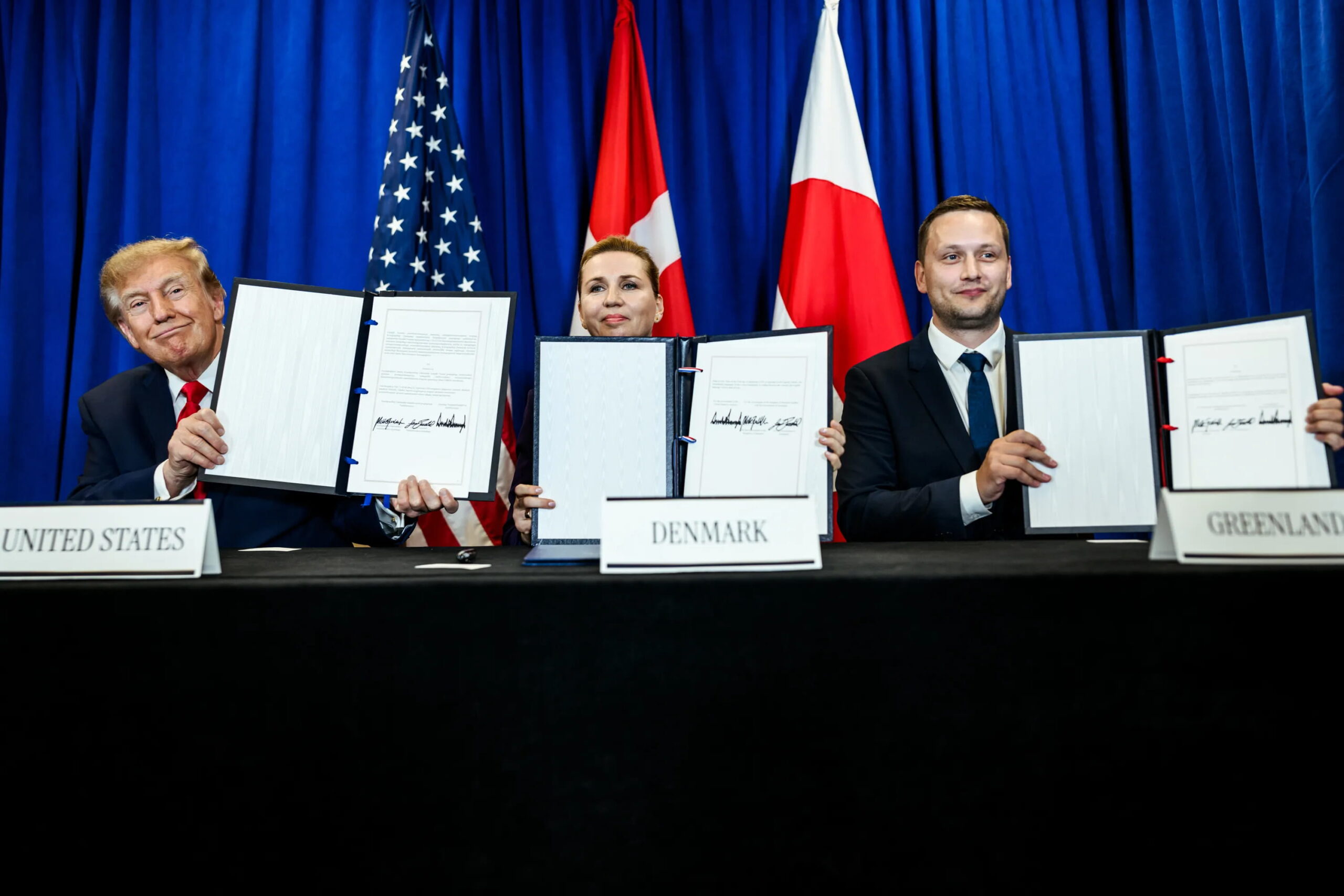
Leaders of the US, Denmark and Greenland announce a new security agreement at the official signing ceremony in September 2026. Photo: White House
The trilateral agreement between the United States, the Kingdom of Denmark, and Kalaallit Nunaat/Greenland, signed on September 22, marks a new phase in Arctic security. While the deal covers many areas, the military angle stands out as a key feature for the future of Transatlantic and Arctic security.
The text builds on the April 1951 US-Danish Defense of Greenland agreement by giving the U.S. broader military access to Greenland. American forces and assets now have greater military mobility across the island by land, air, and sea, including undersea access. In this sense, it supplements the 1951 agreement rather than rewriting it. Just like the 1951 text, the 2026 deal has no expiration date.
The agreement pledges to modernize and expand existing installations at the Pituffik Space Base. This is much needed, as Pituffik is critical to North American early-warning radar activities, space surveillance, and missile tracking from Russia (especially ICBMs and submarine-launched ballistic missiles).
It also expands the U.S. military presence to two new “defense areas” (read: military bases): one at Narsarsuaq in southern Greenland, which will be rebuilt from Cold War-era installations, and another at Mestersvig on the eastern coast. Narsarsuaq will provide better access for air operations and logistics, while Mestersvig will support surveillance, monitoring, and training.
Both future bases will support U.S. military operations along the North Atlantic sea line of communications. The text leaves the door open to “additional” defense areas in the future, if the three parties agree. Finally, it establishes a framework for the proposed Golden Dome missile defense system.
After months of negotiation, this new deal not only strengthens the United States; it strengthens NATO and transatlantic security as a whole. It marks an important step forward for the Alliance, as it overtly supports recent regional endeavors such as the activation of Arctic Sentry.
A crucial aspect is that it defines Greenland’s future in and with NATO if it becomes independent from Denmark. Importantly, the document preserves Danish sovereignty over Greenland, as well as Greenlanders’ self-determination and territorial integrity.
The trilateral agreement strengthens NATO security by explicitly barring non-NATO countries from maintaining a “persistent” military presence in Greenland or establishing “manned or unmanned installations” on the island. This matters, given the range of Russian and Chinese military activities in the Arctic, and it effectively makes Greenland a privileged NATO security space.
As Russia has turned the Arctic into a frontline and strengthens its Bastion Defense concept, it is time for the United States to create its own bastion to protect the North Atlantic and the Arctic.
By developing a more distributed U.S. military presence throughout Greenland, the 2026 deal could pave the way for a new regional military architecture. The strategic endgame should be a coherent, network-centric Arctic military security architecture that interfaces with U.S. combatant commands, NORAD, and NATO’s growing presence in the European High North.
At the intersection of North American approaches, the North Atlantic, and the Arctic, Greenland serves as a steppingstone in this endeavor. Iceland is another critical node. Despite U.S. forces leaving Keflavik in 2006, the 1951 bilateral defense agreement remains in place. It could be expanded and tailored to provide U.S. access and mobility without necessarily establishing a permanent basing presence.
Both Greenland and Iceland anchor the western and central sections of the Greenland-Iceland-United Kingdom (GIUK) gap, a critical chokepoint in the North Atlantic for protecting sea lines of communication (SLOC) against Russian submarines, stand-off missile systems, and defense in depth operations. Securing the SLOC against the Russian threat was central to the recent NATO Northern Viking biennial military exercise involving the U.S. Sixth Fleet and the Icelandic Coast Guard.
By “connecting the nodes,” the result will be a more resilient Northern Flank to support NATO engagement in the European High North and a more credible Northern American defense. Yet for this to happen, the U.S. must also take stock of existing Arctic-related military endeavors and create the necessary “connective tissue” among them – especially U.S. combatant commands, NATO, and NORAD.
A final issue concerns funding the associated infrastructure upgrade. In the case of Greenland, experts noted that the Pentagon may not have the funds for fiscal year 2027. Furthermore, the 2026 deal does not specify timelines for construction, force structure, and deployed assets.
In any case, investments must account for the Arctic’s unique operational environment. This requires a mix of increased domain awareness capabilities (space-based assets, multi-domain surveillance and monitoring systems, etc.), anti-submarine warfare capabilities, continued NORAD modernization, and uncrewed systems.
Mathieu Boulègue is a Non-resident Senior Fellow with the Transatlantic Defense and Security Program at CEPA and Associate Fellow with the Russia and Eurasia Programme at Chatham House – The Royal Institute of International Affairs.