Russia’s 2026 Arctic Strategy: Security and Cooperation
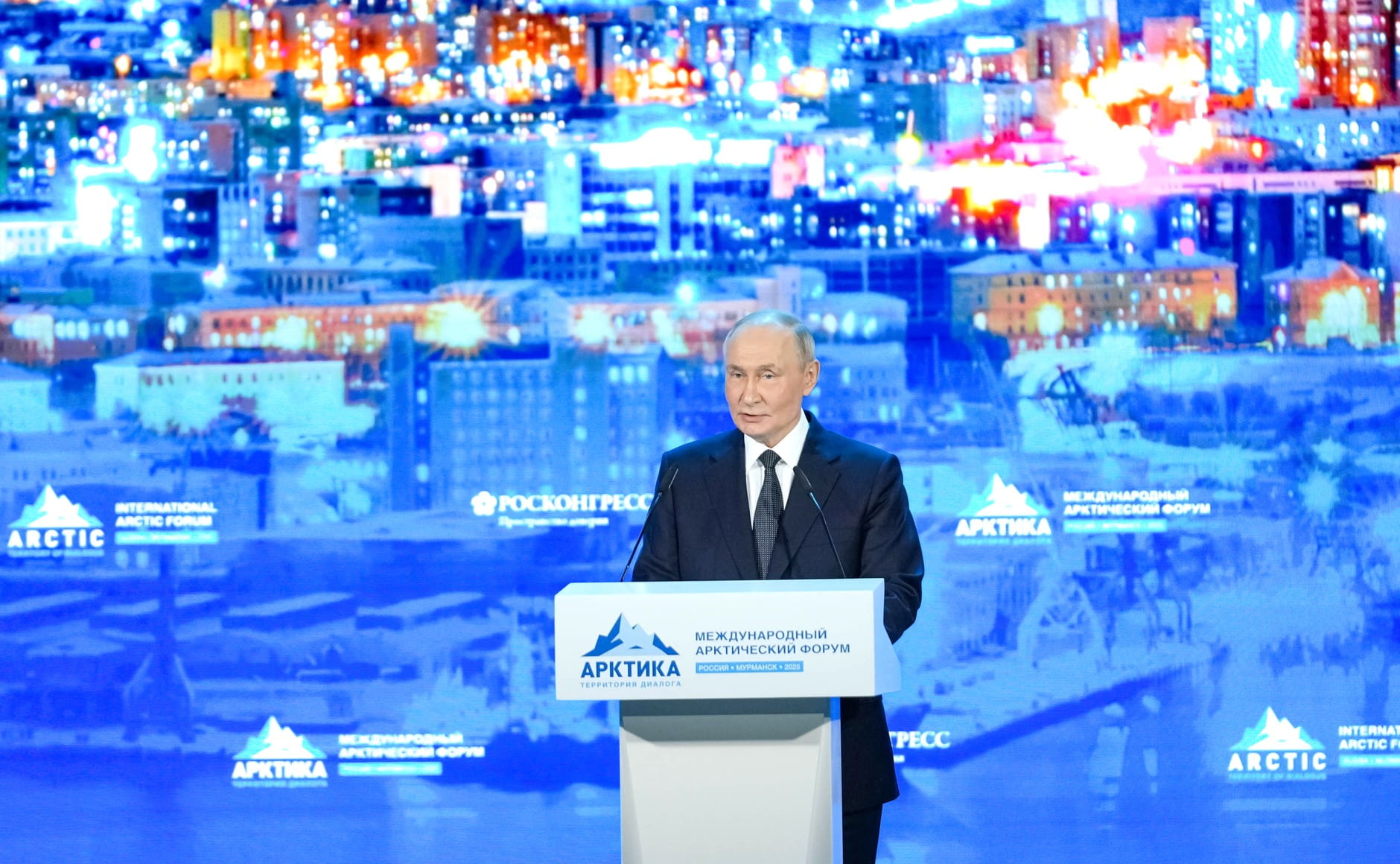
Russian President Vladimir Putin addresses the plenary session of the 6th International Arctic Forum, The Arctic: Territory of Dialogue, Murmansk, Russia, 2025. Photo: Kremlin.ru
On November 26, 2026, Russian President Vladimir Putin approved the new Strategy for the Development of the Arctic Zone of the Russian Federation and Ensuring National Security in the Arctic. The document replaces the 2020 Strategy (revised in 2021 and 2023) and the 2020 Fundamentals of State Policy in the Arctic for the Period up to 2035 (revised in 2023).
The new Strategy covers the period up to 2035, with a longer-term outlook to 2050. The Russian government has been tasked with developing an implementation plan for the Strategy over the next six months.
The 2026 Strategy reveals a Russia that remains committed to the Arctic as a zone of peace and stability, but one that has recalibrated its approach to international cooperation in light of NATO’s expansion, the deterioration of Arctic governance mechanisms, and what Moscow perceives as the militarization and politicization of the region by other states.
Conditional Openness to Cooperation
As with previous strategies, the 2026 Strategy affirms that “the Russian Federation advocates for equal, mutually beneficial international cooperation, strengthening international peace, stability, and security in the Arctic, settlement of disputes by peaceful means on the basis of international law, principles of sovereign equality of states, non-interference in internal affairs of other states, indivisible and undivided security of Arctic states.” This language closely mirrors the 2020 Strategy’s commitments to international law and conflict resolution, demonstrating continuity in Russia’s normative framework.
What has changed is the framing of cooperation as conditional. The Strategy states that “Russia is ready to develop good-neighborly relations with Arctic states, cooperation with other states on issues of Arctic development subject to the respect for the national interests of the Russian Federation by its partners.” While the 2023 Foreign Policy Concept had already shifted toward a more utilitarian approach to international cooperation, the 2026 Strategy builds on this by making that conditionality much more explicit.
The Strategy’s section on “Strategic Stability and Mutually Beneficial International Cooperation” contains 24 tasks, many of which signal openness to engagement. These include “developing multilateral cooperation within the framework of Arctic Council,” “forming relations of good-neighborliness with Arctic states,” “increasing predictability of international relations, preventing militarization of Arctic, preventing unintended armed incidents in Arctic,” and “equal, mutually beneficial cooperation with constructively disposed (towards Russia) Arctic and other states.” The section title pairing “Strategic Stability” with “Mutually Beneficial International Cooperation” is new and significant: “strategic stability” is typically used in the context of discussions on disincentivizing the use of nuclear weapons.
The Strategy also references “China, India, and states of Southeast Asia” as “new centers of economic and political development” whose rise creates opportunities for Russia. This continues the geographic reorientation begun in the 2023 Foreign Policy Concept, which first mentioned cooperation with “non-Arctic states that pursue a constructive policy towards Russia.” The 2026 Strategy’s reference to “cooperation with constructively disposed towards Russia Arctic and other states” is more expansive, opening the door to non-Arctic state engagement.
This aligns with Foreign Minister Sergey Lavrov’s 2026 article, International Cooperation in the Arctic: Challenges and Opportunities, published in August 2026, which identified China and India as important existing partners and highlighted opportunities for cooperation with Brazil, Indonesia, Iran, and other BRICS countries. Lavrov also specifically mentioned South Korea and Singapore, which have expressed interest in individual Arctic projects despite their participation in Western sanctions against Russia.
Engaging with the Arctic Council
Following the 2022 pause of the Arctic Council and Russia’s subsequent withdrawal from the Barents Euro-Arctic Council, the fate of Arctic governance and Russia’s role in such institutions have been widely discussed. The 2023 Foreign Policy Concept notably removed all mentions of the Arctic Council from its text.
The 2026 Strategy confirms that Russia is not walking away from the Arctic Council. The document calls for “Developing multilateral cooperation within the framework of the Arctic Council, proceeding from the national interests of the Russian Federation on an equal and mutually beneficial basis, for the purpose of preserving peace, stability, and the sustainable development of Arctic.”
The qualifier “proceeding from the national interests of the Russian Federation” is significant. Russia’s engagement with the Council is conditional on its own interests being served. The Arctic Five and Barents Euro-Arctic Council are not mentioned, continuing the downgrading of these formats.
Moscow has no desire to unilaterally collapse the Arctic Council, but it refuses to treat the institution as a value in itself. This aligns with Lavrov’s 2026 essay, which argued that Russia remains open to cooperation but will only participate in forums where it is treated as an equal sovereign. The 2025 Putin–Trump Alaska meeting and ongoing U.S.-Russia negotiations to end the war in Ukraine demonstrate Moscow’s preference for bilateral engagement as a complement to, or even substitute for, multilateral coordination.
Security concerns
Security has always been paramount in Russian Arctic strategy, but the 2026 Strategy’s security provisions are the most detailed and expansive of any Russian Arctic doctrinal document. Where the 2023 Foreign Policy Concept spoke broadly of “neutralizing” the militarization policies of unfriendly states, the new Strategy is specific.
The 2026 Arctic Strategy names NATO and the European Union as primary antagonists pursuing a “policy of containment” against Russia. The text highlights the accession of Finland and Sweden and the United Kingdom’s military activities, as catalysts for the region’s militarization. In response, the Strategy mandates maintaining the combat readiness of the Armed Forces to repel aggression and calls for the continuous modernization of military infrastructure adapted to Arctic conditions.
The Strategy also explicitly addresses NATO’s nuclear posture in the Arctic, noting that “NATO views the Arctic as one of the potential theaters of military operations and is practicing the use of armed forces in Arctic conditions, including the possibility of using nuclear weapons.”
The Strategy introduces the “prevention of extremist and terrorist activities, countering external ideological and value‑based expansion and destructive informational and psychological influence on citizens (especially on Indigenous peoples). This is a significant rhetorical change. The protection of Indigenous peoples was previously framed largely through the lens of traditional economic activity and environmental protection. Now it is closely linked to national security and countering information warfare. Furthermore, the Strategy places heavy emphasis on protecting “traditional Russian spiritual-moral values, culture, and historical memory” and countering “legal, protective ecological topics as instruments of external pressure.”
Arctic transport
The 2026 Strategy is the first Arctic strategic document to mention the concept of the “Trans-Arctic Transport Corridor” (TTC). The TTC is defined as “a unified system of routes, including the Northern Sea Route (NSR), inland waterways connected with it, and transport infrastructure facilities, providing for the comprehensive development of the territories of the Arctic Zone and the Far East of the Russian Federation, as well as domestic, international, and transit routes for cargo and passenger transportation along the coast of Russia.”
This represents a broadening of the NSR concept, embedding the shipping route within a larger transport and logistics system. The TTC has been part of the Russian Arctic policy lexicon since President Putin’s speech at the 2025 “Arctic: Territory of Dialogue” forum.
The Strategy sets cargo volume targets for 70–109.1 million tons by 2030 and 110–150.6 million tons by 2035 (up from 37.9 million tons in 2024). The TTC is a national development project, but the 2026 Strategy also envisions international participation. The Strategy calls for “developing with regard for the national interests of the Russian Federation equal, mutually beneficial cooperation with constructively disposed (towards Russia) Arctic and other states on developing the Arctic and implementing joint projects in the Arctic Zone, including projects on developing the Trans-Arctic Transport Corridor and organizing international transit cargo and passenger transportation in its maritime area.”
Arctic shipping and transport connectivity are central to Russia’s economic future. The Arctic accounts for roughly 5.9% of Russia’s GDP. The 2026 Strategy calls for raising that share to 8.4%, with high-tech and knowledge-intensive industries contributing 9.8% of the total.
Russia is open to foreign participation in Arctic shipping, but only from partners “constructively disposed towards Russia.” Moscow sees the TTC as a potential vehicle for international cooperation with non-Western countries. Non-Arctic states are increasingly interested in this corridor. In August 2026, South Korea’s PanStar Acro container ship completed a trial voyage from Busan to Europe via the NSR, returning to Korea after 50 days. South Korea aims to operate regular Arctic shipping by 2030. The Strategy also bolsters Russia’s legal position on the NSR. The Strategy calls for “ensuring the immutability of the historically formed legal regime of internal sea waters of the Russian Federation.”
Main takeaways
Russia’s 2026 Arctic Strategy does not signify a departure from the core principles of earlier policy. Economic development, environmental protection, the wellbeing of northern communities, national security, and the preservation of regional stability remain central objectives.
There is, however, a greater emphasis on the security dimensions of sovereignty, economic and technological self-reliance, and socioeconomic stability. International cooperation is still valued, but it is now more explicitly conditional on whether prospective partners are prepared to engage with Russia on terms Moscow considers mutually beneficial and respectful of its national interests.
The Strategy’s emphasis on the TTC illustrates this clearly. Russia wants shipping in its Arctic waters to be internationally competitive, but embedded within a transport network geared toward Russia’s territorial, economic, and strategic interests.
The same logic applies to the Arctic Council. Russia continues to value the prospect of resuming multilateral cooperation, but insists on the recognition of, and respect for, its national interests in that process.
In general, the 2026 Strategy indicates that Russia remains open to Arctic cooperation while adopting a more diverse and discerning approach to its international partners. Rather than ruling out future cooperation with Western Arctic states, it reflects Moscow’s view that such cooperation will be difficult to restore without broader improvements in political relations.
For Arctic governance, this focus on sovereignty may be hard to reconcile with the region’s interdependence. Climate change, maritime safety, environmental protection, and sustainable development still require international coordination, and Russia’s participation will remain essential to addressing these challenges. Yet the institutional environment in which such cooperation can occur is now substantially more complex than when the previous Strategy was adopted in 2020.
Pavel Devyatkin is a Senior Associate and Leadership Group member at The Arctic Institute.