The Reconfiguration of Arctic Governance after the Ukraine War and South Korea’s Arctic Strategy
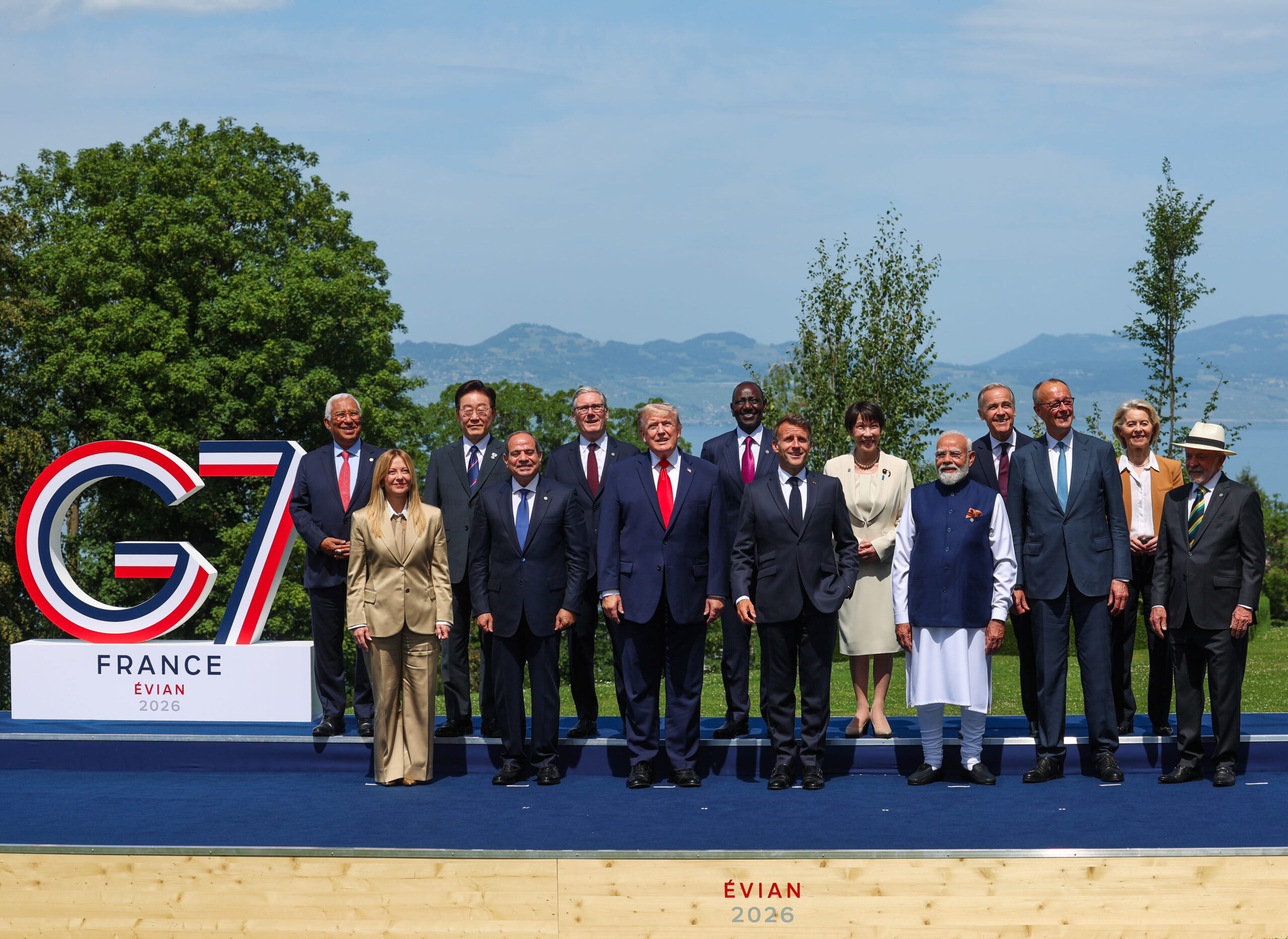
South Korean President Lee Jae Myung joined world leaders for the family photo at the G7 Summit in Évian, France. Photo: Ministry of External Affairs, India
The Arctic Institute Korea Series 2026
- The Arctic Institute’s 2026 Korea Series: An Introduction
- Navigating Korea’s Arctic Sea Route Policy: Origins, Status, and Outlook
- The Reconfiguration of Arctic Governance after the Ukraine War and South Korea’s Arctic Strategy
Russia’s invasion of Ukraine effectively undermined the long-held assumption of ‘Arctic exceptionality’ and triggered structural changes in regional governance. Although the war occurred outside the Arctic, it shook the existing perception of the region as a space for cooperation and low-intensity politics, and intensified European and North American countries’ perceptions of potential security threats posed by a more aggressive and geopolitically resurgent Russia. As a result, the Arctic cooperation framework, which had operated on the premise of Russia’s participation, faced a serious crisis. In March 2022, the seven Western members of the Arctic Council paused their participation in the Arctic Council, and Russia-related cooperation was also halted within the Barents Euro-Arctic Council. These developments demonstrated how quickly regional cooperative frameworks in the Arctic, which had been in place since the end of the Cold War, could be disrupted in a short period of time.1)
These changes pose a particular challenge for South Korea. As a non-Arctic state and an observer in the Arctic Council, Korea has developed its Arctic engagement primarily through scientific cooperation and institutional participation via multilateral frameworks, and thus their weakening, as well as the growing fragmentation of Arctic cooperation in general, require Korea to reconsider how it can maintain its presence and protect its interests without becoming overly dependent on a single country, institution, or geopolitical bloc.
This article draws on the middle-power and network diplomacy literatures to both identify the role Korea can play in Arctic governance and explain the mechanisms through which that role can be exercised. Middle-power diplomacy highlights Korea’s potential to compensate for its limited material influence through multilateralism, functional expertise, and institutional contribution, while network diplomacy emphasizes the importance of building flexible and overlapping relationships among states and non-state actors. On this basis, the article argues that Korea should pursue a three-pillar strategy centered on the preservation and gradual restoration of multilateral institutions, the expansion of functional cooperation in soft-security fields, and the diversification of bilateral and minilateral networks.
Current situation of multilateral diplomacy in the Arctic
The current situation reveals the structural limitations of multilateral diplomacy in the Arctic. Since more than half of the Arctic region falls under Russia’s territory or jurisdiction, a pan-Arctic governance framework the excludes Russia is unlikely to be able to function effectively as a comprehensive regional system. However, Western countries have intensified their response against Russia by severing not only intergovernmental cooperation but also academic and research networks, which has resulted in the weakening of the knowledge base for Arctic cooperation.2) The Arctic Council has been significantly weakened and sidelined since the outbreak of the Russian invasion of Ukraine, but it remains in place and continues to operate in a limited capacity.3) In this context, the informal grouping often referred to as the “Arctic Seven” has gained greater political salience, while Finland’s and Sweden’s accession to NATO has contributed to a stronger NATO presence in the region. Rather than a straightforward institutional shift from cooperation to military competition, the region is currently characterized by a growing institutional vacuum in which existing cooperative mechanisms have been severely weakened and are yet to replaced by a suitable alternative.4)
The Barents Euro-Arctic Council’s (BEAC), on the other hand, has been hit even harder. Established to foster regional cooperation and build trust between Russia and Nordic countries, and BEAC had a multi-layered cooperation structure that included not only central governments but also local governments and indigenous communities.5) However, following the war in Ukraine, Nordic countries and the EU suspended their cooperation with Russia which in turn led to the Russian withdrawal from the BEAC in 2023.6) Finland followed suit shortly after and officially left the Council in 2025 , and hence it is reasonable to assert that the BEAC is no longer fir for purpose; at least not in pursuing its original mandate of has seeking to facilitate the integration of northwestern Russia into the European cooperation framework.
Analytical Frameworks of Middle-Power Diplomacy and Network Diplomacy
Against this background, this paper employs middle-power diplomacy and network diplomacy as complementary analytical frameworks for assessing Korea’s policy options in the Arctic. These approaches are particularly useful for explaining how a non-Arctic state such as Korea can participate in Arctic governance and exercise meaningful influence. Middle-power diplomacy refers to a foreign-policy approach through which states with limited material capabilities seek to enhance their influence by relying on multilateral institutions, international norms, functional expertise, coalition-building, and mediation. Although middle powers lack the capacity to shape the international order unilaterally, they can exert influence by supporting international institutions, promoting issue-specific agendas, facilitating cooperation among states, and providing functional contributions in areas of shared international concern.7) Conceptualised this way, middle-power diplomacy provides a framework for understanding the type of role Korea can realistically perform in Arctic governance.
This perspective has also been applied specifically to Korea’s Arctic diplomacy. For instance, Bae8) examines Korea’s engagement in the Arctic through the lens of middle-power diplomacy and identifies Korea’s acquisition of observer status in the Arctic Council as an important element in the formation of its middle-power role in Arctic governance. Accordingly, Korea’s influence in the Arctic should not be confined to material capabilities only, but should also be assessed in relation to institutional participation, diplomatic engagement, and its ability to gain recognition for its desired Arctic role and/or identity by the Arctic states. In many ways, it follow, Korea’s experience in Arctic governance provides a fertile empirical basis for examining how a non-Arctic middle power can gain influence and prestige through sustained participation in multilateral institutions and issue-specific cooperation.9)
Network diplomacy complements this perspective by explaining how such a role can be best exercised . Rather than relying exclusively on formal bilateral relations or a single multilateral institution, network diplomacy calls for the establishment of flexible, overlapping, and multi-level relationships among a wide range of state and non-state actors. These may include national and subnational governments, international organizations, research institutions, universities, private-sector actors, civil society organizations, and, in the Arctic context, Indigenous organizations. Influence in such networks derives less from hierarchical control than from an actor’s ability to build connections, facilitate the flow of information and knowledge, and occupy a mediator and/or brokerage position among otherwise fragmented actors.10) Network diplomacy therefore provides a framework for understanding the mechanisms through which Korea can translate its middle-power role into practical cooperation.
Taken together, these approaches provide a coherent analytical framework for Korea’s Arctic diplomacy. Middle-power diplomacy explains the type of role that Korea can realistically pursue in Arctic governance, while network diplomacy explains the relationships and mechanisms through which that role can be implemented. Accordingly, the extent and the scope of Korea’s influence should be assessed assessed and contextualised not as a product of material power, but as the outcome of institutional participation, functional contributions, and networked connections among diverse actors. In this framework, more specially, Korea is an institutional contributor that advocates for multilateral cooperation, a functional contributor that provides expertise and practical solutions in specific policy areas and sectors, and is a connector with convening credentials capable of bringing state and non-state actors from across multiple levels of Arctic governance together.
Direction of Korea’s Arctic Policy
Building on the analytical framework outlined above, Korea’s Arctic policy should be organized around three mutually reinforcing directions: preserving and gradually restoring multilateral cooperation, expanding functional contributions in soft-security fields, and diversifying bilateral and minilateral cooperation networks. These three directions translate Korea’s middle-power and network-diplomacy roles into a practical strategy for responding to an increasingly fragmented Arctic order.
The first policy direction is to preserve and gradually restore multilateral cooperation centered on the Arctic Council. The Arctic Council has served as the principal pan-Arctic forum for addressing environmental protection, climate change, maritime affairs, sustainable development, and Indigenous issues, while excluding military and security matters from its mandate. Although its role has been substantially weakened since the 2022, the Council has not disappeared and continues to operate in a limited capacity. It has also ensured that Arctic issues remain primarily managed by the Arctic states and Indigenous representatives, while placing the participation of external actors within an established institutional framework. For a non-Arctic state such as Korea, the Arctic Council retains strategic importance not merely as a channel for exercising policy influence, but as a core institutional foundation for the future restoration of Arctic governance. Even when the Council is unable to function at full capacity, therefore, Korea should help preserve the continuity of multilateral cooperation through available channels, including working groups, research institutions, and international conferences.
Korea has already established the institutional and policy foundations necessary to support such a multilateral approach. Through the establishment of the Dasan Arctic Research Station in 2002, the construction of the icebreaking research vessel Araon in 2009, and the acquisition of full observer status in the Arctic Council in 2013, Korea expanded its involvement in Arctic scientific cooperation and institutional participation. It subsequently developed a legal and policy framework encompassing both the Arctic and Antarctic through the 2018 Basic Plan for the Promotion of Arctic Activities and the 2021 Polar Activities Promotion Act.11) These assets give Korea concrete channels through which to sustain and eventually help restore Arctic Council cooperation. Observer status enables continued participation in, and contribution to, Council meetings and working-group activities, while the Dasan Arctic Research Station and Araon allow Korea to contribute scientific data and expertise. The domestic legal and policy frameworks, on the other hand, provide both the institutional capacity and stability required for enduring engagement in the region.
The second policy direction is to strengthen soft-security and functional cooperation. Korea has accumulated expertise and credibility in non-military fields such as scientific research, climate change response, environmental protection, marine pollution prevention, and navigational safety. These areas are more likely to remain open to cooperation even amid intensifying geopolitical tensions and provide opportunities for Korea to make substantive contributions as a middle power. By linking its capabilities in shipbuilding, shipping, digital technology, renewable energy, green fuels, and polar science to Arctic challenges, Korea can position itself not merely as an actor pursuing economic interests, but as a responsible partner committed to sustainability and international norms.12)
The third policy direction is to diversify Korea’s bilateral and minilateral networks. The positions of Arctic Council observer states are far from uniform. Some maintain close relations with Western states, while China continues to cooperate with Russia, and countries such as India, Singapore, and Switzerland adopt more flexible, issue-specific positions. In this environment, Korea should avoid excessive alignment with any particular bloc and instead build practical cooperation networks connecting both state and non-state actors including.13) Korea’s participation in the Norway-led Arctic Frontiers conference and the Korea-China-Japan Arctic Cooperation Dialogue, which was launched in 2018, could serve as foundations for this form of network diplomacy.
The same principle of diversification should also be applied to commerce and commercial decision making. Historically, Korea has shown considerable interest in Russia’s Northern Sea Route as a potential maritime shortcut between Europe and Asia. However, as sanctions and geopolitical uncertainty persist, Korea should reduce its dependence on a single route or partner, and instead opt for a layered approach aiming to take part and contribute to the development of multiple Arctic maritime routes in partnership with relevant stakeholders.
All in all, Korea’s Arctic policy should continue to support the Arctic Council while remaining receptive towards other relevant multilateral fora and forums. The preservation of rule based regional order, substantive contributions in soft-security fields, and the diversification of bilateral and minilateral networks should be pursued as mutually reinforcing elements of a broader strategy. Such an approach would enable Korea to avoid becoming subordinate to major-power competition while securing a sustained role and greater policy space in Arctic governance as a middle power non-Arctic state.
To implement these three policy, in turn, Korea needs to establish a whole-of-government implementation mechanism capable of coordinating Arctic-related policies that are currently dispersed across different ministries and institutions. More specifically, a whole-of-government coordination mechanism is required to implement these policies consistently across multiple fields, ranging from diplomacy, science, and maritime affairs to industry, the environment, and Indigenous cooperation, with the sole objective of reorganize Korea’s existing institutional, scientific, and industrial assets under the three identified policy strategic. Doing so matters given that Arctic-related responsibilities are currently distributed across several ministries and public institutions, creating the risk of duplicated policy objectives and potential conflicts among diplomatic considerations, industrial interests, and environmental principles.
To this effect, Korea should consider establishing an “Integrated Arctic Policy Platform” under the Office of the President or the Office of the Prime Minister. This platform would not constitute a new government ministry. Rather, it would serve as a mechanism through which relevant ministries and research institutions jointly formulate the national Arctic strategy and determine the priorities of major programs. It should connect Korea’s engagement in the Arctic Council and other multilateral institutions, country-specific bilateral cooperation, scientific and Indigenous cooperation, and Arctic shipping and industrial policy under a single strategic framework.
The platform should also identify customized cooperation projects based on the political, economic, and environmental characteristics of each of the eight Arctic states and their respective potential for cooperation with Korea. For example, Korea could cooperate with Norway on maritime safety and green shipping, with Canada on Indigenous cooperation, climate adaptation, and research on the Northwest Passage, with Finland and Sweden in digital and green technologies, with Iceland on geothermal and renewable energy, and with the United States on scientific research and non-military aspects of maritime security.14)
A system for managing Arctic-related research and development budgets and international cooperation projects on a medium- and long-term basis should also be established under this platform. This would help prevent projects from being discontinued because of short-term political changes or fluctuations in the international environment, while it would also support sustained investment linking scientific research, technological development, human-resource training, and international cooperation.
Conclusion
Since Russia’s invasion of Ukraine, Arctic governance has moved away from the cooperative order long associated with Arctic exceptionalism and toward a more fragmented and uncertain structure. The Arctic Council and the Barents Euro-Arctic Council have both been significantly constrained, while no equivalent institutional framework has yet emerged to replace them. The current Arctic order should therefore be understood not as the end of multilateralism, but as a period of institutional fragmentation in which weakened formal institutions coexist with myriad other forms of bilateral and minilateral cooperation. These changes pose new strategic challenges for South Korea.
Looking ahead, the effectiveness of Korea’s future Arctic policy will depend heavily on external developments beyond its direct control, including the course of the Russia-Ukraine war, the future operating conditions of the Arctic Council, the continuation or adjustment of sanctions on Russia, and the economic and environmental feasibility of Arctic shipping. Korea should therefore avoid overcommitting to any single scenario and instead adopt a flexible and phased approach that can respond to changing regional conditions. In the short term, priority should be given to maintaining institutional and scientific connectivity and managing geopolitical and commercial risks. Over the medium and long term, Korea should continue to strengthen its scientific, technological, and diplomatic capabilities while participating in the development of international rules and cooperative governance arrangements.
Ultimately, Korea is unlikely to shape the Arctic order through material capabilities alone. It can, however, secure a more sustained role by connecting institutions and actors, providing practical expertise and technological contributions, and preserving areas of cooperation even amid wider political tensions. Such an approach would allow Korea to not only protect its national interests in the Arctic, but to also establish itself as a middle power that contributes to a more resilient and inclusive system of regional governance in the Arctic.
Danbi Kim is a Professor of International Relations at Mongolia International University, specialising in Arctic and polar governance, international organisations, and multilateral diplomacy. BongChul Kim is a Professor at Hankuk University of Foreign Studies, specializing in international economic law, Korea–EU relations, and International relations.
References