China-US Relations in the Arctic: Prospects for Cooperation
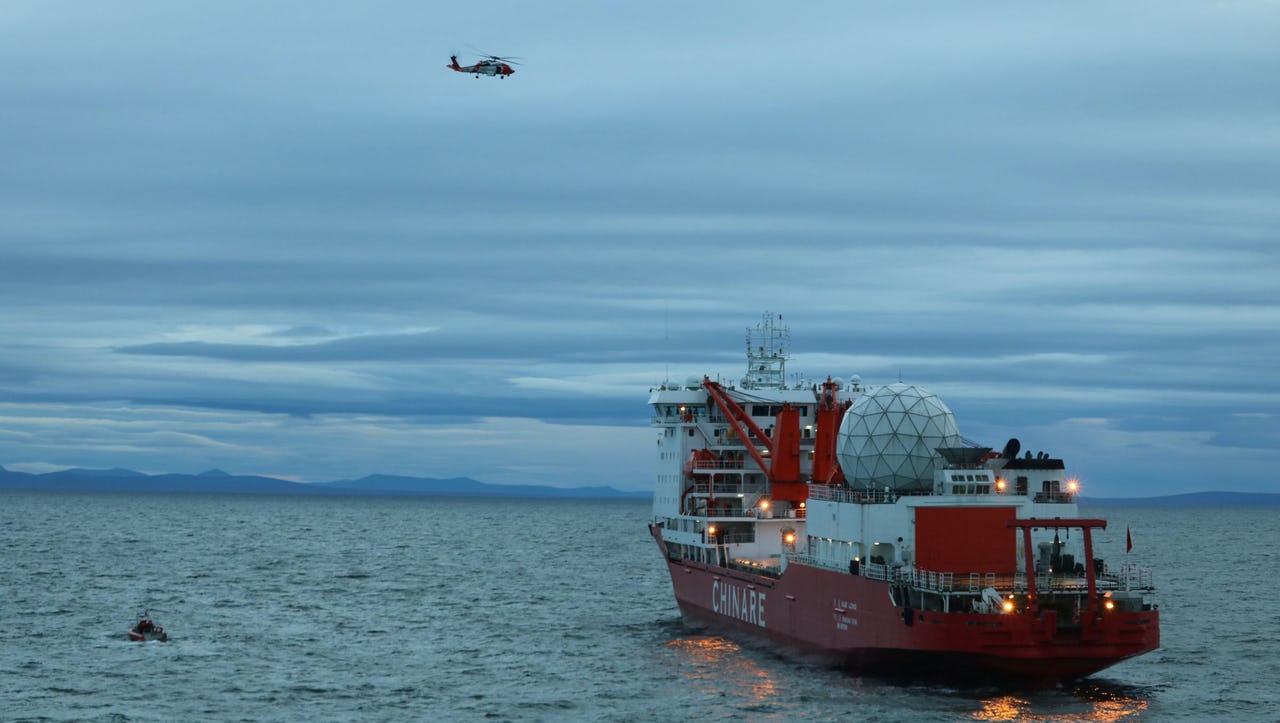
The U.S. Coast Guard medevaced a man suffering a broken arm from the Chinese research vessel Xue Long (Snow Dragon), 15 nautical miles from Nome, Alaska, 2017. Photo: U.S. Coast Guard
It is now commonly acknowledged that the future trajectory of China-US relations will have consequential implications for a wide range of issues and regions, regardless of how directly they are connected to the multiple dynamics shaping the bilateral relationship between Beijing and Washington. The Arctic is no exception, and hence developments in Sino-American relations are likely to shape the prospects for cooperation, competition, and governance in the region. Arctic affairs, in turn, may provide an important ‘avenue’ through which the two superpowers could seek to manage their broader relationship.
Against this background, this event report summarizes the speeches delivered by six scholars from China, the United States, and Canada during a session of the Arctic Circle Assembly in Reykjavik, Iceland, on October 9, 2026. The session, organized by Ocean Conservancy (USA) and Tongji University (China), brought together the speakers to discuss the possibilities and constraints for China-US cooperation in the Arctic. They reflect a range of perspectives on how the two countries might manage strategic competition while preserving opportunities for practical cooperation. It is important to clarify from the outset, however, that the summaries below report the speakers’ individual remarks; they are not intended to constitute an academic paper or a single, jointly developed argument.
Pan Min
Can China and the United States maintain strategic stability in the Arctic despite growing geopolitical competition? How can the two countries manage their differences while preserving opportunities for cooperation? As climate change, expanding maritime activities, and security concerns reshape the region, the Arctic presents both challenges and opportunities for major-power relations. Cooperation in science, maritime safety, clean energy, and multilateral governance could offer a practical pathway toward constructive strategic stability.
The concept of constructive strategic stability, introduced at the China-US leaders’ meeting on May 14, 2026, emphasizes four dimensions: stability based on cooperation, stability through moderate competition, stability with manageable differences, and long-term stability oriented toward peace. It provides a framework for managing competition while maintaining cooperation in areas of shared interest.
In this sense, the Arctic can serve as a valuable testing ground for a new model of major-power interaction. The goal is not to eliminate differences between China and the United States, but to build mechanisms that reduce risks, increase transparency, and sustain cooperation where possible.
First, scientific cooperation can serve as the foundation for mutual trust. Arctic science is one of the least politically sensitive and most promising areas for cooperation. Over the past decades, scientific exchanges between China and the United States have contributed to a better understanding of Arctic environmental change. Future cooperation could focus on sea-ice monitoring, extreme weather events, methane emissions, permafrost degradation, and marine ecosystems. The Fifth International Polar Year, expected in 2032–2033, could provide an important opportunity to rebuild international scientific cooperation. Joint preparation and implementation of IPY-5 could help restore scientific connections and continue the tradition of using science as a bridge between countries. Scientific communities, universities, and research institutions can also serve as stabilizing channels when government-level relations face difficulties.
Second, maritime safety provides another practical entry point for Arctic stability. As Arctic shipping continues to increase, China and the United States share common interests in ensuring safe and sustainable navigation. Possible areas of cooperation include sharing ice and weather information, improving navigation warnings, strengthening emergency communications, and enhancing search-and-rescue cooperation. Cooperation on oil-spill response and maritime safety is particularly suitable for confidence building because it focuses on humanitarian needs rather than geopolitical competition. Both countries can also work together through the International Maritime Organization, especially in implementing the Polar Code and promoting environmentally responsible Arctic shipping.
Third, the energy transition represents a new area of common interest. Traditional energy cooperation remains important, but Arctic energy cooperation should not be limited to fossil fuels. The United States, especially Alaska, has abundant energy resources and technological capabilities. China has extensive experience in infrastructure development, renewable energy technologies, and deploying them at scale. Future cooperation could focus on technology, services, and sustainable infrastructure rather than ownership of strategic assets. Renewable energy offers particularly promising opportunities. Many Arctic communities are remote and depend heavily on diesel fuel. China’s experience in solar photovoltaic technology, energy storage, and microgrid systems, combined with Alaska’s unique Arctic conditions, could provide valuable models for a clean energy transition in remote regions.
Fourth, institutional coordination is essential for preserving Arctic governance. Constructive strategic stability requires strengthening existing international institutions. The Arctic Council, the International Maritime Organization, the International Arctic Science Committee, and other mechanisms provide important platforms for maintaining communication and cooperation. The Central Arctic Ocean Fisheries Agreement is also an example of how countries can cooperate on scientific research and resource conservation, even under conditions of strategic competition. Future efforts should focus not only on competition over rules, but also on cooperation in developing technical standards and practical arrangements that improve predictability and reduce misunderstanding.
Finally, a constructive strategic stability framework for the Arctic should follow three principles. First, China and the United States should prevent Arctic activities from becoming sources of unnecessary escalation. Second, functional cooperation should continue in areas such as science, environmental protection, maritime safety, and emergency response. Third, bilateral cooperation should be embedded within multilateral institutions, which can provide greater stability and legitimacy.
In conclusion, constructive strategic stability does not require China and the United States to eliminate competition. Rather, it requires both sides to manage competition responsibly. If the Arctic becomes a region where China and the United States can compete without conflict and cooperate without dependence, it could provide valuable lessons for managing major-power relations in the twenty-first century.
Henry Huntington
The overall picture of China-US cooperation is not especially encouraging at present. This means, however, that any potential cooperative activities are especially important and valuable. Concerning the Arctic, we can place these potential activities in a few categories.
Formal agreements on matters of policy. The CAO Fisheries Agreement is a recent example of China and the United States cooperating with other countries on environmental and economic policies on a formal, intergovernmental basis. Both continue to participate in this forum. China and the United States could in theory also cooperate on similar matters in the Arctic, such as shipping, deep-sea mining, subsea cables, geoengineering, and more. It seems unlikely, however, that any action in these areas would start with discussions between China and the United States. More likely, if any action is to be taken, it would be in a multilateral forum in which China and the United States take part, perhaps led by other countries.
Formal or informal agreements on matters of practice or operations. China and the United States already cooperate with regard to shipping, aviation, and other practical matters. This cooperation typically takes place within established international norms. There is scope for further practical cooperation, for example on maritime operations and safety. Ships traveling from China to North America pass through the Aleutian Islands and the Bering Sea, including waters within the US exclusive economic zone. The Marine Exchange of Alaska (MXAK) already works with vessels transiting these waters to ensure safety, respond in cases of distress, and monitor traffic patterns. This type of cooperation could be extended farther north. In addition, mariners could cooperate on reporting weather and ice conditions and other matters relevant to maritime safety. No one benefits from a shipping accident in Arctic waters, so cooperation here benefits all parties. Putting such ideas into practice could involve formal cooperation, for example through the Arctic Council as a forum in which both China and the United States take part, or through the maritime industry.
Second-track cooperation on scholarship and sharing ideas. Second-track diplomacy can take many forms, including scientific collaboration, cultural exchanges, education programs, and more. As scholars, we can work together to develop ideas that may appeal to both countries and prepare for opportunities to cooperate. We expect those opportunities to arise at some point, even if we cannot predict exactly when. Scholarly exchanges can also help share ideas and build mutual understanding, which we can use in our respective countries to better inform both the public and officials about one another and help avoid misunderstanding and misinterpretation. These are practical steps we ourselves can take, including by writing this paper.
Deng Beixi
The recently held US-China summit set a new framework: a constructive strategic stability relationship. At its core is positive stability, with cooperation serving as the main channel for setting boundaries on competition and preventing it from sliding into conflict. The meeting produced visible outcomes in trade, counternarcotics, and Artificial Intelligence (AI). That tells us something important: when the two sides focus on concrete areas with low political sensitivity, functional cooperation can go a long way. Of course, some may say the window for cooperation is tied closely to the US midterm election calendar. Compared with China’s more stable domestic policy environment, a shift in the US political landscape could affect how long cooperation lasts.
Although the summit did not address the Arctic, it offers a useful way of thinking about it: functional cooperation.
That said, challenges are real. The strategic trust deficit between China and the United States in Arctic affairs has now persisted for seven years. It dates back to then-Secretary of State Mike Pompeo’s unfounded allegations at the 2019 Arctic Council Ministerial Meeting. It has been overshadowed by other, more prominent conflicts, but it has not gone away. At the bilateral level, distrust, misperception, and securitized narratives are intertwined. Add to that the asymmetry in the two sides’ Arctic political identities; Washington, for example, does not recognize China’s self-described status as a “near-Arctic state.” The recently proposed Arctic Security and Diplomacy Act is clearly aimed at China and seeks to raise the threshold for Chinese Arctic scientific research. And the Arctic is not, in bilateral terms, the most urgent issue, nor the easiest place to produce visible results. So a large-scale, all-encompassing cooperation mechanism will be difficult to build. Still, we can hold realistic and cautiously optimistic expectations, and I would highlight three tracks.
First, use multilateral mechanisms. Arctic Council working groups, for example, can serve as institutional vehicles for functional cooperation. Strategic trust could be built through concrete issues—science, fisheries, environmental monitoring. The Central Arctic Ocean Fisheries Agreement, or CAOFA, is a successful example of cooperation among China, the United States, Russia, and others. It proves that even in times of political turbulence, functional cooperation can be achieved and sustained. In addition, the planning and implementation of the Fifth International Polar Year could also offer a chance to break the current deadlock in Arctic research cooperation.
Second, try to restore bilateral dialogue, especially on contentious issues, so that each side can hear the other’s position. Consider, for example, the legal status of the waters above the extended continental shelf unilaterally claimed by the United States in the Arctic Ocean, where China conducts routine Arctic scientific expeditions. China argues that the waters in that area are high seas and that, because the United States is not a party to UNCLOS, its claim cannot be considered by the Commission on the Limits of the Continental Shelf. That differs from the US position under customary international law. The two countries have not held ocean law and polar affairs talks for several years. A platform for discussing law of the sea issues as well as the scope and content of China’s Arctic research activities would help avoid potential conflict, particularly escalation in law enforcement. In recent years, the US Coast Guard has shown considerable restraint toward China’s Arctic scientific activities, generally using routine measures such as shadowing and escorting.
Third, advance Track II cooperation. With official channels blocked, academic exchanges like this US-China Arctic social science workshop help keep the lines open. Through international platforms such as the Arctic Circle Assembly, we send a signal to the world that academic communities in the world’s two so-called superpowers are still working to avoid decoupling and disconnection. Subnational actors, market actors, research institutions, and youth groups can also be important forces in sustaining bilateral Arctic interaction.
In conclusion, US-China Arctic cooperation should not aim for a grand, all-in-one breakthrough. It should adopt a functional approach to cooperation: start with concrete issues, keep mechanisms alive, restore dialogue, expand Track II, and build strategic trust step by step.
Jennifer Spence
As a Canadian looking at the US-China relationship, I would argue that the prospects for cooperation between these two countries in the Arctic cannot be separated from their broader geopolitical relationship. Strategic competition, legitimate security concerns, and differences in national interests shape the opportunities and constraints for cooperation. However, viewing Arctic affairs primarily through the lens of bilateral competition risks obscuring shared interests and responsibilities, as well as the consequences of failing to cooperate.
In this context, it is important to recognize that narratives matter because they shape policy choices. In the United States, Chinese activities in the Arctic are increasingly assessed through a security lens, while narratives about American intentions can reinforce Chinese distrust of the US. These perspectives influence which research partnerships are considered acceptable, the willingness of institutions to engage, and whether opportunities for cooperation are evaluated on their merits. This does not mean dismissing legitimate concerns about research security, dual-use technologies, or transparency. Rather, it requires distinguishing demonstrated risks from assumed ones and developing appropriate responses. The challenge is to manage the risks of cooperation without losing sight of the risks of not cooperating.
The Agreement to Prevent Unregulated High Seas Fisheries in the Central Arctic Ocean (CAOFA) offers an instructive example of what remains possible. Bringing together the United States, China, and other parties around a precautionary approach to fisheries management, the Agreement recognizes that scientific uncertainty and shared responsibilities cannot be addressed by any country acting alone. Its Scientific Coordinating Group supports a Joint Program of Scientific Research and Monitoring, providing a framework for coordinating research priorities, methodologies, observations, and information exchange, and offering opportunities to incorporate Indigenous and local knowledge. CAOFA illustrates three important principles: (1) cooperation does not require agreement on every issue; (2) institutions and agreed processes can provide continuity when political relationships deteriorate; and (3) trust need not always be a prerequisite for cooperation—it can also emerge through sustained engagement around shared objectives. Although CAOFA is not a universal model, it demonstrates the value of practical, rules-based multilateral cooperation.
Drawing from the CAOFA experience, specific pathways for US-China cooperation can be identified, including: delivering on existing commitments, especially through coordinated scientific research and monitoring; protecting responsible scientific cooperation by differentiating sensitive from non-sensitive research and establishing clear expectations for transparency, reciprocity, research integrity, data governance, and appropriate safeguards; and sustaining communication and relationships through Track II exchanges among scientists, policy specialists, and institutions, particularly in multilateral settings where cooperation can focus on concrete deliverables.
Ultimately, the Arctic is not simply a stage for competition between major powers. Arctic states, Indigenous Peoples, and northern communities have diverse interests, priorities, and responsibilities, and the costs of diminished US-China cooperation extend well beyond their bilateral relationship. Successful cooperation should therefore be assessed by its contribution to Arctic governance, environmental protection, and the well-being of Arctic peoples, rather than by improvements in bilateral relations alone. Progress does not require resolving every geopolitical disagreement. It requires protecting existing avenues for cooperation and investing in the practical foundations that can sustain and strengthen them.
Pavel Devyatkin
The United States and China may cooperate in the Arctic despite their broader geopolitical rivalry. Filtering every issue through great-power competition risks contaminating one of the last spaces where mutually beneficial cooperation remains possible. A framework of “competitive coexistence” should be advanced. This acknowledges that rivals need to cooperate amid competition. Arctic maritime safety is a particularly strong area where cooperation requires neither trust nor strategic alignment, only shared recognition that neither side benefits from a preventable disaster at sea.
America’s Arctic posture has hardened. The second Trump administration pursues “American Arctic dominance,” viewing the region as an energy source and strategic reserve. Withdrawal from the Paris Accord and a fleeting interest in cooperating with Russia signal that resource extraction now outweighs climate stewardship. Congress is also moving to restrict foreign scientific access through the bipartisan Arctic Security and Diplomacy Act, which would bar adversaries’ vessels from conducting marine research in US waters. Together these measures reflect a securitized, zero-sum policy leaving little room for pragmatic cooperation.
The space for cooperation is narrowing. The Pentagon has blacklisted 88 Chinese institutions and ordered 30 US universities to audit research partnerships with Chinese institutions, while Trump’s climate skepticism further complicates Arctic research. One narrow channel remains: maritime safety, especially in the Bering Strait. As ice recedes and shipping traffic grows, an oil spill, collision, or emergency would devastate Alaskan communities regardless of flag. Washington should treat Chinese shipping as a commercial reality to be shaped and regulated rather than a threat to be repelled. Cooperation here requires only mutual recognition that disaster prevention serves everyone’s interests.
Concrete measures could institutionalize this channel. These include:
- Information sharing: real-time vessel tracking, joint weather and sea-ice reporting, shared navigation databases, and hazard notification protocols.
- Joint exercises could also be held: China-US Coast Guard search-and-rescue drills, ideally expanded to include Russia, Canada, Japan, and South Korea.
- Infrastructure coordination shared emergency stations, interoperable communications, and icebreaker protocols so that whoever is closest can respond. This should be paired with institutionalized de-escalation channels functioning as early-warning systems before minor incidents escalate.
Competitive coexistence is a realistic framework that acknowledges that strategic competition and functional cooperation are not mutually exclusive. If Washington and Beijing can demonstrate pragmatic cooperation in the Arctic amid deep rivalry, it would prove that competitive coexistence remains an achievable basis for managing this century’s most consequential relationship.
Zhao Long
As China-US relations enter a new phase, can Arctic cooperation contribute to a more constructive relationship of strategic stability based on mutual respect, fairness, and reciprocity? The answer is yes, provided both sides identify practical areas of shared interest while recognizing growing political and security constraints.
Climate-driven scientific cooperation remains the key, while multilateral engagement and governance offer the most practical opportunities. In 2018, an American scientist joined China’s ninth Arctic expedition aboard the Xuelong. Researchers from both countries have also participated in initiatives such as MOSAiC and the International Polar Year. However, political tensions, declining US climate engagement, research funding pressures, and heightened scrutiny of Chinese scientific activities are narrowing opportunities for cooperation. As accelerating Arctic warming reshapes ecosystems and facilitates increased human and commercial activity, preserving scientific networks and strengthening multilateral channels—including through the Arctic Council working groups, the IMO, and the IASC—should be priorities.
The Central Arctic Ocean Fisheries Agreement offers a particularly useful model. Both countries are parties to the agreement, and its Scientific Coordinating Group provides an established channel for cooperation. At its fourth meeting, held in Hangzhou in March 2026, participants discussed joint monitoring, data sharing, and scientific research. These are practical areas where cooperation can continue even when bilateral relations come under pressure.
Maritime safety offers concrete common ground. According to PAME, vessel activity in the Arctic Polar Code area increased by approximately 40 percent between 2013 and 2025. Growing fishing activity, energy transportation, and commercial shipping increase the need for reliable sea-ice forecasts, emergency response, and maritime and aeronautical search and rescue. These shared challenges provide practical grounds for China-US coordination. Such dialogue is particularly important for Chinese merchant vessels transiting the Bering Strait en route to Russia and Europe. Green shipping issues, including low-sulfur fuels, black carbon emissions, wastewater discharge, and underwater noise, also represent shared concerns. Taken together, these issues create further opportunities for China-US coordination on maritime safety and environmental protection.
Commercial shipping and energy offer more limited prospects. The Northern Sea Route matters to China’s trade with Europe and its participation in Arctic economic development. The United States, as an Arctic coastal state, also has interests in maritime access, security, and resource development. However, sanctions on Russia, geopolitical tensions, and sensitivities surrounding maritime technology constrain joint commercial ventures. The Alaska LNG project may present a potential opportunity, given China’s energy-import needs. Nevertheless, high infrastructure costs, financing challenges, and US-China trade tensions make its commercial prospects uncertain. Energy should therefore be regarded as a possible avenue for engagement rather than a firm foundation for bilateral Arctic cooperation.
Second-track diplomacy can help keep competition manageable. Legitimate security concerns deserve serious discussion, but treating an expanding range of Chinese scientific, commercial, and civilian activities primarily as security threats risks further narrowing cooperation. Think tanks, universities, and scientific institutions can maintain professional contacts, identify practical initiatives, and explore how reasonable security precautions can coexist with scientific and commercial engagement.
Arctic cooperation cannot resolve fundamental China-US differences, but it can help prevent strategic competition from eliminating every opportunity for coordination. Preserving scientific networks, strengthening multilateral mechanisms, exchanging expertise on maritime safety, and sustaining second-track dialogue are modest but meaningful steps toward keeping the Arctic a domain of practical cooperation rather than unchecked rivalry.
Pan Min (PhD) is a Professor and Deputy Director of the Center for Polar and Oceanic Studies in the School of Political Science and International Relations at Tongji University. Henry P. Huntington (PhD) is the Director of Arctic Science at Ocean Conservancy. Prof. Deng Beixi is the Director of the Division of Polar Policy Studies at the Polar Research Institute of China (PRIC). Jennifer Spence is The Eddie Goldenberg Research Chair in Arctic Governance and Community Resilience at the University of Ottawa. Pavel Devyatkin is a Senior Associate and a Leadership Group member at The Arctic Institute. Zhao Long is the Director and Senior Fellow at the Institute for International Strategic and Security Studies and the Center for Marine and Polar Studies at the Shanghai Institutes for International Studies.