The India Question in Greenland Agreement
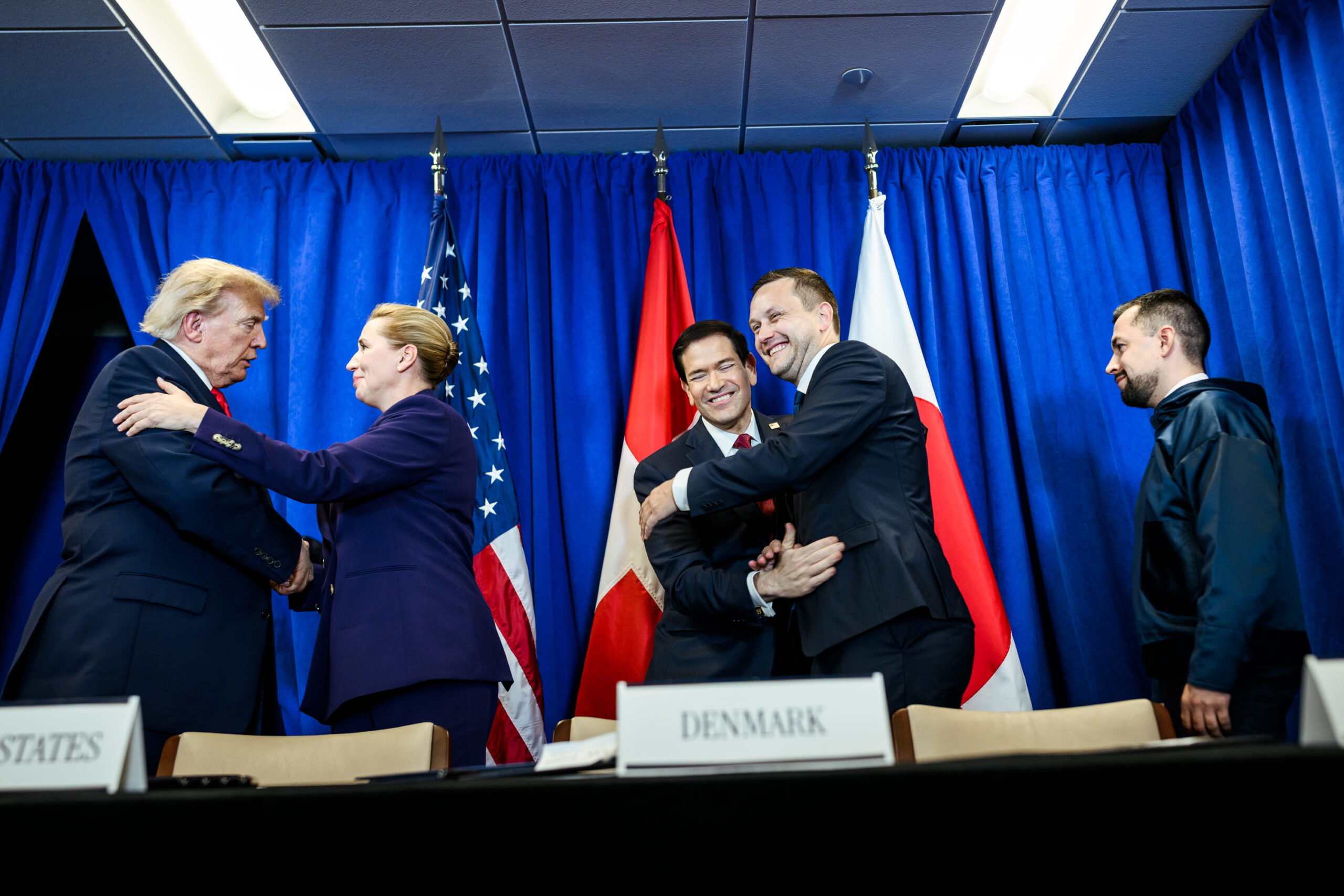
U.S. President Donald J. Trump participates in a trilateral signing ceremony with Prime Minister Mette Frederiksen of Denmark and Prime Minister Jan-Frederik Nielsen of Greenland, Tuesday, September 22, 2026, at United Nations Headquarters in New York City. Photo: White House
The recently signed Agreement between the United States, Denmark and Greenland has already been analysed from multiple angles, including its implications for the European Union, Greenland’s political future and ability to implement key elements of the agreement, the broader trajectory of transatlantic security cooperation and great-power competition, and China’s interests in Greenland. What has received less attention, however, is how the agreement may affect India and, albeit to a lower extent, Japan, and South Korea interests in the Arctic and Greenland.
Article 10 of the agreement restricts states, and investors from states, that are not NATO members, NATO partners or EU member states from obtaining control or significant influence in “sensitive sectors”. This provision matters a great deal to India which is neither a NATO member nor a NATO partner. Any arrangement that excludes India from meaningful participation, in turn, could run the risk of producing unintended geopolitical effects. For instance, reduced access to Greenland may reinforce the incentive for New Delhi to deepen its engagement with Russia’s Arctic region where its access to resources and economic opportunities remains less constrained.
If managed strategically, however, Article 10 could create an opening for stronger Arctic cooperation between India, the Nordic states and the EU. For this to happen, it is important, first and foremost, to recognise that India’s interests in Greenland are real. This was on clear display on September 22 when Indian Ambassador, Manish Prabhat, held a series of meetings in Nuuk where discussions included investment, mining, skilled manpower, tourism and cultural cooperation.
The practical opportunity, therefore, is to use Article 10 not simply as a barrier to Indian investment, but as a framework for structuring it. The provision leaves room for non-NATO and non-EU participation where “the relevant parties agree”, creating scope for Indian companies to enter Greenland through co-investment and joint ventures with NATO or EU-linked partners. New Delhi and its European partners, especially the Nordic states, could build on this opening by connecting prospective cooperation in Greenland with areas in which they already have overlapping interests in the Indo-Pacific; areas such as maritime security, technological resilience, defence-industrial cooperation and critical-infrastructure protection. Instead of treating Greenland as a stand-alone investment question, in other words, both the EU and NATO should seek to embed India’s Arctic engagement within a wider pattern of cooperation that links European and Indian interests across the Arctic and Indo-Pacific.
Such an approach, more importantly, would not only make India’s Arctic engagement more politically legible to its European partners but may also benefit Greenland itself. For one, joint ventures involving European or Nordic actors could make it easier for Greenlandic authorities to manage and implement investment-screening requirements, while providing access to institutional expertise and financial capacity.
Ultimately, the significance of the recently signed Agreement extends well beyond the transatlantic framework in which it has largely been discussed. For India, Article 10 raises questions about how a non-NATO, non-EU state can pursue its legitimate economic interests in Greenland and thus avoid exclusion from an increasingly strategic Arctic economy. India, however, is not the only Asian state with an interest in Greenland. Japan and South Korea have also shown interest in the island although their status as NATO partners gives them a different position under the Agreement.
What is implicit in this discussion is that Greenland is more than a narrowly European or North American security issue. Decisions taken over investment, infrastructure and resource access on the island increasingly affect how non-Arctic states think about the role of Arctic resources in their supply-chain diversification, and hence economic resiliency, efforts. The implication is not necessarily that outside actors should acquire a formal voice in regional affairs but that their legitimate economic interests should be both acknowledged and incorporated into a strategic framework capable of creating productive linkages between the Arctic and other regions.
The current Agreement, it follows, presents Arctic stakeholders with two distinct pathways to choose from. On the one hand, they could use it as the basis for a more structured partnership between Europe, NATO, and Asian states, including India, by encouraging joint investment, technological cooperation and a more productive form of Asian engagement in the Arctic. On the other, they could employ it as an exclusionary mechanism; one that narrows access so sharply that Asian states increasingly conclude that meaningful participation in Greenland is unrealistic. Such an outcome would be especially consequential in India where loss of direct access could incentivise a much more visible tilt towards Russia’s Arctic region.
Seen this way, what is at stake is not simply a choice about who is permitted to invest in Greenland but what kind of Arctic economic order Brussels and Washington want to help create. A more strategic approach would use investment screening not only as a protective instrument but also as a framework for building trusted partnerships. If Europe, US and NATO can combine security safeguards with meaningful avenues for cooperation, Article 10 could help connect rather than divide the Arctic from the wider global economy while simultaneously bringing India closer to the fold. If, by contrast, it is applied in a way that excludes legitimate external interests without offering credible alternatives, it may unintentionally encourage the forms of geopolitical fragmentation that the broader transatlantic security agenda is intended to prevent. In such a scenario, Russia will likely emerge as the main beneficiary.
Nima Khorrami is a Senior Associate at The Arctic Institute.