The United States is the Greatest Threat to Canada’s Arctic Sovereignty
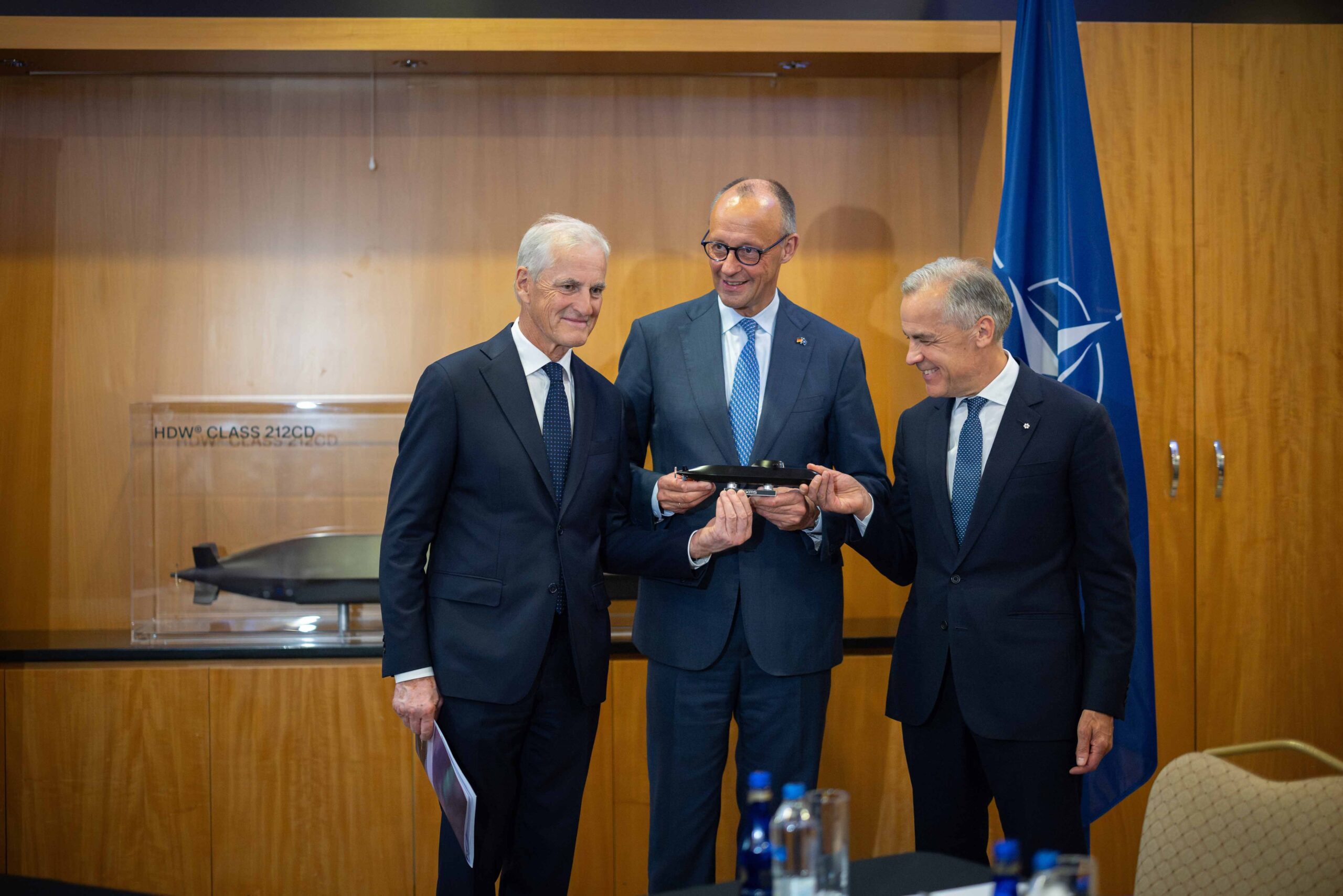
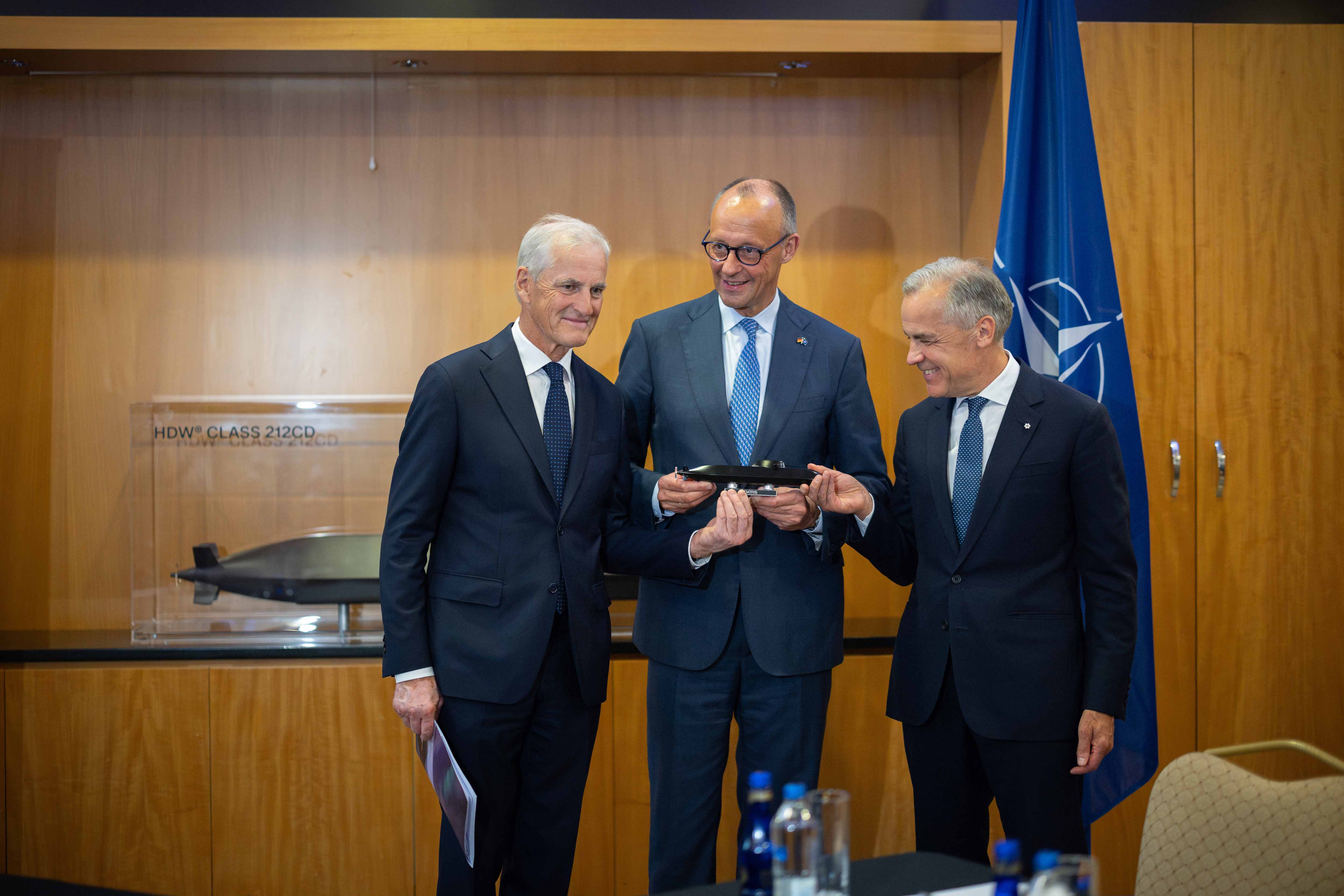
Prime Minister Mark Carney, Chancellor Frederich Merz, Prime Minister Jonas Gahr Støre meet to have a trilateral meeting after the Canadian announcement to purchase TKMS Submarines, on the margins of the 2026 NATO Leaders’ conference, in Ankara, Türkiye. Photo: Daniel Pereira
On the north shore of Burrard Inlet, at the Vancouver shipyards, the mighty CCGS Imnaryuaq is finally taking shape. On October 14, a “keel laying” ceremony was held as the first module of the 158-metre-long polar icebreaker was set in place. Over the next few years, the rest of the ship will be assembled around that section.
Defence Minister David McGuinty marked the milestone by asserting that “Canada’s Arctic sovereignty depends on our ability to be present, to operate, and to respond.”
Most people – and Mr. McGuinty might be among them – think that the greatest threats to Canada’s Arctic sovereignty come from Russia and China. That’s not actually the case. The greatest threat has always been the United States, and while we could never match the world’s most powerful military, we can, by demonstrating our will to secure the Canadian Arctic against all threats, deny them any excuse to deploy there.
The “Arctic Archipelago” at the top of North America is composed of more than 19,000 islands, some larger than Great Britain. It was acquired by Canada in 1880, 13 years after Confederation, when Britain finally transferred its title to us.
Two decades elapsed before Captain Joseph-Elzéar Bernier sailed northward in the CGS Arctic, mounting plaques on rocks and headlands to confirm Canada’s sovereignty. The Royal Canadian Mounted Police established several far-flung outposts after the First World War, and in 1930, an increasingly ambitious Department of External Affairs persuaded Norway to renounce a claim made on its behalf by Otto Sverdrup, the first European to reach the northwestern part of the archipelago.
Americans began appearing in numbers during the Second World War, when the U.S. Air Force built runways and weather stations to support a polar route from the western United States to Europe. The onset of the Cold War led to a greater American presence, as radar stations were built across the Canadian Arctic to detect Soviet bombers and intercontinental ballistic missiles headed for the United States. Many of the stations remain operational today. The thinking, then and now, is that early warning of a “first strike” would enable the U.S. military to launch its own missiles before their silos were destroyed.
As more Americans arrived, officials in Ottawa worried that all or part of the Canadian Arctic might be annexed by the United States. In 1953 and 1955, a number of Inuit families were relocated northward to Resolute Bay and Grise Fiord to act as “human flag poles” for Canadian sovereignty.
In 1969, an American ice-strengthened supertanker, the SS Manhattan, set out to test whether the Northwest Passage, a series of straits and channels, was a viable route for transporting oil from northern Alaska to the Atlantic coast. Prime Minister Pierre Trudeau dispatched two icebreakers to accompany the SS Manhattan. The supertanker became stuck in the ice on more than 10 occasions, and every time, a Canadian icebreaker was there to free it. This may have been the courteous thing to do, but make no mistake, Canada was manifesting its control over the waterway.
The following year, Parliament extended Canada’s territorial sea from three to 12 nautical miles, closing off a high seas route through the Northwest Passage. It also claimed pollution prevention jurisdiction over all waters within 100 nautical miles of Canada’s Arctic islands, prompting a diplomatic protest by the United States.
The outlines of a legal dispute emerged. Canada claimed the Northwest Passage was “internal waters” under its full control. The United States insisted it was an “international strait” open to ships from any country.
In 1985, the United States sent an icebreaker, the USCGC Polar Sea, through the Northwest Passage without requesting Canada’s permission. Foreign Minister Joe Clark responded by granting the permission that had not been sought.
Mr. Clark also began working on a diplomatic solution for future voyages, and in 1988 Prime Minister Brian Mulroney and President Ronald Reagan signed the Arctic Cooperation Agreement. The bilateral treaty constituted an “agreement to disagree,” with the United States promising to always seek permission before sending a Coast Guard icebreaker through the Northwest Passage, and Canada promising to always grant permission when asked.
When the Imnaryuaq enters service in 2032, it will replace the CCGS Louis S. St-Laurent, a vessel that was launched six decades ago.
An icebreaker this old is an anomaly because these ships lead demanding lives. The main source of wear and tear is not the ice but the work demanded of the engines, which in heavy ice have to drive the ship hard forward and then immediately reverse, before driving forward and reversing again. It is the weight of the ship, driven onto the ice, that does the actual breaking. The Louis, as the flagship of the Canadian Coast Guard is affectionately known, only survives because its engines were replaced in 1993.
Shortly before he was elected prime minister in 2006, Stephen Harper promised to replace the Louis with three new polar icebreakers. Two years later, the promise was scaled back to just one icebreaker. In 2011, the plan for that single icebreaker was folded into Mr. Harper’s new National Shipbuilding Strategy where, apart from the issuing of a design contract, it languished until 2025.
That is when U.S. President Donald Trump began talking about making Canada the 51st state. The threat was “a real thing,” according to then-prime minister Justin Trudeau, who said that Mr. Trump had his eye on Canada’s critical minerals, most of which are located in the northern portions of this country.
The issue of the Northwest Passage had already resurfaced. During the first Trump administration, Navy Secretary Richard Spencer said that an Arctic “freedom of navigation” exercise was under consideration. He did not specify where the exercise would take place, though a non-consensual voyage through Russia’s Arctic straits would be foolhardy in the extreme.
The Canadian government took advantage of the ambiguity to not issue a response. Indeed, Mr. Trudeau’s most significant contribution to Canadian Arctic sovereignty only came during his last week in office when contracts for two polar icebreakers were signed. In addition to the Imnaryuaq being built in North Vancouver, the CCGS Arpatuuq will be assembled in Lévis, Que.
After Mark Carney became prime minister, a contract for six additional “medium” icebreakers was signed.
Mr. Trump will have left the White House years before any of Canada’s new icebreakers are launched. Yet the announcements about them are part of a larger effort to assure this and future presidents that Canada can protect U.S. security interests in the Arctic. The message to America is, essentially, “we’ve got your back.”
Canada and its European allies have responded to Mr. Trump’s constant demands for increased military spending by raising the NATO target from 2 to 3.5 and then to 5 per cent of GDP, with highways, ports and other infrastructure eligible to be counted within that final 1.5-per-cent increase.
As the Carney government immediately recognized, Canada’s Arctic provides rich opportunities for “dual use” spending. Tens of billions of dollars are being directed to new roads, a port, improved airfields, an expanded hydro-electric dam, and a range of other measures that will support Arctic residents and businesses investing there.
The effort to reach 5 per cent is further facilitated by the fact that most of Canada’s major weapon systems urgently need replacing. As it happens, many of them will be able to contribute to Arctic security.
Canada will acquire submarines that can operate under Arctic sea-ice, long-range surveillance planes that can patrol the region’s vast spaces, and fighter jets that can continue a long tradition of intercepting Russian bombers as they test Canada’s capability to respond along the edges of our Arctic airspace.
Tens of billions will also be spent on upgrades to Arctic radar stations, enabling them to detect cruise and hypersonic missiles in addition to bombers and ICBMs, thereby ensuring that Canada maintains a role in U.S. nuclear security.
In one particularly clever move, the Carney government decided to transfer the Canadian Coast Guard into the Department of National Defence. This will enable the entire Coast Guard fleet renewal to count as military spending, with the Imnaryuaq alone adding $4-billion to the ledger.
No Canadian official will publicly admit that the United States is the main threat to Canada’s Arctic sovereignty. Instead, they will pay lip service to Mr. Trump’s concerns, most of which come straight from Fox News and a cluster of right-wing Washington think tanks.
Mr. Trump has, for instance, repeatedly asserted that Greenland is surrounded by Russian and Chinese warships. This is demonstrably false, but instead of speaking truth to power, Canada and its European allies have promised a greater NATO presence in the region.
It’s also assumed that Russia’s territorial aspirations extend to Canada’s Arctic. But one has to ask, why would the world’s largest country, which already has more resources than it could ever exploit, wish to acquire more Arctic? Russia certainly does not need the Northwest Passage, as the Northern Sea Route along its coast benefits from the “Arctic Oscillation,” a circular pattern of winds and currents that pushes sea-ice away from Russia and toward the Canadian side of the Arctic Ocean.
As for China, the rising superpower has demonstrated an ability to secure the natural resources it needs through foreign investment and international trade. In English Bay, at the entrance to Burrard Inlet, dozens of oil tankers and bulk carriers are waiting to load Canadian natural resources and carry them to China. China will take advantage of Arctic shipping routes, but knows that it can only do so safely by co-operating with coastal states. In 2015, the Chinese government directed that any Chinese shipping company wishing to use the Northwest Passage should follow Canadian laws and regulations.
It is possible that Russian and Chinese agents will engage in espionage, subversion and perhaps even sabotage in the Canadian Arctic, but no more there than elsewhere in this country. In any case, nefarious actors are easier to detect in small communities than in large, relatively anonymous cities.
All that said, sometimes a bit of misinformation can be a good thing. Canadians can acknowledge Mr. Trump’s concerns about Russia and China while building the new dual-use icebreakers, roads, ports and upgraded airports that we actually need.
Three thousand kilometres from the Vancouver shipyards, a statue of a man in a parka stands along the shore of the Northwest Passage at Resolute Bay, Nunavut. The statue was commissioned by Nunavut Tunngavik Incorporated, the organization that represents the Inuit of the territory, and it carries the following inscription: “In memory of Inuit who landed here in 1953 and 1955, and those who came after. They came to these desolate shores to pursue the Government’s promise of a more prosperous life. They endured and overcame great hardship, and dedicated their lives to Canada’s sovereignty in these lands and waters.”
The Inuit contribution to Canadian Arctic sovereignty was recognized by Joe Clark in 1985, when he told the House of Commons, “From time immemorial Canada’s Inuit people have used and occupied the ice as they have used and occupied the land.”
Mr. Clark’s statement was informed by lawyers in the Department of External Affairs who would have cited a 1975 judgment of the International Court of Justice in a case concerning the Western Sahara, which held that nomadic peoples can acquire and later transfer sovereign rights to a state. For the same reason, the Canadian government, when negotiating the Nunavut Land Claims Agreement a few years later, willingly accepted a paragraph advanced by the Inuit negotiators that affirmed “Canada’s sovereignty over the waters of the arctic archipelago is supported by Inuit use and occupancy.”
All of which bring us back to Canada’s new polar icebreakers being given Inuktitut names.
According to a news release, the name Imnaryuaq was chosen “in collaboration with Inuit organizations – in alignment with the Government of Canada’s commitment to build a stronger relationship with Indigenous Peoples based on rights, respect, cooperation, and partnership.” Reconciliation is certainly important, but the name will have another, equally significant effect.
In the middle of his first term, in 2019, Mr. Trump surprised Danish Prime Minister Mette Frederiksen by telling her that he wanted to buy Greenland. She responded that he was speaking to the wrong person, and that any such decision would rest with those who live on that island, more than 88 per cent of whom are Inuit.
Mr. Trump apparently received the message. During his second term, he sent Donald Trump Jr. and then Vice-President JD Vance to persuade the Greenlandic Inuit that they would be better off as part of the United States. These efforts failed, with polls showing that more than 75 per cent of Greenlanders reject the idea, and only 8 per cent support it.
The Inuit of the Arctic Archipelago have a similar right of self-determination, one that extends across the 19,000 islands and includes the straits and channels in between. They chose Canada when they negotiated the creation of Nunavut in 1993 and expressly assigned their sovereign rights to this country.
For this reason, our Inuktitut-named icebreakers will be unassailable assertions of Canada’s sovereignty. In true Canadian style, they constitute a polite but very firm “back off.”
This article was first published by The Globe and Mail on 24 October 2026.
Michael Byers teaches at the University of British Columbia. His book International Law and the Arctic won the 2014 Donner Prize.