Japan's Corporate Engines in the Arctic: Industrial Drivers of LNG, Shipping, and Technological Adaptation
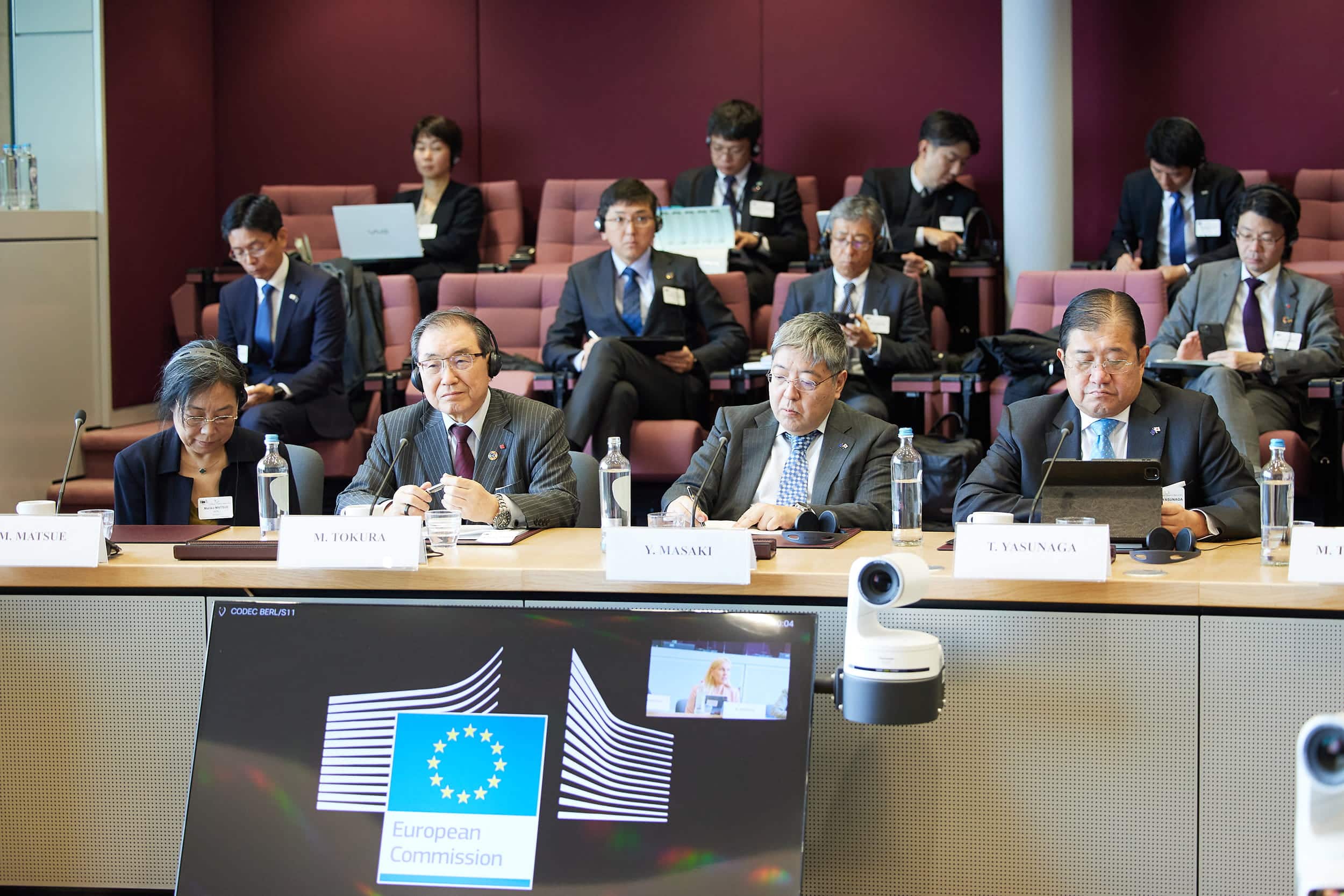
Masakazu Tokura, president of Sumitomo Chemical Co., Ltd and chairman of the Japan Business Federation, during a meeting at the European Commission along with other representatives of Keidanren, Japan Business Federation in 2023. Photo: Bea Bar Kallos / European Union
The Arctic Institute Japan Series 2026
- The Arctic Institute’s 2026 Japan Series: An Introduction
- Rising Sun in the Warming Arctic: As Great Power Competition Returns to the Polar Region, Japan Is Positioned for Prominence
- Distinctive Characteristics of Japan’s Arctic Approach and Engagement with Arctic Governance
- Japan’s Corporate Engines in the Arctic: Industrial Drivers of LNG, Shipping, and Technological Adaptation
- Beyond the Northern Sea Route: The Developmental State and Japanese Arctic Energy Policy
- The Role of Russia in Japan’s Arctic Policy
- FOIP Goes Northward: Japan’s Maritime Identity and the Defense of Rule of Law in the Arctic
- Towards a Shared Arctic Vision: Japan and the Nordic States in an Interconnected World
- Legal and Scientific Cooperation in the Context of Japan Canada Relations: Pathways for Increased Arctic Cooperation?
- The Role of EU-Japan Collaboration in Trans-Arctic Cable Development
- Liminal Diplomacy at the Poles: Japan’s Disaster Risk Reduction and the Making of Arctic Order
- The Arctic Institute’s 2026 Japan Series: Conclusion
As climate change and technological innovation accelerate the opening of Arctic shipping corridors, Japan’s ‘northern’ engagement has evolved into a comprehensive industrial architecture that moves past geopolitical rivalry and includes sovereign finance, maritime logistics, and data governance. This approach embodies a state–corporate symbiosis in which government agencies and private enterprises collaboratively shape access, investment, and operations, and simultaneously generate mutually dependent fiscal, logistical, and informational risks.
Drawing on empirical evidence from 2019 to 2025, this article examines three emblematic cases: the fiscal and sovereign exposures of the Arctic LNG-2 project between Japan Oil, Gas and Metals National Corporation (JOGMEC) and Mitsui; the operational reconfiguration of Mitsui O.S.K. Lines (MOL) under sanctions; and the commercial use of satellite data by the Japan Aerospace Exploration Agency (JAXA). Together, these cases illustrate how overlapping financial guarantees, transport infrastructures, and information systems both sustain commercial continuity and accentuate structural contradictions within Japan’s Arctic engagement.
The article will then proceed to explore how Arctic resources and the Northern Sea Route translate into stable commercial flows within a hybrid governance framework in Japan by focusing on two interconnected questions: How do Japanese businesses and financial institutions sustain operations amidst evolving geopolitical and environmental constraints? And how does the intersection of financial, logistical, and data governance influence institutional adaptability and structural outcomes?
Case 1: Arctic LNG-2 (Mitsui & JOGMEC) — Fiscal and Contractual Exposure
Japan’s Arctic industrial strategy is most directly reflected in the Arctic LNG-2 project. In 2019, Mitsui and JOGMEC formally established a state-corporate partnership by jointly establishing Japan Arctic LNG B.V. The consortium holds a 10% stake in the project, with JOGMEC contributing 75% and Mitsui & Co. contributing 25%,1) equivalent to a production share of approximately 1.98 million tons per year (about 27 cargoes) with 19.8 million tons per year in the project’s total capacity.2) This arrangement grants Japan limited but crucial strategic influence. Other major shareholders in the project include Russia’s Novatek and France’s TotalEnergies both of which are core investors and underwriters. The strategic importance of the project became even more apparent in July 2025 when JOGMEC reiterated its support for the project in spite of escalating sanctions against Russia3) thereby demonstrating Tokyo’s commitment to maintaining its stake in the project.
Mitsui provides project financing and manages long-term offtake contracts through buyers such as JERA, Osaka Gas, and Tokyo Gas, integrating LNG into Japan’s domestic LNG supply chain . This arrangement aligns with Japan’s national energy security goals and meets corporate commercial targets and profitability margins. However, it also exacerbates financial vulnerability. Under “take-or-pay” clauses, Japanese buyers remain liable for payments even if sanctions or logistical disruptions lead to delivery interruptions. A year’s production stoppage could result in losses of US$850 million to US$900 million, which portfolio swaps can only partially offset. In November 2023, Mitsui disclosed that its investment and loans in the project reached US$115 million,4) with guarantees totalling approximately US$1.7 billion.5) By December, the company had withdrawn its on-site staff but retained its equity. This withdrawal indicates the uncertainty surrounding the project’s operation, while the continued shareholding highlights the structural rigidity of the fiscal commitments.
Acting as the national financial guarantor, JOGMEC effectively transforms private commercial debt into sovereign risk. It guarantees private investment but transfers market risk to the public balance sheet. In 2024, following a cash flow freeze caused by sanctions, JOGMEC reportedly prepaid approximately US$890 million to honour bank guarantees;6) a move that preserved the credit of Japanese investors but transferred losses in the private market to taxpayers. Meanwhile, tanker shortages and sanctions prolonged operational instability into 2025. Arctic LNG-2 suspended liquefaction in April 20247) and only entered a phase of limited and fragile operational resumption in April 2025,8) eventually exporting small volumes via Chinese terminals by September 2025.9)
The Arctic LNG-2 case reveals the dual nature of Japan’s state-corporation mechanism: it is a powerful tool for driving industrial capacity into the Arctic region and yet it also exposes the country to significant fiscal vulnerabilities. Therefore, Japan urgently needs institutional reforms, such as the introduction of tiered, time-limited sovereign guarantee mechanisms, gradually reducing sovereign guarantees as projects mature. This phased risk framework has been applied in other infrastructure financing tools, such as South Korea’s K-Sure export credit programs and the UK’s infrastructure guarantee scheme in which sovereign support gradually diminishes as revenue predictability increases. By applying this model to the Arctic LNG projects, JOGMEC can initially assume the risk and act as a catalyst, and then allow private partners to fully assume the risk once revenue stabilizes, thereby achieving a reasonable transfer of risk and return.
Case 2: MOL — Shipping, Insurance, and Sanction Resilience
Mitsui O.S.K. Lines (MOL) anchors the operational pillar of Japan’s Arctic engagement by transforming state-backed capital into functional maritime capability. Its ARC7-class carriers, each capable of transporting approximately 172,000 cubic meters of LNG equipped with stern-first icebreaking performance, form the logistical foundation of Japan’s Northern Sea Route (NSR) strategy.10) Without these vessels, Japan’s upstream equity stakes and downstream contractual commitments would remain commercially dormant.
On 15 May 2025, the European Union (EU) imposed sanctions on three LNG carriers operated or controlled by MOL: the North Moon, the North Ocean, and the North Light. The sanctions exposed Japan’s structural dependence on Western compliance systems.11) Although these vessels never entered European ports, the sanctions suspended their Protection and Indemnity (P&I) insurance making them technically seaworthy but commercially inoperable. In July 2025, the EU lifted restrictions after Japan confirmed the termination of LNG shipments from the Yamal and Arctic LNG-2 projects.12) While Russian LNG shipments did not resume, the delisting restored the vessels’ insurability and legal operability, allowing MOL to redeploy its ARC7 fleet for non-Russian Arctic or adjacent LNG routes. This incident exposed Japan’s lack of an independent maritime risk mechanism and its reliance on the International Group of P&I Insurers (IGP) which insures over 90% of global ocean-going vessel tonnage.13)
While alternatives to IGP, including regional reinsurance in Asia or the Middle East, sovereign guarantee insurance, or self-insurance exist, moreover, they tend to remain constrained by political, financial, and legal barriers. Rather than fully disengaging from the International Group of P&I Insurers, Japan faces the need to reduce its structural dependence on a single compliance and insurance framework. Institutional resilience in this context is more likely to emerge through contractual innovation and layered risk-management mechanisms, rather than through outright decoupling. In the future, Arctic LNG charter agreements should include sanctions response clauses, require compliance audits before chartering, share costs during insurance suspensions, and automatically reinstate insurance upon delisting. These contractual instruments can transform geopolitical uncertainty into measurable, insurable risk, enabling Mitsui O.S.K. Lines to manage rather than bear volatility.
Simultaneously, the JOGMEC and the Financial Services Agency (FSA) could jointly design a limited sovereign reinsurance framework that would not replace third-party compliance mechanisms, but rather function as a residual backstop for risks that remain uninsurable under private or international regimes. In this layered structure, third-party insurers and compliance regimes would continue to govern day-to-day operations, while sovereign reinsurance would absorb only extreme, sanctions-related tail risks. The 2025 sanctions demonstrate that Japan’s survivability in the Arctic depends not only on technological capabilities but also on legal and financial infrastructure. Long-term resilience stems not from isolation but from integrating third-party compliance, risk sharing, and unified sanctions agreements into Japan’s maritime governance structure. Institutionalizing these frameworks will ensure operational predictability and safeguard Japan’s Arctic supply chains within an evolving global system.
Case 3: JAXA — Satellite Data, Commercialization, and Evidentiary Authority
The Japan Aerospace Exploration Agency (JAXA) occupies a leading position in Japan’s Arctic-related analytical and technological endeavours. Through its satellite monitoring systems, JAXA translates environmental fluctuations into actionable intelligence thereby contributing to maritime security and strategic planning in line with Japan’s Basic Plan on Ocean Policy Plan. Instruments such as the Advanced Microwave Scanning Radiometer 2 (AMSR2) and ALOS-2/PALSAR-2, carried on the Shizuku satellite, continuously provide high-resolution data on sea ice concentration, drift, and coastline changes.14) These datasets provide an analytical foundation for shipping, reinsurance, and energy companies operating along the Northern Sea Route (NSR).
Despite its scientific rigour, however, JAXA has yet to translate its technical achievements into commercial influence. In September 2024, JAXA’s Arctic Sea Ice Observation Satellite (AMSR2) recorded a minimum sea ice area of 4.07 million square kilometers,15) while the U.S. National Snow and Ice Data Center (NSIDC) reported an area of 4.28 million square kilometers.16) Although this difference may seem small, it can have a significant impact on insurance rates, voyage planning, and force majeure rulings. In commercial settings, the absence of an agreed evidentiary hierarchy amplifies the significance of such discrepancies. Due to the lack of certified calibration standards, cross-agency verification, and a legal attribution framework, it follows, JAXA’s data cannot currently function as authoritative evidence in contractual or regulatory settings, despite their technical sophistication.
There are indications, however, that Japanese policymakers plan to expand the applications of national satellite data. The Cabinet Office’s Space Policy document emphasizes the importance of dual-use commercial integration, and parliamentary discussions in 2023 and 2024 also mentioned the potential for strengthening data-driven risk management in maritime sector. In this context, bridging this evidentiary gap requires institutional innovation at the interface between scientific production and commercial adjudication; namely the construction of legally recognized processes, verification systems, and auditing protocols to transform scientific datasets into commercially acceptable evidence. A phased implementation of this transition is feasible.
Building on the institutional gap identified above, a phased pathway toward evidentiary authority can be analytically specified. First, JAXA should conduct algorithm calibration and sensor harmonization to establish repeatable accuracy thresholds consistent with benchmark datasets. Second, traceability and metadata verification standards should be developed to ensure independent verification of each data point across different platforms. Third, collaboration with classification societies such as Lloyd’s Register or DNV could be pursued in order to conduct contract-based verification trials along selected Northern Sea Route corridors, integrating certified satellite observation data into charter party insurance and underwriting models.
If successful, such a program could serve as the basis for ISO-level data assurance standard, elevating JAXA’s satellite products to contract-level benchmarks for Arctic navigation and insurance underwriting. This transformation would reposition Japan from a producer of scientific information to a guarantor of evidentiary reliability. Integrating verified space-borne measurement data into legal and commercial frameworks would enhance the resilience and autonomy of Japan’s Arctic operations, translating technological advancements into enforceable contractual validity.
Comparative Synthesis and Policy Implications
Japan’s Arctic engagement follows a triangular framework integrating capital, operations, and knowledge, forming a state-corporate ecosystem that creates both opportunities and embeds risks. At the capital level, Mitsui and JOGMEC forms the financial backbone, channeling sovereign-guaranteed capital into projects such as the Arctic LNG-2 project. These guarantees promote private sector participation but also expose public finances to potential losses during periods of prolonged market turmoil or heightened international tensions and subsequent introduction of sanction regimes.
At the operational level, MOL forms the execution core, translating financial commitments into tangible logistics capacity along the NSR. However, MOL remains structurally reliant on Western insurance and sanction compliance systems, and thus its operational capabilities are often constrained by Western policy preferences and strategic priorities that may not align with the commercial interests of the Japanese government or MOL.
At the knowledge level, lastly, JAXA anchors the informational dimension, providing high-resolution satellite intelligence to mitigate environmental uncertainty. It, however, lacks a legal verification framework for contracts or underwriting thereby limiting and/or constraining the state’s ability to fully utilise its scientific competence for strategic gains.
Recognizing these interconnected vulnerabilities requires the creation of mechanisms that strengthen institutional resilience while remaining consistent with Japan’s strategic, measured, and characteristically light-touch posture in the Arctic. The recommendations that follow do not assume predetermined outcomes; rather, they outline plausible pathways through which Japan’s technological and financial strengths could be converted into a more structured and effective risk-management capability.
First, the Ministry of Finance (MOF), the Ministry of Economy, Trade and Industry (METI), and JOGMEC should launch a tiered, time-limited sovereign-guarantee pilot scheme. Implemented over a six- to twelve-month period within the next few years and gradually phased out as revenue streams mature, this mechanism would cap fiscal exposure at predefined thresholds and require annual performance audits. Such design features would ensure that JOGMEC functions as a catalytic financier rather than a de facto long-term insurer.
Second, MOL should work with the Japan Shipowners’ Association and leading maritime law firms to develop standardized, “sanction-ready” charterparty clauses. The Japanese shipping sector has traditionally relied on templates issued by the London Maritime Arbitrators Association (LMAA) and the International Group (IG), but today’s evolving sanctions landscape demands contingency clauses tailored to Japan’s specific regulatory and operational context. Aligning this process with the renewal and contract cycles of Japan’s Arctic fleet would allow for a smooth, phased integration.
Third, JAXA should partner with Lloyd’s Register and DNV to conduct pilot initiatives for third-party certification of satellite-derived environmental data using internationally recognized frameworks, including ISO-aligned standards. Rather than adopting fixed project durations, these pilots should be synchronized with forthcoming Arctic sailing seasons in order to enable verification procedures to evolve with emerging technologies and shifting regulatory conditions.
Collectively, these measures could allow Japan to shift from static forms of protectionism to a model of adaptive resilience; one that deploys layered safeguards rather than attempting to insulate each institutional node from external shocks. This involves limiting fiscal exposure through diminishing-returns mechanisms, sharing operational risks through more flexible contractual architectures, and reducing informational uncertainty through independently verified data assurance. By coordinating these reforms, Tokyo could reinforce its commercial presence in the Arctic while remaining aligned with international norms and evolving sanctions frameworks. More broadly, such measures would support the emergence of a more anticipatory Arctic strategy; one that develops through iterative accountability, periodic review cycles, and measurable adjustments across finance, logistics, and information systems.
Conclusion
Japan’s Arctic engagement illustrates how calibrated coordination between the state and corporate sectors can sustain a meaningful presence in a challenging geopolitical environment. Its strength lies in the alignment between state-led strategic intent and corporate operational capacity, while its vulnerability arises from the concentration of fiscal, operational, and information risks within a small set of institutions. The reforms outlined above are not merely technical refinements but steps toward reconfiguring Japan’s approach to industrial risk management and institutional design. As such, their utility, should they be implemented, extend beyond the Arctic.
Unsurprisingly, these reforms do not, by and themselves, guarantee a more comprehensive and resilient Arctic posture. However, they do create the conditions under which such outcomes become more achievable. By treating uncertainty as an expected and manageable component of policy rather than an aberration, Japan can cultivate a more resilient and credible role in the region. In a region increasingly shaped by military signalling, diplomatic competition, and resource-driven narratives, Japan’s restrained, technical, and governance-oriented approach may offer a distinct comparative advantage. If institutionalized over time, more specifically, this orientation could help Japan evolve from a careful participant into a consistent contributor to Arctic commercial and regulatory architectures; not through grand strategic gestures, but through the steady provision of reliable technology, calibrated financing, and verifiable information. This trajectory would not predetermine Japan’s future influence, but it would likely place it in a stronger position to shape Arctic governance incrementally and pragmatically.
Fangda Yu holds a Master of International Business (Quantitative Methods) from the Fletcher School of Law and Diplomacy at Tufts University.
References