Legal and Scientific Cooperation in the Context of Japan Canada Relations: Pathways for Increased Arctic Cooperation?
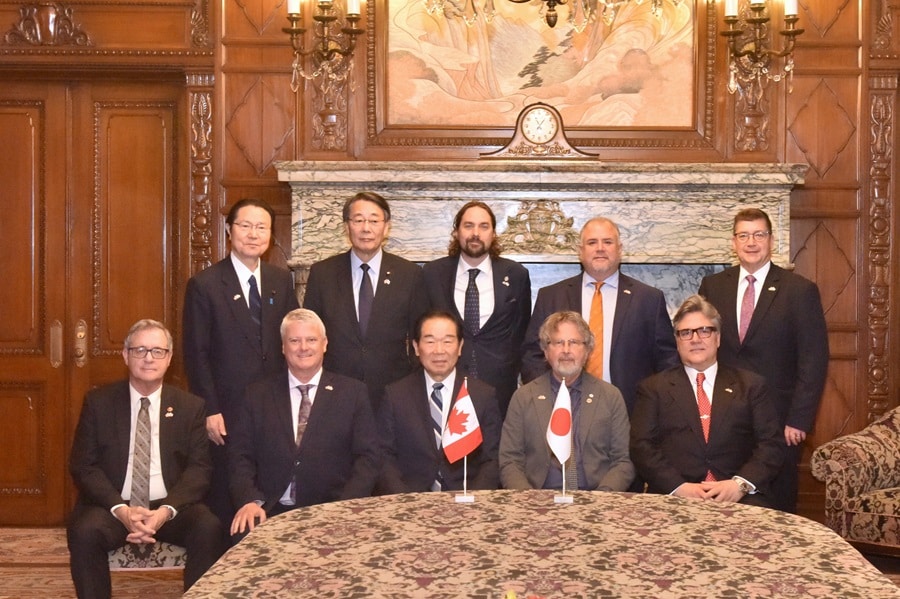
A parliamentary delegation from Canada, led by Senator Stan Kutcher, paid an official visit to Japan in May 2025 and held a number of meetings with their Japanese counterparts aimed at improving bilateral relations between the two nations. Photo: House of Representatives (Shugiin)
The Arctic Institute Japan Series 2026
- The Arctic Institute’s 2026 Japan Series: An Introduction
- Rising Sun in the Warming Arctic: As Great Power Competition Returns to the Polar Region, Japan Is Positioned for Prominence
- Distinctive Characteristics of Japan’s Arctic Approach and Engagement with Arctic Governance
- Japan’s Corporate Engines in the Arctic: Industrial Drivers of LNG, Shipping, and Technological Adaptation
- Beyond the Northern Sea Route: The Developmental State and Japanese Arctic Energy Policy
- The Role of Russia in Japan’s Arctic Policy
- FOIP Goes Northward: Japan’s Maritime Identity and the Defense of Rule of Law in the Arctic
- Towards a Shared Arctic Vision: Japan and the Nordic States in an Interconnected World
- Legal and Scientific Cooperation in the Context of Japan Canada Relations: Pathways for Increased Arctic Cooperation?
- The Role of EU-Japan Collaboration in Trans-Arctic Cable Development
- Liminal Diplomacy at the Poles: Japan’s Disaster Risk Reduction and the Making of Arctic Order
- The Arctic Institute’s 2026 Japan Series: Conclusion
The 2023 Basic Plan on Ocean Policy integrates the Arctic into Japan’s broader maritime security framework, emphasizing the development of maritime law, sustainable use of maritime routes and resources, and science diplomacy.1) Science diplomacy, in particular, reflects an understanding of how climate change reshapes the Arctic, making the region a critical arena for global transformations affecting various aspects of national security for both Arctic and non-Arctic states. Amid growing geopolitical competition, more broadly, science diplomacy allows Japan to maintain a credible regional presence while expanding partnerships under shifting international conditions.
This strategy has enabled Japan to establish an extensive international research network through a layered multilateral architecture, including ministerial dialogues, bilateral agreements, and sectoral cooperation. Central to this network is the ArCS flagship program, supported by national institutions such as the National Institute of Polar Research (NIPR) and the Japan Agency for Marine-Earth Science and Technology (JAMSTEC).2) This approach has been especially effective in fostering cooperation with Nordic countries, Russia, and the United States. By contrast, partnerships with Canada remain underdeveloped, reflecting Canada’s prioritization of domestic Arctic governance and transatlantic alliances, despite deepening Japan–Canada cooperation in the Indo-Pacific.3)
This article examines the nascent state of Japan–Canada Arctic relations, analyzing the linkages between the Indo-Pacific and the Canadian Arctic, and highlighting shared strategic concerns. It argues that science diplomacy offers a practical entry point for deeper engagement, including legal cooperation through data-driven submissions to international fora. Leveraging these opportunities could allow Japan and Canada to replicate elements of their successful Indo-Pacific cooperation in the Arctic by advancing mutually beneficial partnerships and ultimately strengthening their bilateral relation beyond the Indo-Pacific context.
Japan’s science diplomacy at the base of its Arctic Policy
Geographically, Japan is the closest Asian nation to the Arctic which has been engaged with the Arctic far longer than any other Asian nation, consistently viewing it as a fertile ground for scientific research. This principle was formalized in its first Arctic Policy, which positioned the region as critical for understanding climate change mechanisms affecting the Japanese archipelago, exploring opportunities for energy security and logistics, and promoting international cooperation and the rule of law.4) This cooperative approach to regional challenges has yielded tangible results, particularly with the United States5) and Nordic countries.6)
This science and research based strategy, moreover, laid the foundation for its observer status in the Arctic Council in 2013,7) where its contributions include scientific expertise across nine working groups on biodiversity, pollutant mitigation, and meteorology. Similarly, its major national stakeholders, such as NIPR, JAMSTEC, and the Japan Aerospace Exploration Agency (JAXA), provide project proposals and financial support.8)
The science diplomacy approach also addresses practical challenges situated at the intersection of national security and climate change. On one hand, the loss of sea ice and greenhouse gas (GHG) releases intensify extreme climate events in the Northern Hemisphere9) affecting Japan’s coasts, ecosystems, aquaculture, and agriculture. On the other hand, the disappearance of ice is improving access to Arctic resources, which could enhance Japan’s overall national security by, amongst other things, allowing it to diversify its energy supplier network, and facilities access to regional sea routes, such as North Sea Routes (NSR), for longer periods of time reducing Asia–Europe navigation times by up to 40%.10)
This approach’s engagement with, and relevance to, practical issues is perhaps best evident by the fact that national and private stakeholders have supported Arctic research and navigation initiatives, allowing Japan to retain a strong presence in the Arctic Council.11) Central to this effort is the ArCS program, Japan’s largest Arctic research initiative, which has developed an international network since 2011 and addresses ten overlapping research themes across three interdisciplinary objectives.12) ArCs multidimensionality, it is important to note, aligns with the 2023 Basic Ocean Policy, enabling Japan to employ advanced research infrastructures, such as ice-breaking vessels, unmanned research vessels, and satellites, to provide comprehensive and actionable knowledge for domestic and international stakeholders including Indigenous communities.
Reflecting its middle-power status, its identity as a norm entrepreneur, and its commitment to mitigating regional frictions arising from climate-driven economic opportunities, Japan also emphasizes adherence to international norms, including UNCLOS and the Ilulissat Declaration13) in conduct of its Arctic strategy. In addition, Scientific research underpins its legal contributions to various regional and multilateral bodies including data-driven proposals for the International Code for Ships Operating in Polar Waters (Polar Code), SOLAS, and MARPOL.14)
Canada’s inward-looking Arctic Policy and reluctant engagement with Asian countries in the Arctic
Canada has traditionally viewed the Arctic as a matter of national sovereignty, emphasizing domestic priorities shaped by Indigenous and provincial stakeholders, including security, governance, and resource management.15) This view has been further reinforced by the opportunities provided by climate change which has amplified opportunities for new shipping routes and resource extraction; a trend that has prompted Canada to expand its security presence in the region and seek to strengthen cooperation with its Nordic NATO allies.16)
Conversely, this means that the Canadian government tends to leverage multilateral fora, including the Arctic Council, IMO and UNDP, to mainly address non-traditional security issues, ranging from Indigenous empowerment and maritime safety to environmental protection, while the traditional security issues are still operationalized within the NATO frameworks and bilateral agreements with its members.17) This dual-level approach separates traditional security, focused on Arctic states, from non-traditional security where limited engagement with non-regional actors has paved the way for occasional and issue-specific cooperation between Japan and a host of other nations. Such endeavours, however, are infrequent as evident in the fact that Japan’s National Institute of Polar Research (NIPR) has only collaborated with the Canadian High Arctic Research Station (CHARS) once.18)
Arguably, the most striking aspect of Canada’s inward-looking Arctic diplomacy is that it stands in sharp contrast to its 2022 Indo-Pacific Strategy, which promotes dynamic engagement through five interconnected objectives: enhancing traditional security, expanding supply chain resilience, people-to-people connection, ensuring a sustainable future and fostering diplomatic engagement.19) This proactive approach underpins Canada’s rapidly expanding partnership with Japan in trade, academia, cybersecurity, sustainability, and maritime defense.
The vibrancy of their relation also provides fertile grounds for increased bilateral cooperation in the Arctic. The Japan–Canada Joint Action Plan reflects overlapping commitments to maritime order, including UNCLOS, the Agreement to Prevent Unregulated High Seas Fisheries in the Central Arctic Ocean, and the Polar Code.20) Equally significant, initiatives such as Canada’s endorsement of Japan as an observer in Operation Nanook and a joint panel at the 2024 Arctic Circle Assembly – “The View of the Canadian Arctic Through an Indo-Pacific Lens” – indicate growing alignment. Collectively, these engagements provide a foundation for deeper scientific cooperation addressing Arctic climate challenges and enhancing navigation safety.
How science diplomacy focused on environmental issues could unlock this cooperation
The Arctic is four times more impacted by climate change than any other part of the world. This phenomenon, called Arctic amplification, escalates ice melting, which is diminishing the entire globe’s heat regulation and increasing permafrost thawing. This leads to the further release of greenhouse gases (GHG, i.e. CO₂ and CH₄), and the amplification of microbial decomposition of vast frozen carbon stocks.21) The transformations in the region are also leading to unpredictable drifting ice patches and extreme climatic events like storm-driven waves both of which increase navigational risks alongside the region’s waterways and hence negatively impact the perceptions of the region as a safe maritime zone.22)
Recently, researchers have also highlighted the interconnectedness of the Indo-Pacific Ocean’s health to the Canadian Arctic: The Indo-Pacific Warm Pool (IPWP) negatively correlates with Canadian Arctic sea ice23) while Asian dust contributes to the Arctic amplification.24) Climate change research, thus, provides a direct avenue for Japan to engage Canada, leveraging initial cooperation between NIPR and CHARS under ArCS. What is more, expanding this network to other Canadian institutions can consolidate monitoring of the IPWP and Arctic environmental phenomena.
Above all, research on climate change provides a unique opportunity to further develop space partnership between the two nations’ space agencies within the framework of the Canadian Arctic Weather Science Project.25) Joint satellite missions can track ice density, ice-cap movement, and meteorological data, integrating with open-source systems like NIPR’s Arctic Data Archive System and Canada’s Polar Data Catalogue to improve climate modeling and forecasting. Beyond climate research, these infrastructures can enhance logistics, navigation safety, and situational awareness in the Canadian Arctic.
Expanding the collaboration through norm entrepreneurship
A robust scientific cooperation also provides the foundation for effective data-driven legal submissions to enhance Arctic navigation safety. Existing legal frameworks—including UNCLOS, the Polar Code, MARPOL, and SOLAS—were not designed for Arctic conditions and could not anticipate climate change-driven challenges such as drifting ice patches and extreme marine storms. These frameworks also contain regulatory gaps in pollution control, black carbon emissions, oil spill preparedness, and rerouting to avoid sensitive areas remain insufficiently addressed.26)
Although research linking climate change to navigation safety is still emerging, the Intergovernmental Panel on Climate Change (2019) forecasts that extreme maritime events could cost the global economy $428 billion per year by 2050 and $1.98 trillion per year by 2100.27) The combination of Arctic amplification and legal gaps underscores the scale and scope of the opportunity, and the need, for Japan–Canada cooperation. They can utilise their shared commitment to maritime governance and proactive engagement in international fora to co-design an approach based on a clear logic of division of labor whereby Japan contributes with scientific expertise and Canada provides legal expertise and regional authority. This would form a strong base for addressing current (International) legal loopholes and voids with evidence-based, science-driven submissions.
As a preliminary step, Japan and Canada should hold 2+2 or inter-ministerial consultations to establish ad-hoc working groups on navigation legislation. Taking a cue from similar endeavours in the past,28) these groups would harmonise safety standards, demonstrate leadership in norm-setting, and ensure feasible implementation. Two areas in particular should be given priority. Data driven cooperation with regard to the development of international rules/frameworks and legal cooperation aimed at addressing gray zone activities.
Data-driven cooperation can specifically address challenges in developing the Polar Water Operational Manuals (PWOM) under the Polar Code, where obtaining daily low-temperature data remains an obstacle.29) Joint satellite programs in the Northwest Passage could provide dynamic ice-patch mapping and real-time navigation updates. Similarly, ArCS-supported initiatives could improve protocols for greenhouse gas and short-lived climate pollutant (SLCP) management, filling persistent gaps in the Polar Code.
Legal collaboration, on the other hand, can be designed in a way to address a wide array of issues including Arctic grey-zone challenges which arise from fragmented governance and rising regional tensions. While the Canadian Arctic has not experienced a hike in the number of such activities compared to the European Arctic,30) scholars warns against discounting potential future vulnerabilities to undersea cable cuts, increased presence of dual-use assets by adversaries, and subtle lawfare.31)
What is unique about Legal cooperation over gray zone activities is that doing so would benefit both countries; it aligns with Japan’s interest in deterring similar activities in Asia Pacific while it provides Canada with yet another instrument to reinforce and better uphold its Arctic sovereignty principles. For instance, joint study groups could clarify ambiguous UNCLOS provisions, advance shared positions, redefine and expand the legal definition of “damage” to include cyberattacks, and strengthen the rule of law in contexts below the threshold of armed conflict. Such works would prove particularly revenant in the context of Far North Fiber project where Japan is a direct stakeholder, and Canada hosts landing points in Nunavik and Grise Fiord.32)
Conclusion
Science diplomacy forms the backbone of Japan’s Arctic policy, enabling it to maintain relevance in key Arctic fora while leveraging expertise in climate research, maritime law, and risk and disaster management. The 2023 Ocean Policy strengthens this role, linking Arctic research to international maritime governance and providing a flexible instrument for expanding partnerships under evolving geopolitical conditions.
Canada’s recent Indo-Pacific engagement, exemplified by its dynamic partnership with Japan, contrasts with its historically inward-looking Arctic policy. Nevertheless, existing bilateral mechanisms, combined with Japan’s science-based approach, offer a clear pathway to deepen Arctic cooperation. ArCS-led projects and joint initiatives within Arctic Council working groups could serve as the foundation for linking climate and environmental challenges in the Canadian Arctic to broader Indo-Pacific security and legal frameworks.
By aligning scientific expertise, legal capacity, and shared norms, Japan and Canada can transform nascent Arctic engagement into a strategic partnership that generates mutual benefits, enhances climate resilience, and upholds governance standards. Beyond bilateral gains, such cooperation positions both countries as responsible actors capable of linking Indo-Pacific principles to Arctic security, ensuring that emerging challenges are addressed proactively and collaboratively.
Giulia Saccone is a recent master graduate in Asian Studies at Stockholm University and a member of the International Team for the Study of Security, Verona specialising in Japan’s international relations.
References