FOIP Goes Northward: Japan's Maritime Identity and the Defense of Rule of Law in the Arctic
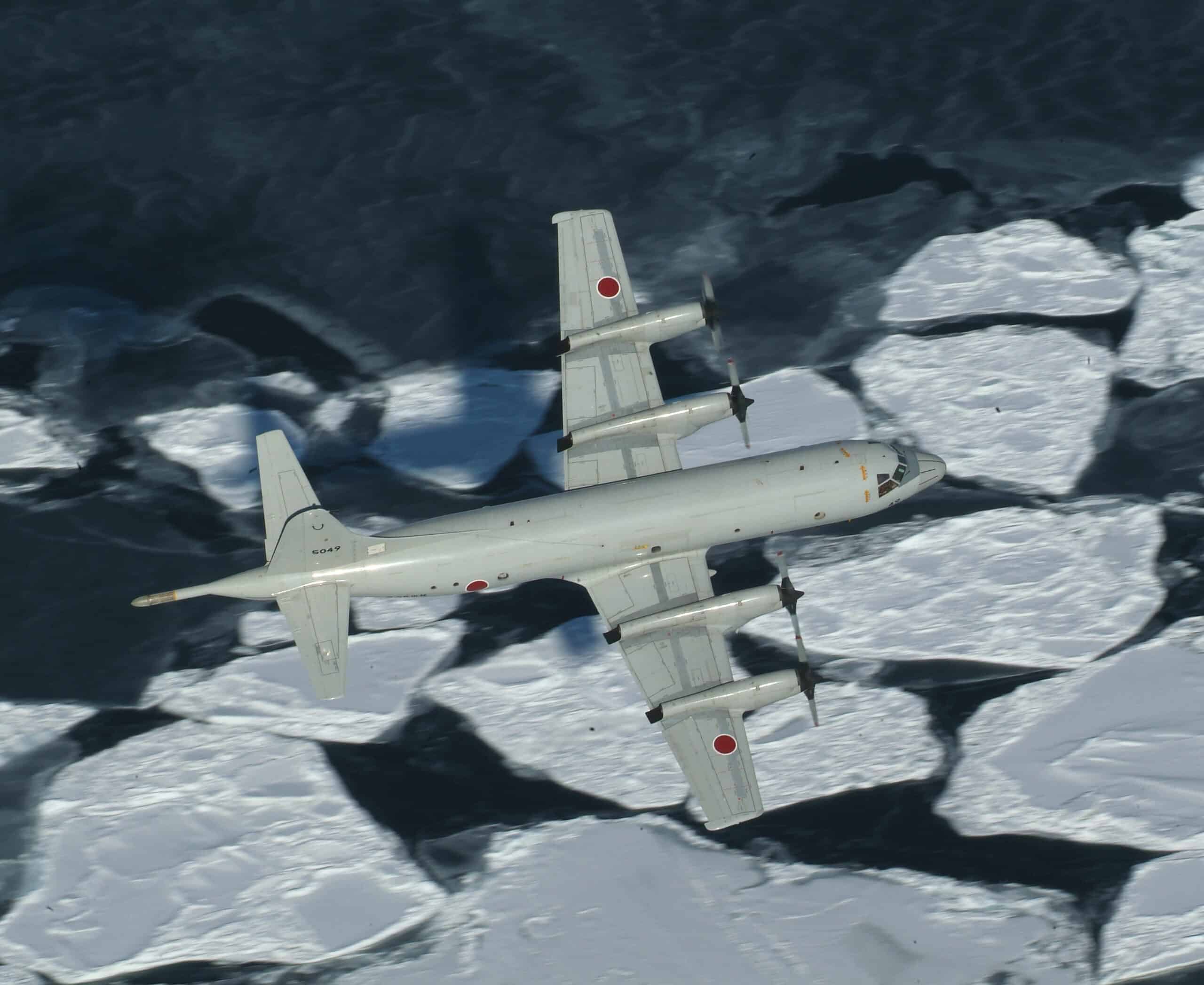
Japan Maritime Self-Defense Force. Photo: Japan Maritime Self-Defense Force
The Arctic Institute Japan Series 2026
- The Arctic Institute’s 2026 Japan Series: An Introduction
- Rising Sun in the Warming Arctic: As Great Power Competition Returns to the Polar Region, Japan Is Positioned for Prominence
- Distinctive Characteristics of Japan’s Arctic Approach and Engagement with Arctic Governance
- Japan’s Corporate Engines in the Arctic: Industrial Drivers of LNG, Shipping, and Technological Adaptation
- Beyond the Northern Sea Route: The Developmental State and Japanese Arctic Energy Policy
- The Role of Russia in Japan’s Arctic Policy
- FOIP Goes Northward: Japan’s Maritime Identity and the Defense of Rule of Law in the Arctic
- Towards a Shared Arctic Vision: Japan and the Nordic States in an Interconnected World
- Legal and Scientific Cooperation in the Context of Japan Canada Relations: Pathways for Increased Arctic Cooperation?
- The Role of EU-Japan Collaboration in Trans-Arctic Cable Development
- Liminal Diplomacy at the Poles: Japan’s Disaster Risk Reduction and the Making of Arctic Order
- The Arctic Institute’s 2026 Japan Series: Conclusion
Japan’s Ministry of Defense 2022 Response Strategy on Climate Change explicitly links Arctic environmental changes to national security.1) The document warns that the melting of sea ice will open new shipping routes, expose seabed resources, and trigger competition among major powers. It highlights risks such as instability from disputes over Arctic resources, China’s advancement into the Arctic via the Sea of Japan, and the Northern Sea Route (NSR) becoming a critical passage. In this framing, climate change operates as a threat multiplier with Arctic warming intensifying geopolitical competition and amplifying vulnerabilities in Japan’s security environment, thus affecting its national defense posture in the Indo-Pacific.
Japan’s broader strategic framework for addressing such challenges is its “Free and Open Indo-Pacific” (FOIP) vision, launched by Prime Minister Shinzo Abe in 2016.2) FOIP is Japan’s grand strategy for defending maritime openness and a rules-based order. The vision builds on three pillars: (1) promoting the rule of law and freedom of navigation, (2) enhancing economic prosperity through connectivity, and (3) peace and stability via capacity building and humanitarian assistance. The core principles are further refined to include principles for: (1) fostering peace and rules to promote prosperity, (2) addressing challenges in the Indo-Pacific, (3) establishing connectivity on multiple levels, and (4) extending efforts for security and safe usage measures from maritime to aerial domains.3)
For years, FOIP has been understood as a regional strategy with a focus on the waters around Japan, the South China Sea, and the broader Indo-Pacific. Tokyo is now stretching that vision northward notwithstanding the fact that it is not an Arctic state. Japan describes itself as one of the “surrounding states”4) with respect to the Arctic; a framing that allows it to fold the Arctic into FOIP and treat two distant maritime theaters as parts of a single, integrated ocean policy.
This article argues that this development is driven by two factors. Externally, the convergence of Chinese and Russian ambitions in the Arctic threatens the rules-based order that FOIP seeks to uphold. Internally, Japan’s maritime identity and engagement with northern waters compel it to treat the Arctic as an extension of its maritime corridors and strategic horizon. Combined, these factors, or pressure points, reshape FOIP’s logic to extend its principles into the Arctic.
Arctic Militarization and the Defense of the Rule of Law in the Arctic
Systemically, the Arctic is becoming a focal point of strategic militarization, as major powers like Russia and China expand their presence and capabilities in pursuit of geopolitical influence, resource control, and dominance over emerging maritime routes.
Russia’s Arctic military posture centers on air and maritime early warning and defense. It includes the reopening of 50 Soviet‑era bases, refurbishment of 13 airfields and 10 radar stations, expansion of 20 border posts and 10 rescue outposts, and the deployment of special forces within an Arctic Brigade for exercises and training.5) Russia also operates more than 40 icebreakers.6)
Particularly, the NSR, which runs along Russia’s Arctic coast, is under Moscow’s control.7) To claim regulatory authority, Russia invokes Article 234 of the UN Law of the Sea Convention (UNCLOS) which permits coastal states to set rules for ships traveling through ice-covered waters in their exclusive economic zones mainly for environmental protection. This includes requiring advance permits, mandatory pilotage, and icebreaker escorts. While Moscow has actively promoted the NSR as a global energy corridor for Arctic oil and LNG exports,8) many fear such moves could weaponize access as geopolitical leverage, conditioning passage on political compliance or restricting transit during crises.
Meanwhile, China has declared itself a “near-Arctic state”9) despite being far from the Arctic Circle. It backs this claim with growing interests and capabilities: a fleet of 5 icebreakers,10) the Polar Silk Road initiative under the Belt and Road framework, and increasingly regular research voyages that serve dual-use purposes.11)
Japan sees these developments through two lenses. The first lens is revisionist threats. Japan’s 2022 National Security Strategy identifies China as a revisionist power and Russia as a violator of sovereignty, presenting them as dimensions of a unified threat to maritime order.12) The second lens is Japan’s alliance with the US. From the Arctic, Chinese forces could threaten the US East Coast as easily as the West; a scenario which Tokyo believes could potentially undermine its own strategic interests.13)
In response, Japan has begun to operationalize FOIP’s security aspects in the Arctic. In September 2020,14) the Maritime Self-Defense Force entered the Arctic Ocean for the first time when the training ship Kashima sailed through the Bering Strait into the Arctic Circle with about 310 crew and trainees. The voyage, though symbolic and marked by an onboard “Arctic Festival” (北極祭), signaled Japan’s intent to assert strategic presence and build operational familiarity in a contested space. Furthermore, conducted in concert with the US, the deployment was intended as a form of silent pressure and deterrence against Russian and Chinese ambitions, as explained by Keishi Ono, the Director of International Exchange and Libraries at the National Institute for Defense Studies, in discussion with the author in March 2024.
Moreover, Japan is diversifying its Arctic partnerships. It has deepened bilateral15) ties with other Arctic states and it continues to actively participate16) in multilateral institutions like the Arctic Council (AC). These efforts allow Japan to advance FOIP’s rule of law pillar by supporting UNCLOS-based governance, its connectivity pillar through joint shipping and energy projects, and its stability pillar via scientific cooperation and capacity building. In doing so, Japan reduces overdependence on any single ally and embeds FOIP principles into a broader coalition of Arctic stakeholders.
Contextualised this way, it is reasonable to assert that Arctic militarization has incentivised Japan to adapt its FOIP to a new maritime theater where sovereignty is diffuse, alliances are fluid, and governance norms remain unsettled. By responding to the strategic assertiveness of China and Russia in the region, Japan is reacting to external threats while actively extending FOIP into the Arctic. More broadly, the Arctic deployment and Japan’s growing engagement in Arctic institutions demonstrate how FOIP is being operationalized beyond its original Indo-Pacific focus.
Japan’s Maritime Identity and the Domestic Logic of its Arctic Engagement
Historical Engagement
Japan’s Arctic engagement is rooted in a maritime identity that links northern waters to national survival and strategic imagination. As early as the 1930s-1940s, Tokyo closely monitored Soviet Arctic exploration and the development of the NSR, viewing it through a maritime security lens.17) Particularly, Japan’s imperial government was concerned about its “northern fisheries,” especially crab and salmon stocks off the Soviet coast and in the Bering Sea, which were important to its coastal economy.18)
Japan’s Arctic involvement took off in 1957 when a Hokkaido University professor led a research expedition to Greenland.19) In 1991, Japan became the first non-Arctic country to establish a permanent observation station in Norway’s Svalbard archipelago. Tokyo was also present at the founding of the AC in 1996 though it was not until 2013 when it gained AC observer status alongside China, India, Singapore, and South Korea; a development that was interpreted as a sign of growing Asian interest in the region. Between 1993 and 1999, last but certainly not least, Japan co-led with Norway and Russia the International Northern Sea Route Programme which mapped out future shipping opportunities.
This long-standing presence shapes how Japan interprets and implements FOIP. Its decades of Arctic engagement through scientific diplomacy, multilateral cooperation, and sustainable development mirror FOIP’s principles of a rules-based maritime order. Rather than treating the Arctic as a new frontier, Japan sees it as a familiar maritime space where it can extend FOIP’s principles.
Hokkaidō as Arctic Gateway
Within that context, Hokkaidō has been central to Japan’s Arctic identity.20) The name Hokkaidō (北海道), literally meaning “Northern Sea Route” or “Road to the Northern Sea,” was adopted in 1869 by the Meiji government to replace the older name Ezochi. The name echoes a deeper imperial logic of connectivity to link distant peripheries to the maritime center of the Japanese state. The name also reflects the island’s geographic position. Compared to other East Asian ports, it is geographically closer to Arctic sea routes like the NSR. This makes Hokkaidō a “natural” Arctic hub for Arctic logistics and research.21)
Hokkaidō and its capital, Sapporo, have also actively redefined their northernness through concepts like hoppōken (北方圏, Northern Region22) and “winter city”,23) enabling both local and national officials to align with Arctic and sub-Arctic cities facing similar climatic challenges. These frameworks have helped bridge the latitude gap between Japan and the Arctic, allowing Hokkaidō to participate in interregional forums such as the Northern Forum and the World Winter Cities Association for Mayors. Through these platforms, it has built direct ties with cities in Russia, Canada, and Scandinavia. Sapporo, in particular, has leveraged its “winter city” identity to host international conferences and build partnerships with cities like Norilsk24) and Magadan.25) This regional diplomacy supports FOIP by promoting peace and stability through capacity building and cooperation.
Policy Integration
Japan’s national institutions have integrated the Arctic into its oceanic strategy to align the Arctic with FOIP’s global orientation. The Headquarters for Ocean Policy and the Arctic Liaison Committee coordinate across ministries to ensure that Japan can achieve multiple objectives in the Arctic through FOIP.26) The Arctic was first mentioned in the 2013 Second Basic Plan on Ocean Policy with a particular emphasis on environmental monitoring and shipping routes.27) This narrow focus was further broadened in 2015 when Japan formally adopted its 2015 Arctic Policy which outlines three priorities: research and development, international cooperation, and sustainable use.28)
Importantly, the 2018 Third Basic Plan on Ocean Policy explicitly incorporates the Arctic into Japan’s broader oceanic strategy, identifying the region as critical for “maintaining and developing a free and open maritime order based on the rule of law.”29) This language mirrors FOIP principles, ensuring that Arctic policy advances the same objectives Japan pursues in the Indo‑Pacific. The 2022 Japan-Canada Action Plan reinforces this alignment by explicitly including “Maintaining Maritime Order in the Arctic” within Indo-Pacific cooperation.30) It also commits both countries to continued collaboration on maritime governance, including efforts to combat illegal, unreported, and unregulated fishing.
Enhancing Connectivity through Arctic Shipping and Energy Routes
Strategically, Japan views Arctic sea routes as vital to its long-term (energy) security given the fact that it imports close to 96% of its energy needs.31) The NSR in particular has received the most attention in Japanese policy circles due to its tangible benefits as an emerging maritime shortcuts between Japan and Europe. Compared to the traditional Suez Canal route, NSR reduces Asia-Europe shipping distances by up to 36–40% (~7,200 km) and voyage times by 10–15 days.32) Meanwhile, traffic alongside the NSR route is on the rise; in 2025, for instance, it recorded 103 full transits by 88 vessels carrying about 3.2 million tons of cargo.33) For a trading and import-dependent nation like Japan, this emerging route advances FOIP’s principles of economic prosperity through maritime openness, and hence it provides an advantage and opportunity that Japan simply cannot afford to miss.
At the same time, Japan’s reliance on Russian Arctic energy underscores the tension between energy security and geopolitical risk. In 2023, Russia was Japan’s third-largest liquefied natural gas (LNG) supplier accounting for 9.3% of total imports.34) Despite sanctions and geopolitical tensions following Russia’s invasion of Ukraine, Japan has secured a US waiver to continue LNG imports from Sakhalin-235) and maintain involvement in Arctic LNG 236) and Sakhalin-1. Prime Minister Sanae Takaichi defended the exemption by citing the difficulty of securing alternative sources and warning that Japan’s withdrawal could open the door for China to acquire a stake in these strategic offshore energy projects. This reflects a pragmatic effort to prevent China from monopolizing strategic energy projects, thereby safeguarding FOIP’s broader objective of balanced connectivity.
Building on this immediate focus on the NSR, Japan’s Arctic strategy also considers the broader spectrum of emerging polar routes, weighing operational feasibility, geopolitical constraints, and long-term governance opportunities. The Northwest Passage (NWP), while technically a shorter route between Asia and North America than the Panama Canal, remains peripheral to Japan’s shipping plans.37) Persistent heavy ice, limited infrastructure, high insurance costs, and the legal uncertainty surrounding Canada’s sovereignty claim make the NWP a less reliable option.38) Even as climate change gradually improves navigability, these structural and regulatory obstacles mean the NWP is unlikely to play a central role in Japanese Arctic shipping strategy in the near term.
By contrast, the Transpolar Sea Route (TSR)39) represents a future-oriented opportunity that aligns closely with Japan’s FOIP-driven objectives. Running across the Central Arctic Ocean above the North Pole, the TSR would avoid the territorial waters of both Russia and Canada, thereby reducing geopolitical friction and enabling multilateral management under UNCLOS frameworks. Although commercial use remains a longer-term prospect, Japan is actively preparing for the route’s potential through scientific research, policy engagement, and participation in multilateral governance initiatives such as the Central Arctic Ocean Fisheries Agreement (CAOFA).40) Programs like the Arctic Challenge for Sustainability II,41) moreover, integrate applied research with policy development, and hence enable Japanese scientists to shape environmental standards, monitoring protocols, and governance norms in the Central Arctic Ocean.
Taken together, Japan’s Arctic engagement reflects a clear hierarchy of priorities: immediate utilisation of the NSR for its relative logistical efficiency and energy access, strategic preparation for the TSR as a rules-based, multilateral corridor for the future, and limited focus on the NWP due to operational and legal constraints. In this way, Japan leverages Arctic shipping and energy routes not only to secure economic and energy interests but also to extend FOIP principles, promote maritime openness, and establish a normative presence in the governance of the Central Arctic Ocean.
Conclusion
This analysis demonstrates how the Arctic fits into Japan’s FOIP grand strategy linking the two maritime theaters of the Indo-Pacific and the Arctic. Externally, the convergence of Chinese and Russian ambitions in the Arctic threatens the rules-based order that FOIP is designed to uphold. Internally, shaped by historical engagement, regional geography, and energy dependence, Japan’s maritime identity compels it to view the Arctic as an extension of its strategic space.
In operational terms, Japan advances FOIP’s principles in the Arctic by upholding the rule of law through support for UNCLOS and multilateral governance, enhancing connectivity through Arctic shipping and energy routes, and promoting peace and stability through scientific diplomacy and coalition-building. The prioritisation of the NSR for immediate economic and energy security, coupled with preparatory engagement in the TSR as a multilateral, rules-based future route, exemplifies this strategic calibration, while the NWP remains a secondary concern due to structural and legal constraints.
These dynamics carry broader implications for middle powers navigating an era of intensified great power competition. By conceptualising distant regions as extensions of their strategic geography and leveraging historical experience, institutional frameworks, and normative influence, this category of state actors can project power, diversify strategic dependencies, and actively contribute to the governance of global commons. Japan’s Arctic engagement, thus, demonstrates how middle powers can operationalise strategy to safeguard national interests while shaping emerging international and regional orders.
Khang Pham is a Master’s candidate in International Relations at the Graduate School of Asia-Pacific Studies, Waseda University, Japan. Pham’s research is centered around Climate Security with a regional focus on Asia-Pacific and the Arctic.
References