The Faroe Islands in WTO? A Path to Sovereignty and Recognition or Paradiplomatic Crisis with Denmark over the Arctic?
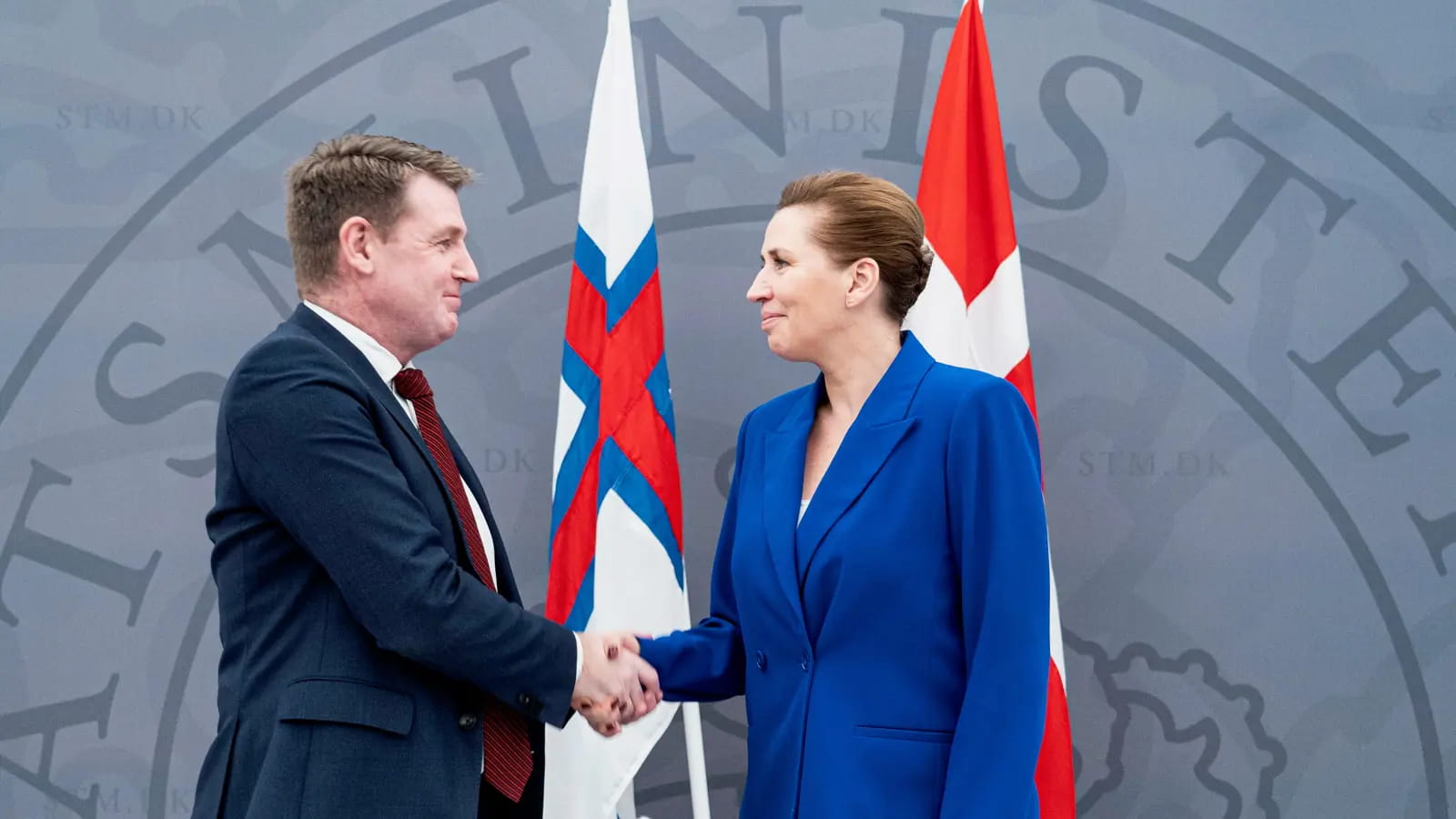
Danish Prime Minister Mette Frederiksen and Prime Minister in the Faroe Islands, Aksel V. Johannesen, signed a joint request to the President of the Supreme Court to review the legality of the Home Rule Act for letting the Faroe Islands join WTO as an independent state. Photo: The Government of the Faroe Islands
Are the Faroe Islands on the path to independence, or is the road to sovereignty more complicated than that? With the Supreme Court ruling on the 10th of September 2025, it is established that the Faroe Islands can apply for membership in the World Trade Organization (WTO) on equal terms with other states, including Denmark, and form trade agreements independently from Denmark’s foreign policy leadership. It is stated that the two countries in practice will address potential conflicts of interest and differences through general parliamentary work and discussions on foreign policy committees.1) The criticism is that the Faroe Islands can directly pursue a foreign policy different from the one originating in Copenhagen. But what will the consequences be, and what significance can it have for the future of the Kingdom of Denmark (known as “Rigsfællesskabet” in Danish, which is a unique union between Denmark, the Faroe Island and Greenland)? The Faroe Islands’ admission to the WTO is an interesting example of how substates navigate the international system. Despite the Faroe Islands being a self-governing territory under the Kingdom of Denmark, they have managed to potentially achieve WTO membership. This raises important questions about the sovereignty of substates, international recognition, and Faroese paradiplomacy.
I analyze the issue and focus on how the study of substates can contribute to a broader understanding of the dynamics within the Arctic. I include theoretical perspectives from substate literature on sovereignty, recognition, and paradiplomacy to uncover opportunities and consequences in the relationship between the substate, the Faroe Islands, and the administering country, Denmark. I analyze the Supreme Court ruling and the Faroe Islands’ admission to the WTO as an independent case study that contributes substantially to describing sovereignty dynamics for other substates and their relationship with international organizations. I analyze the Faroe Islands from an actor perspective, where Faroese leaders’ articulations, actions, and the consequences of those actions constitute knowledge about substate affairs within the Kingdom of Denmark that is interesting to investigate. I will discuss the consequences of a more sovereign Faroe Islands in the geopolitical situation in the Arctic, and its implications for the relationship between Denmark, US, EU and Russia.
I argue that the Faroe Islands’ admission to the WTO strengthens equality and consensus-based progression within the Kingdom of Denmark. It increases Faroese self-determination and contributes to the development of a closer semi-federal union with the Faroe Islands. At the same time, it places the Faroe Islands in a larger foreign and geopolitical context that is complex to navigate, where the Faroe Islands may become entangled in relations with the EU, Russia, China, and the U.S. My argument builds on similar points from the debate on the Faroe Islands case in the Supreme Court2) as well as the special semi-federal relationship characterizing the structure of the Kingdom of Denmark.3) By this, the Faroe Islands undergo a transforming progress from being a geostrategic brick into a geopolitical actor with agency.
Although foreign policy is overall handled by Denmark, the Faroe Islands need to be able to act independently in international markets and organizations to protect and advance their economic interests, particularly in fisheries and exports. I argue that Denmark should not consider the Faroe Islands’ WTO admission as a threat to Danish foreign policy for three reasons:
- Denmark continues to retain overarching responsibility for foreign policy, while it still gives the Faroe Islands room to maneuver in areas that are vital to the islands’ economy and identity.
- It increases a freedom of action, creates international visibility of a pluralistic willingness to cooperate with a postcolonial territory, legitimizes Faroese interests, which can be beneficial to Denmark in the long term, and provides relationship to larger networks that can create a sustainable Faroese economic and political independence.
- It illustrates how paradiplomacy contributes to a flexible, multidimensional, and layered sovereignty, where different levels of the state structure participate in the formulation of foreign policy.
Faroese sovereignty, levels of autonomy and agency
Sovereignty is a fundamental concept in International Relations, denoting states’ independent authority over their territory and right to self-determination without interference from other states.4) The Faroe Islands do not have full sovereignty as an independent state, as foreign policy and defense are still under Denmark’s authority, but with the Supreme Court ruling, this relationship has changed5) WTO admission marks a degree of partial sovereignty attainment and an expansion of the scope of self-government. The Faroe Islands can act with a certain degree of autonomy in trade-related matters. This development can be characterized as the acquisition of functional sovereignty, where sovereignty rights in specific areas are exercised by the Faroe Islands on par with other domestically reclaimed areas. This occurs without making the Faroe Islands an independent state. It is central to analyze the two dynamics at play, both externally and internally, in the Faroe Islands’ WTO admission: a multilayered sovereignty process and Faroese agency.
Baldacchino’s (2017) model is a good way to describe the dynamics surrounding different levels of sovereignty and substate processes of autonomy. He emphasizes that tensions can arise in the relationship between “shared rule” and “self-rule” concerning the substate and the administering country.6) The Faroe Islands’ possibility of WTO membership characterizes a move towards greater “self-rule.” This is reinforced by the Home Rule Act’s provision allowing membership in an international organization based on the transfer of key areas of responsibility to the Faroe Islands from Denmark.7) According to the model, the areas that the Faroe Islands can take control of, are hard power instruments, such as international trade and organizational memberships. These areas are to be managed by local politicians rather than by the administering country.8) On a continuum from thick to thin levels of autonomy, a move towards greater autonomy leads to increased efficiency and localization of autonomy, as well as a push towards greater self-determination, which still involves limited sovereignty.9) This creates a degree of institutional independence in jurisdictional autonomy and it brings the Faroe Islands one step closer to a larger self-governance over its own territory, independently from Denmark.
But limited autonomy is still not sufficient to explain the Faroe Islands’ process towards greater sovereignty. The concept of agency is essential to include due to its theorization of who can act and who is bound to follow larger states in the international system. Wivel (2025) describes agency as a multidimensional perspective that should be seen in the relationship between states. Important for states’ concept of agency are military weight, economic growth, and perceptual factors within the state, such as political leaders, socially constituted norms, and practices. Either a state is an international actor with foreign policy agency, or it is not.10) Based on Wivel’s concept, The Faroe Islands’ admission to the WTO is a way in which the country attempts to possess, act, and perform on equal footing with other states in the international system. For the Faroe Islands, it is about being recognized internally and externally within the Kingdom of Denmark as an equal partner, capable of acting on its own behalf, conducting its own trade policy, and engaging internationally without Denmark. The Speaker of the Faroese Parliament, Aksel V. Johannesen, emphasizes a consideration for the Faroe Islands’ economy and industry as key elements for Faroese WTO admission.11) Although Faroese identity is not directly a central element, the WTO admission is a way for the Faroe Islands to act and perform as a distinctly quasi-state actor. It constitutes a Faroese agency that prioritizes Faroese interests as central in international politics. By this, the Faroese transforms from being a geostrategic brick with no voice and relevance in other states’ understanding of global politics into a geopolitical actor with reclaimed agency. WTO membership provides the opportunity and platform for the transformation.
The Faroe Islands’ constitution of an agency as a state-like actor and attainment of greater internal and external sovereignty within the Kingdom of Denmark are plausible reasons for why the Faroe Islands achieve greater international recognition. It becomes more important to know what the Faroe Islands think about their own local issues in the international system. Membership entails that other members will recognize the Faroe Islands’ legitimate role as a trading partner, even though the Faroe Islands are not a recognized sovereign state. This emphasizes that recognition is not necessarily binary (state versus non-state) but is a nuanced and complex landscape. The possible WTO admission shows that international recognition can be based on a functional and sector-based understanding that non-sovereign territories can act independently and autonomously from the administering country.12) The Faroe Islands’ status in the WTO provides an international platform to protect and promote Faroese trade interests, strengthening a Faroese international profile, voice, and legitimacy, even without full independence.
Paradiplomacy and sovereignty: A supplement, not a threat
Does the Faroese WTO admission threaten or supplement a relationship with Denmark and other allies? To explain this, paradiplomacy plays a significant role. Paradiplomacy refers to substate actors’ engagement in international relations and cooperation outside or parallel to the formal foreign policy conducted by the sovereign state. Paradiplomacy often arises in situations where substate entities wish to promote their own interests, establish international connections, or increase their influence in areas that directly affect their economy, culture, or political status. It promotes “nation-building.”13) The WTO admission is an example of paradiplomacy, where the substate entity engages directly in international relations without being independent states. The Faroe Islands break with the Kingdom of Denmark as unitary actors. This is illustrated by the Faroe Islands interests in trade and export policy with the WTO as characterization of a nation-building process for the Faroese. It means that Faroese identity and self-perception in the world are reflected by the international community when the Faroe Islands determine their own trade policy interests. The paradiplomatic then becomes a means to achieve a greater goal, namely recognition.
In this way, Faroese and Danish identities will not be able to coexist if there is no equal space given for both ways of living and coexistence. This necessitates further alienation of Faroese identity and self-understanding if Faroese norms and social ways of life are not intrinsically incorporated into the framework of the union with Denmark. To promote Faroese interests and distinct ways of life, paradiplomacy plays a state-building role.14) Through mutual recognition processes, individuals are constituted as subjects who have duties to restrain themselves out of moral consideration for other subjects. Recognition is a description of epistemic authority and the collective constitution of a moral world.15) It means that a paradiplomatic practice largely demonstrates an understanding of the plurality within the Kingdom of Denmark: That there is space for diversity, changeability, and progressivity toward greater self-determination for postcolonial areas. It proves that Faroese identity is worthy of recognition and legitimacy.
Paradiplomacy gives the Faroe Islands the opportunity to pursue a supplementary foreign policy within the area of trade and to establish connections with other WTO members that are not unconditionally aligned with Danish foreign policy. An example of this is the Faroe Islands’ trade with Russia despite Denmark and the EU’s boycott of Russian goods.16) Although the Faroe Islands pursue a different paradiplomacy toward Russia, it increases the country’s maneuvering options in global politics. This can strengthen the Faroe Islands’ economic interests, political status, and international voice, but it can also bring the Faroe Islands into major political dilemmas, where economic considerations may harm relations with Denmark and the EU in relation to Russia. For the Faroe Islands, which have a significant degree of self-government in fisheries, trade, and the economy,17) Faroese paradiplomacy is a way to exercise and expand self-government on the international stage. This occurs through constitutional and legalistic channels. Criekemans (2020) defines paradiplomacy as an expression of substate diplomacy. He emphasizes that substates suffer in their relations with powerful international actors and encounter institutional barriers. They can build smaller niches, but generally substates are unable to become part of multilateral agreements. Instead, substates must invest in building international legal recognition, for example through agreements or structurally contributing with subsidies to multilateral organizations.18) The Faroe Islands’ paradiplomatic efforts lead them precisely in the direction that results in successful repatriation of multiple areas from Denmark. It strengthens the international recognition of Faroese interests, which are seen as separate from Danish ones.
The Faroe Islands on the path towards new challenges in the Arctic?
The Faroe Islands’ admission to the WTO brings a new situation in the Arctic that puts the Faroe Islands to the test and changes the dynamics and the cohesion with Denmark. The geopolitical situation in Europe, with a threatening Russia, war in Ukraine, and hybrid attacks on European security, makes it difficult for the Faroe Islands to navigate in a dilemma-filled waters. In the construction of European security architecture, the Scandinavian countries are moving closer together,19) while the Faroe Islands are only indirectly part of the ‘Coalition of the Willing.’ This occurs despite the Faroe Islands’ geopolitical position and legitimate voice in the debate.
My discussion examines how the Faroe Islands’ relationship with Russia affects security dilemmas in the Arctic, and how the Russian Faroese relationship interacts with Denmark’s and the EU’s policies. Two questions are interesting to discuss: Is a Faroese Russian relationship sustainable, and can the Faroe Islands stand alone in the Arctic and refrain from taking a position on conflicts on the European continent? The Faroe Islands’ location near the Arctic creates a complex dynamic, where economic, maritime security, and diplomatic considerations are amplified.
The economy of the Faroe Islands depends on fisheries, and Russia, as an Arctic power, constitutes a potentially important partner in terms of resource utilization and admission to new markets.20) The fear of Russian fishing in Faroese waters concerns the suspicion that Russia is spying on the seabed using private fishing vessels.21) This creates a complex interdependence22) between the Faroe Islands and Russia, which is characterized by an overt competition, security risks, and a willingness to cooperate, as the fishing trade politics with Russia shows.23) The Russian Faroese collaboration is a realistic, pragmatic, and opportunistic strategy that ensures economic growth but at the same time challenges the security policy framework with Denmark, the USA, and NATO.24) Russia’s construction of military facilities and increased presence in the Arctic puts the Kingdom under pressure. Denmark may find itself squeezed between fulfilling its obligations for military surveillance of Greenland and the Arctic while accommodating the Faroe Islands’ trade policy with Russia. Following Russia’s military interventions in Ukraine and Georgia, Denmark and the EU have taken a critical and security-based approach to Russia.25) This dynamic creates a potentially tense situation in which the Faroe Islands’ economic cooperation with Russia clashes with the security policy priorities of Denmark and the EU. It places demands on diplomatic and institutional solutions that can ensure coordination and prevent unwanted tensions within the Kingdom.
The Faroe Islands may find themselves in a situation where they can be pressured in a diplomatic situation between Russia, NATO, US and Denmark, e.g. in the Arctic Council.26) The future significance of the Faroe Islands in the Arctic illustrates how small actors can gain a disproportionate geopolitical importance in areas of international interest and become a focal point for key solutions.27) The Faroe Islands’ admission to the WTO makes the islands an actor on the international level, where Faroese interests can and should be considered within a broader geopolitical perspective that balances economic development and security policy. The question remains whether the Faroese are up for the challenge in a changing Arctic region, both in diplomacy, foreign policy, military security and general resilience within the nation.
Conclusion
The Faroe Islands’ potential membership in WTO illustrates how international institutions adapt to complex sovereignty arrangements and recognize substate actors through the exercise of functional sovereignty. It reflects a development in substate literature where sovereignty is more flexible and complex, and paradiplomacy becomes an important tool for substates to navigate globalization. International participation increases the Faroe Islands’ economic independence and political profile while maintaining Denmark’s overall sovereignty in foreign policy. A future Faroese WTO membership shows how substates can utilize international institutions and legalistic pathways to perform within the framework of a state-like agency and expand Faroese room of maneuvering. It gives an opportunity to a recognition externally towards an international community and internally in the union between the Faroe Islands and Denmark.
Faroese WTO membership is a concrete manifestation of paradiplomacy, where Faroese interests are highly prioritized. It creates a complex interdependence with Russia, making it difficult for the Faroe Islands to navigate a new geopolitical and security-driven situation in the Arctic between a relationship with Denmark, EU, US and Russia. The case illustrates how paradiplomacy functions as an important tool for extending the scope of autonomy, nation-building, creating international recognition, and increasing freedom of action in a globalized world. The Faroe Islands can be placed in a geopolitical position between state-actors in the Arctic region due to its geostrategic position, trade interests and a growing performance as a nation with agency.
Niklas Klein Nielsen is a Danish scholar in International Relations and has a Master degree in Political Science from the University of Copenhagen. He works as a teaching assistant in International Relations at the Department of Political Science in Copenhagen.
References