Nordic Minilateralism: How Finland and Sweden Are Quietly Redefining EU-NATO Cooperation in the North
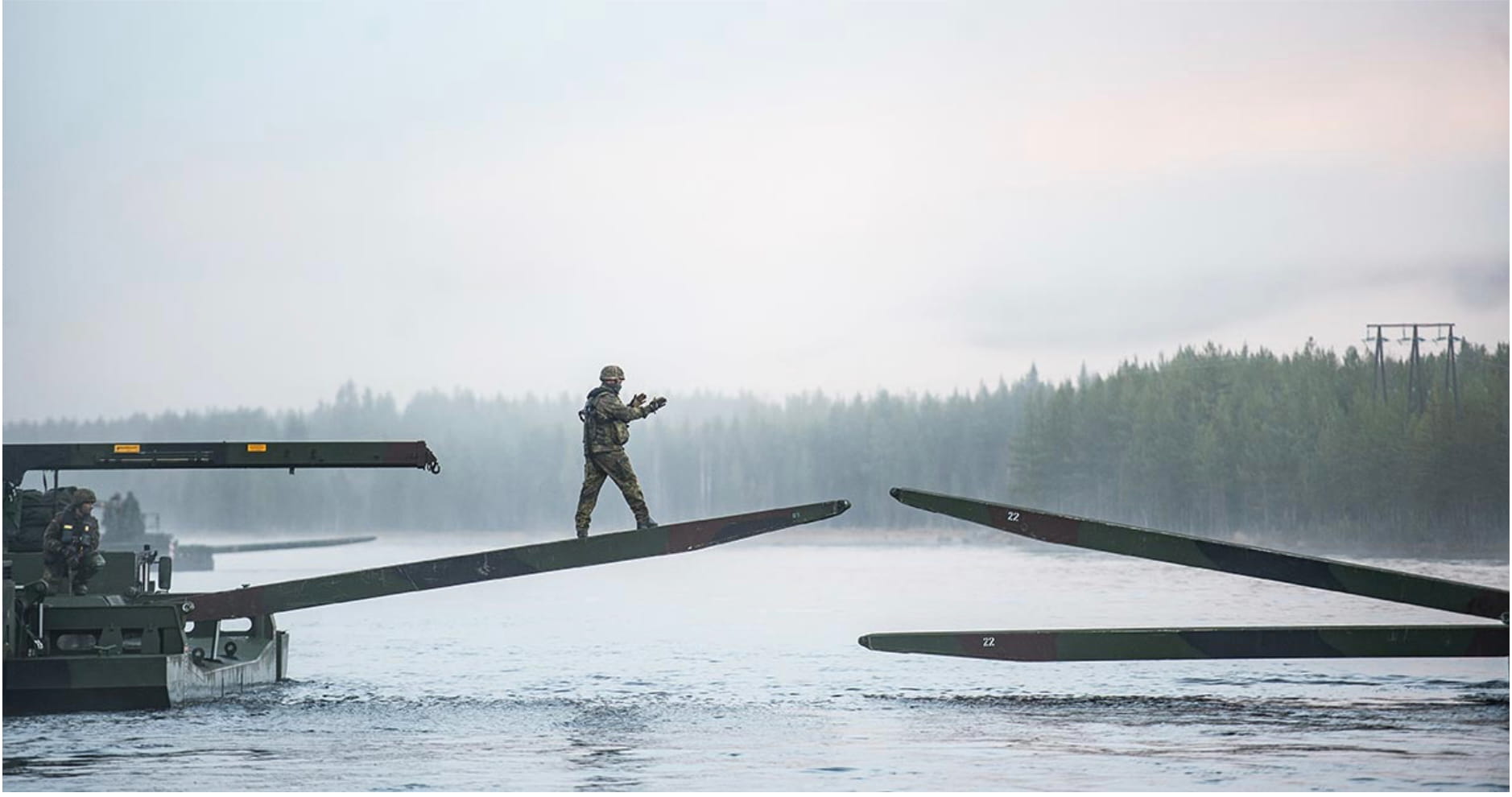
German soldier during a river crossing exercise on October 23, 2018, as part of Exercise Trident Juncture at Camp Rodsmoen, Rena, Norway. Photo: Marc-André Gaudreault
The transatlantic relationship has long suffered from a curious paradox: the European Union (EU) and NATO share 23 member states,1) broadly overlapping security interests and values, yet institutional barriers, legacy frameworks, and diverging national interests have prevented the two organizations from functioning as a fully integrated Euro-Atlantic defense architecture. Few regions make this gap more consequential than the Arctic.2) As climate change opens new shipping lanes,3) unlocks contested resources,4) and accelerates great-power competition in the High North,5) the absence of coherent EU–NATO coordination would risk leaving one of the alliance’s most vulnerable regions without a coherent security framework, and without the kind of Nordic minilateralism that could provide one.
This gap is not accidental. NATO was created as an intergovernmental alliance centered on collective defense and military deterrence, while the EU evolved into a far broader political and economic union incorporating significant supranational elements. Although their purposes have increasingly converged around shared goals of peace, security, and stability, their fundamentally different institutional logics continue to complicate cooperation. The accession of Finland and Sweden to NATO in 2023–24 has indeed redrawn the map of Northern Europe, but it has not, on its own, resolved the deeper institutional frictions between the EU and NATO, nor has it produced, on its own, a coherent framework for Arctic security governance. In fact, the true transformation lies elsewhere: in a quiet but decisive shift toward a network-based, Nordic-led form of ‘minilateral cooperation’ that is rewriting the script for EU–NATO interaction.6)
We argue that Nordic-led minilateralism, expressed through frameworks such as the Nordic Defense Cooperation (NORDEFCO) or the Joint Expeditionary Force (JEF),7) offers a bottom-up path toward strengthened EU–NATO synergy. Minilateralism refers to a form of security cooperation bringing together between two and a dozen like-minded states pursuing shared objectives through flexible and often informal frameworks, aimed at achieving concrete results more efficiently than through large multilateral organizations. These networks operate on trust, shared geography, operational practice and institutional “osmosis” rather than formal merger.8) The Arctic region in particular serves as a laboratory for how this can work: the interplay of EU, NATO and national Nordic initiatives demonstrates how flexible webs of cooperation might deliver closer alignment of European and transatlantic defense. In effect, by focusing on the region where geography, shared ecosystems and common threat perceptions coincide, the Nordic minilateral model could provide a template9) for bridging the EU–NATO divide.10)
The Persistent EU–NATO Trap
For more than two decades, the EU and NATO have pursued “mutual reinforcement” in principle while struggling to achieve it in practice. Both share 23 members and overlapping mandates, yet institutional rivalries and national vetoes have prevented effective cooperation.
Efforts such as the 2003 Berlin Plus arrangements or the 2016,11) 2018,12) and 202313) joint declarations created limited, mostly symbolic progress.14) The enduring Cyprus–Turkey dispute blocks even basic intelligence sharing, and bureaucratic duplication persists in crisis management and capability development.15)
For all their differences, the EU and NATO are two halves of Europe’s security architecture.16) Their cooperation is not an optional improvement but a structural necessity. The EU brings the regulatory, economic, and industrial instruments that modern defense requires — from sanctions and energy security to critical-infrastructure protection and hybrid resilience.17) NATO, by contrast, provides deterrence credibility, operational command structures, and collective defense. In an era when threats transcend the line between civilian and military — cyberattacks, disinformation, and infrastructure sabotage — neither institution can act effectively in isolation.
Beyond function, cooperation carries political weight. The EU anchors democratic legitimacy and economic leverage, while NATO provides strategic cohesion and hard-power reassurance. A coherent interface between them amplifies both deterrence and solidarity. Finally, the EU–NATO relationship embodies the broader question of whether the transatlantic community can adapt its governance to 21st-century complexity. When 23 countries share membership in both institutions, but coordination remains partial, the credibility of Western unity itself is at stake.18)
EU–NATO Relations in the Arctic: A Historical Overview
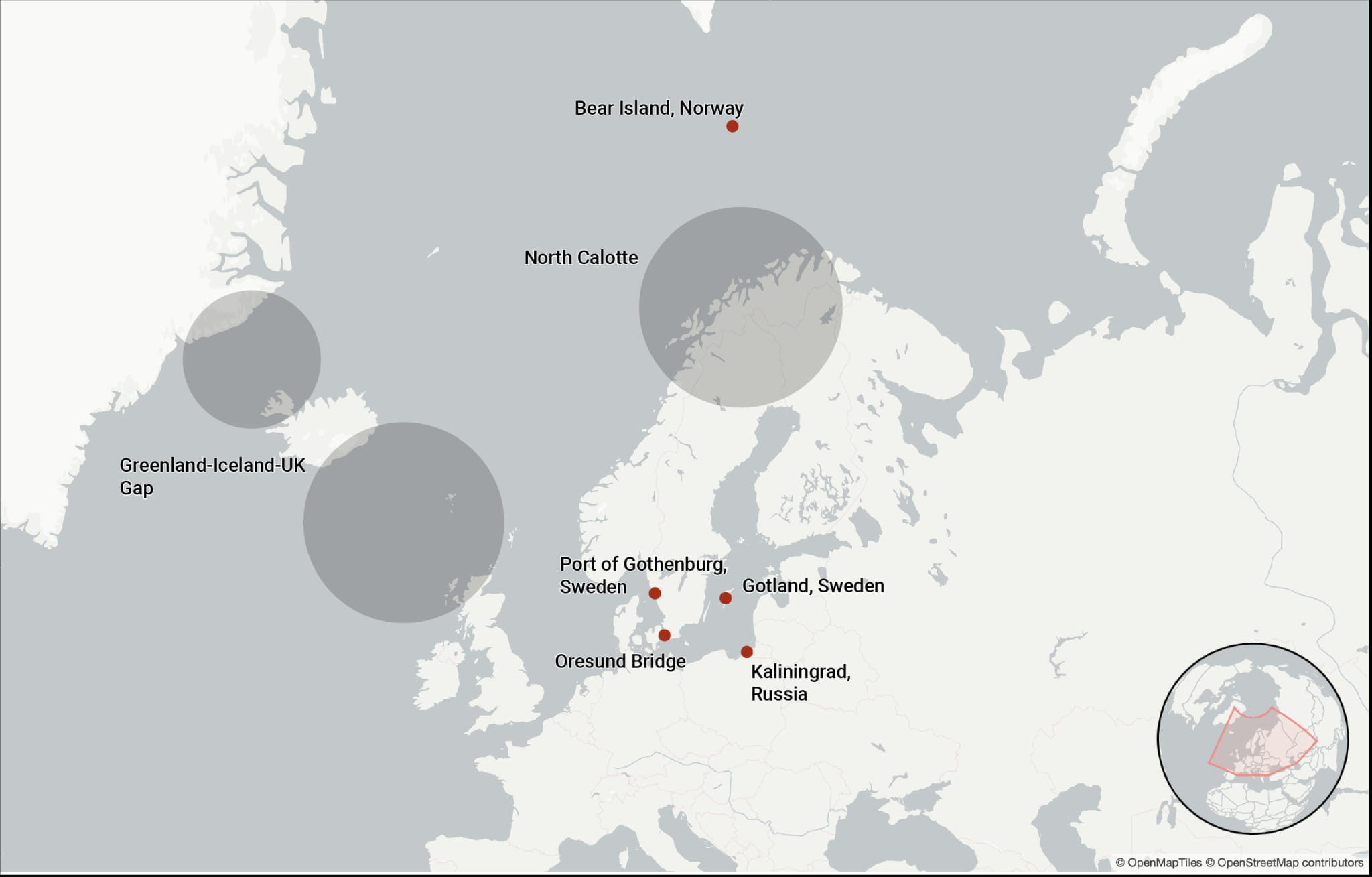
The Arctic has been part of the NATO story since the Alliance’s inception in 1949. During the Cold War the Greenland-Iceland-UK (GIUK) gap, Soviet Northern Fleet basing and submarine transit under the ice required continuous surveillance, early warning and naval presence by NATO member-states. Meanwhile, the European Economic Community and later the EU had no formal defense role in the region; their focus was largely environmental, cross-border and resource-development oriented.19)
With the end of the Cold War, the Arctic was often described as a “low-tension” region where cooperation — exemplified by the formation of the Arctic Council in 1996 — appeared feasible. But beneath the surface, strategic competition never disappeared.
The Russian annexation of Crimea in 2014 and its subsequent militarization of the Arctic revived attention in both NATO and EU policy circles.20) On the European side, the EU adopted its first formal Arctic policy in 2008 and then updated it in 2012, 2016 and in 2021 under the Joint Communication “A Stronger EU Engagement for a Peaceful, Sustainable and Prosperous Arctic.”21) This marked a shift: for the first time EU policy explicitly acknowledged military-security issues rather than focusing solely on the environment or economy.
On the NATO side, a 2024 Defense Department Arctic Strategy underlined that the United States “must stand ready” in the High North in light of Russia’s war in Ukraine, China-Russia cooperation and climate-driven access to resources and routes.22) Russia’s expanding military footprint across the Kola Peninsula and its northern coastline, combined with China’s ambitions to develop a “Polar Silk Road,” have indeed redefined the region’s geostrategic meaning.23) Despite these developments, the institutional frame remained incomplete: there is still no dedicated EU–NATO Arctic working group or formal joint command for the High North that fully integrates both institutions, even as the European Parliament has highlighted the need for more structured EU–NATO coordination in the Arctic.24) Thus, a gap exists: shared interests but no seamless institutional bridge. This vacuum is precisely what Nordic minilateral networks have begun to fill.
As security concerns multiply in the Arctic, the inability of the EU and NATO to act jointly has become increasingly evident. Even in domains where interests clearly converge, such as hybrid threats or Arctic infrastructure resilience, there is still no formal cooperation. Complementarity, in short, has not produced integration or cooperation, even when geography and interests align.
Why does this gap matter? The Arctic is more than a remote theatre. Long characterised by low political tension and cooperative governance,25) the region is increasingly exposed to the spillover of geopolitical conflicts originating elsewhere—most notably the collapse of NATO–Russia relations following the war in Ukraine and the extension of broader great-power competition into the High North.26) These dynamics are now eroding the cooperative assumptions on which Arctic governance was built.27) As The Arctic Institute has observed, “the future battlefield is melting.”28) For the European Union, this matters not because the Arctic constitutes a distinct crisis theatre, but because it sits at the intersection of northern member states’ security, transatlantic deterrence, and the EU’s broader maritime and resilience agendas. In this context, how the EU and NATO engage—or fail to engage—in the Arctic becomes a litmus test of their ability to adapt institutional coordination to the spillover of external conflicts into regions previously structured around stability rather than crisis management.
In short, the Arctic has emerged as an arena where EU and NATO interests increasingly converge, while institutional alignment continues to lag. This tension forms the backdrop to the Nordic contribution—but not because the Nordic states act as a unified bloc.29) As the Finnish and Swedish cases illustrate, national trajectories and institutional preferences remain distinct: Finland’s security posture has long been shaped by direct exposure to Russia and a strong reliance on NATO deterrence, while Sweden historically privileged strategic autonomy and a more cautious engagement with alliance structures.30) Rather than producing uniform positions, these differences have encouraged pragmatic coordination through informal and minilateral frameworks, allowing states to work around institutional rigidities and reconcile divergent EU–NATO preferences.
The Nordic Turn: From Neutrality to Strategic Catalysts
Until recently, Nordic security was characterized by institutional asymmetry. Denmark was in NATO but opted out of the EU’s Common Security and Defense Policy (CSDP). Norway and Iceland are NATO members outside the EU. Finland and Sweden belonged to the EU but remained militarily non-aligned. This patchwork limited regional coherence and forced each government to balance differently between Brussels and Brussels-adjacent institutions.
Russia’s full-scale invasion of Ukraine altered that equation. Both Finland and Sweden reassessed the costs of non-alignment. For Helsinki, NATO membership offered a force multiplier — the ability to combine territorial defense with collective deterrence.31) For Stockholm, neutrality had become a liability once Finland applied.
With Finland joining NATO in April 2023 and Sweden following in March 2024, the Nordic area reached complete institutional alignment. Every state in the region is now tied, in some form, to both the EU and NATO. Denmark has since abandoned its CSDP opt-out,32) while Norway and Iceland maintain structured partnerships with the EU. This new symmetry has removed the final structural obstacle to Nordic defense coherence.33)
The Nordic Turn: Minilateralism as a Bridge
The Nordic Defense Cooperation (NORDEFCO), established in 2009,34) has evolved from a modest coordination platform into the principal engine of Nordic defense integration.35) It now brings together all five Nordic countries — some in both the EU and NATO, others in one or the other — and translates their shared political will into concrete military cooperation.
NORDEFCO facilitates regular joint exercises such as Arctic Challenge and Nordic Response,36) supports cross-border air operations, coordinates logistics, and develops common procurement projects. It has also integrated cyber-defense and hybrid-threat components, including cooperation with the European Centre of Excellence for Countering Hybrid Threats in Helsinki.37)
Crucially, NORDEFCO operates outside the bureaucratic frameworks that often slow decision-making in Brussels. Its informality allows for rapid adaptation and experimentation. By linking national, EU, and NATO priorities, NORDEFCO has become a functional bridge between the two organizations.
Beyond NORDEFCO, the Joint Expeditionary Force (JEF) — led by the United Kingdom and including all Nordic and Baltic states — provides a rapid-reaction capability fully interoperable38) with NATO but outside its bureaucracy.39) For Finland and Sweden, participating in the JEF even before NATO membership-built habits of coordination and operational trust.40)
In parallel, Arctic cooperation mechanisms such as the Arctic Security Forces Roundtable41) and Arctic Coast Guard Forum exemplify the same flexible pragmatism.42) Together, these minilateral networks have produced a dense web of collaboration that links the operational, industrial, and political levels of regional security.43)
Examples abound:
- Joint air operations and exercises like Arctic Challenge and Nordic Response 2024, now conducted under harmonized EU–NATO standards.
- Shared defense procurement aligning with both NATO capability targets and EU industrial funding tools, e.g., PESCO44) and the EDF45)
- Cyber and hybrid threat coordination, where Sweden and Finland have explicitly sought to link NORDEFCO discussions with NATO’s Hybrid Centre of Excellence in Helsinki and the EU’s cyberdefense policies.
This practical integration bypasses the formal EU–NATO blockage while delivering precisely the kind of “functional cooperation” both institutions profess to seek.
The Nordics’ influence rests not on size but on credibility. With overlapping memberships and deep mutual trust,46) they are uniquely placed to mediate between the EU and NATO. Finnish and Swedish defense ministries explicitly describe Nordic cooperation as a “complement to European and Euro-Atlantic cooperation.”47)
Nordic officials now meet almost daily in various constellations to coordinate positions. This constant contact generates what might be called institutional osmosis: ideas, standards, and procedures circulate informally across organizations before being formalized in Brussels. The result is a steady convergence of EU and NATO practices in areas such as hybrid resilience, capability development, and situational awareness.48)
Rather than waiting for an elusive EU–NATO grand bargain, the Nordic states create cooperation through performance. Each successful exercise, procurement, or policy alignment within these regional frameworks demonstrates that the two organizations can operate in tandem when trust and interoperability exist on the ground.
In this environment, Nordic cooperation has matured into a form of functional integration that operates below the threshold of formal treaty law. Rather than creating new institutions, Nordic states rely on dense patterns of interoperability, habitual coordination, and trust built through repeated operational interaction. Within frameworks such as NORDEFCO the Arctic Security Forces Roundtable, and the Arctic Coast Guard Forum, national authorities quietly align procedures, share situational awareness, and coordinate responses across institutional boundaries. This practice-based cooperation enables collective action on hybrid threats, maritime surveillance, and infrastructure protection in ways that formal EU–NATO mechanisms have struggled to deliver. What emerges is not institutional merger, but operational osmosis: a continuous circulation of practices and capabilities between EU and NATO ecosystems, mediated through Nordic networks and sustained by performance rather than hierarchy.
The influence of this northern experimentation now indeed reaches well beyond the Arctic. The operational coherence achieved along NATO’s northern flank increasingly shapes both EU and NATO strategic planning. The European Commission’s Defense Investment Gaps communication (2023) explicitly advocates “regional clusters of cooperation” to accelerate capability development,49) while NATO’s Regional Plans (2024) integrate the Nordic–Baltic theatre as a single functional space.50) The logic underpinning both documents mirrors the Nordic experience: cooperation should emerge where geography, trust, and capability intersect, rather than where institutions prescribe it. The High North has thus become not merely a regional focus, but a strategic template for the kind of pragmatic, layered defense architecture Europe requires.
Minilateralism’s strength — its flexibility — also exposes its limits. Without careful alignment, a proliferation of small-group initiatives could fragment strategic coherence or compete with established multilateral frameworks. Nordic cooperation depends on a high degree of political convergence and mutual confidence that cannot be taken for granted indefinitely. Future divergences — over defense spending, industrial priorities, or Arctic resource governance — could test the durability of this model.
Nevertheless, the alternative remains less convincing. Waiting for institutional reform to resolve entrenched EU–NATO blockages risks strategic inertia. By contrast, Nordic minilateralism demonstrates that adaptability can be a source of integration: that networks built on trust, proximity, and practice can quietly realign Europe’s security architecture from below. The task ahead is to preserve this agility while anchoring it in transparent governance and broader European solidarity. The Arctic, once viewed as a remote periphery, now stands as the most dynamic testing ground for what 21st-century transatlantic cooperation can become.
Conclusion: The Nordic Bridge That Works
Finland and Sweden’s NATO membership did not magically fix EU–NATO dysfunction — but it created the conditions for others to do so. By aligning institutional memberships and deepening functional cooperation, the Nordics have transformed Northern Europe into a living demonstration of how integration can advance from below.
The real legacy of this enlargement lies not in the new seats around NATO’s table, but in the dense web of minilateral cooperation that now connects Brussels and Brussels-adjacent actors through Nordic pragmatism.
At a time when global polarization strains Western cohesion, the Nordic experience offers a subtler lesson: coherence need not descend from grand reform, but can rise instead from networks of states choosing to act together. In the High North, that choice has already been made — and it is quietly redefining the future of Euro-Atlantic cooperation.
Jacob Begley is a Master’s student at Sciences Po Lille (France) and incoming student at Johns Hopkins University SAIS-Europe, Bologna (Italy).
References