Navigating Korea’s Arctic Sea Route Policy: Origins, Status, and Outlook
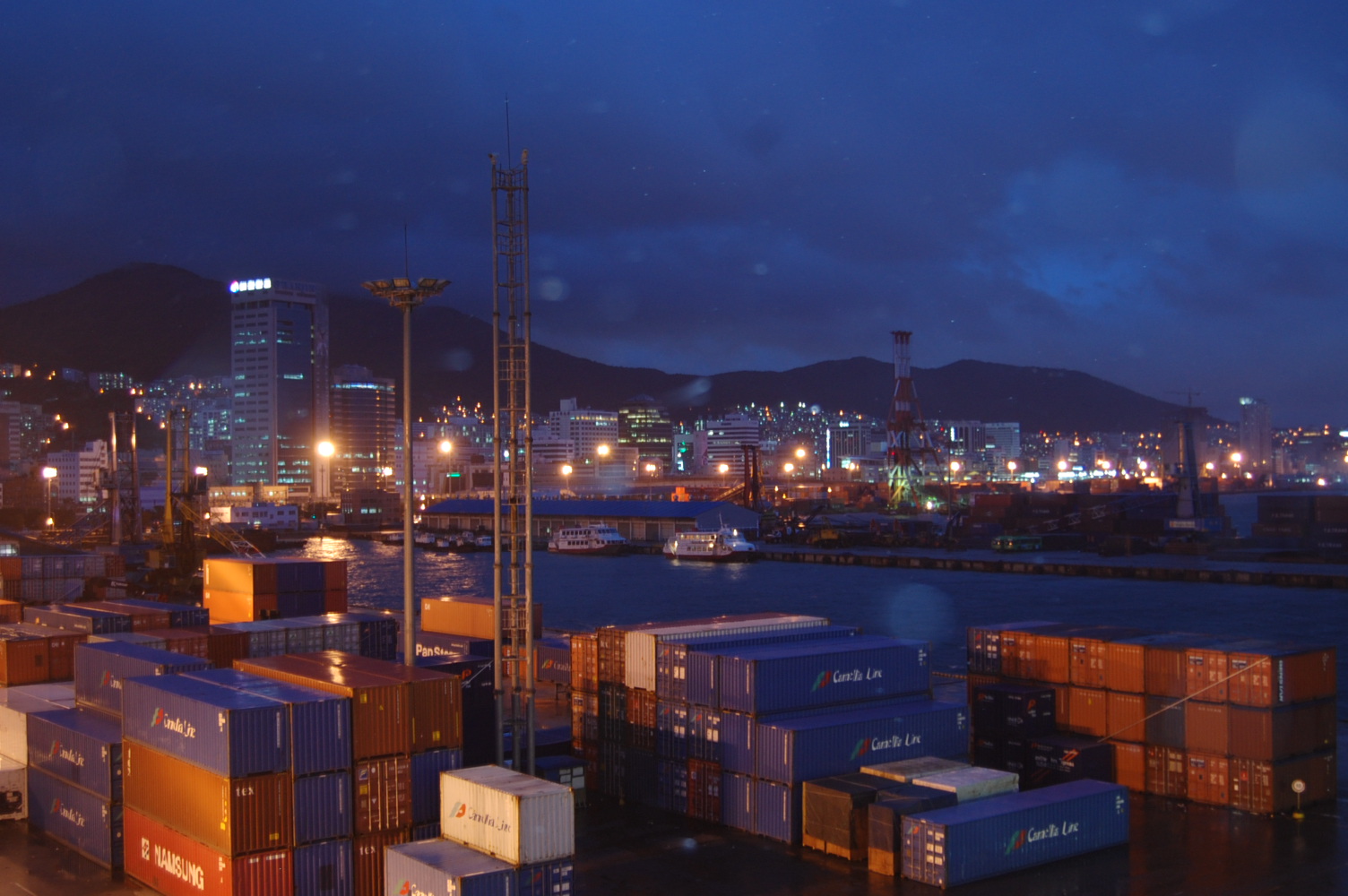
Container terminal at the Port of Busan, South Korea, the designated gateway for Korea’s Arctic Sea Route ambitions. Photo: Martin Pueschel
The Arctic Institute Korea Series 2026
- The Arctic Institute’s 2026 Korea Series: An Introduction
- Navigating Korea’s Arctic Sea Route Policy: Origins, Status, and Outlook
In January 2026, the Korean government announced its intention to conduct a trial container voyage from Busan to Europe through the Northern Sea Route.1) The voyage materialized broadly on schedule: on 22 August 2026, the Panstar Acro, a 2,758-TEU container ship acquired from HMM and refitted for polar navigation, departed Busan for Felixstowe, Rotterdam, and Gdansk2) and completed its 50-day round trip without any incident when it docked at Busan five days behind its original schedule on 11 October. This was the first Korean container ship to complete a round trip to Europe through the Arctic and the first Korean transit of the route of any kind since 2016.3) Notwithstanding the media frenzy, relatively little has been said about the rationale behind the program, how it is to be carried forward from here, or what Korea ultimately envisions for its role in Arctic shipping. This article seeks to address that gap, while acknowledging from the outset that it offers only a partial account. It is written from the perspective of someone within Korea’s Arctic community who has followed the evolution of this agenda from outside the immediate circle of decision-making. The analysis that follows is therefore not an official interpretation, but an attempt to provide a clearer understanding of developments that have so far received limited public explanation.
Origins: an old interest, newly willed
The first point to clarify is that Korea’s interest in Arctic sea routes is not new. What is new is the political will behind it which, in turn, necessitates explaining where that will come from.
Historically, Korea’s engagement with the Arctic has been shaped through an oceanic perspective, and that origin continues to influence its approach today. The Arctic agenda has long been anchored within the country’s maritime policy institutions, with government-funded Arctic Ocean research, spearheaded by the Ministry of Oceans and Fisheries (MOF), beginning around the year 2000.4) Unsurprisingly, the policy framework that developed from this foundation was largely maritime in character. It evolved through a series of government-wide initiatives drafted by MOF, including the 2012 plan for advancing polar policy,5) the Arctic policy implementation plan and establishment of a dedicated Polar Policy Team in July 2013; the same year Korea gained observer status in the Arctic Council6) and released its first Arctic Policy Master Plan.
The Master Plan outlined thirty-one priorities spanning international cooperation, scientific research, Arctic-related business development, and institutional reform for the 2013–2017 period. Notably, its economic pillar identified the use of Arctic shipping routes as a strategic objective, including measures such as reducing port fees, introducing cargo-volume incentives to attract vessels, and upgrading domestic port infrastructure in anticipation of increased transit traffic.7)
What followed is instructive. Between 2013 and 2016, by MOF’s count, there were roughly five trial runs including Hyundai Glovis’ naphtha voyage in 2013, CJ Logistics in 2015, and Pan Ocean and SLK Kukbo in 2016.8) From 2017 onwards, however, no further test voyages were announced. The voyages achieved their technical objectives yet none led to follow-on services. The economics could not be sustained by individual carriers and shippers acting alone, and commercial use of the route was, and largely remains, premature. Subsequent documents kept the ambition alive on paper, including a second Master Plan in 2018 and the First Master Plan for the Promotion of Polar Activities in 2022,9) but Korea’s engagement with the route remained relatively dormant.
The central question, therefore, is not why Korea has maintained an interest in Arctic shipping, but why this interest has resurfaced so forcefully after a decade of limited momentum. From my perspective, the distinction between 2015 and 2025 lies less in economic fundamentals or changes in Arctic conditions than in the emergence of political willingness to act.
The clearest example of this shift came from a discussion I encountered in a conference room in Busan. In February 2025, I was invited to participate as a member of a Busan Metropolitan City task force on Arctic Sea Routes.10) During the discussions, one word recurred among fellow participants, many of them local academics: Hemingway. Their point was that Busan now has only the old man and the sea: a working-age population draining out of the city, leaving it aged, and a local economy under mounting strain. What emerged was a strong and bipartisan local demand for economic renewal. The Arctic route was increasingly viewed not simply as a shipping opportunity, but as a strategic narrative capable of attracting national attention and central-government investment to Busan and the wider southeastern region of Korea.
The timing also warrants analytic attention. This was the interregnum that followed the illegal martial-law attempt of December 2024 and the presidential impeachment that ensued. A snap presidential election was held in June 2025, and two phrases, both centered on Busan, performed unusually well on the campaign trail in the southeast: utilizing the Arctic Sea Route, and relocating the Ministry of Oceans and Fisheries to Busan. Both suggested something the region had long felt deprived of; namely sustained political attention from the center and, with it, the prospect of reversing the outflow of young residents by stimulating maritime-industry investment and creating permanent local jobs. The candidate who won, now President Lee Jae Myung, performed far more strongly in Busan than his party had in the previous election with the margin behind the leading candidate in this conservative-leaning city narrowed from 20.10 percentage points in 2022 to 11.25 in 2025; an improvement of 8.85 percentage points.11) The lawmaker who had led Lee’s Busan campaign was subsequently appointed the administration’s first Minister of Oceans and Fisheries; an appointment that in effect helped sustain the Ministry’s momentum on Arctic Sea Route policy including the establishment of an Arctic Sea Route Task Force within MOF in June 2025.12)
The result is something genuinely new. “Building a K-maritime power that leads the Arctic Sea Route era” was written into the administration’s national agenda as task fifty-six, confirmed by the Cabinet in September 2025.13) To many Arctic specialists in Korea, this marks the first time an Arctic keyword has appeared among a sitting Korean government’s priority commitments. Alongside it came the order to move MOF’s headquarters to Busan and the creation, within the Ministry, of a dedicated body, the Office of Arctic Sea Route Strategy and Development, to advance the agenda which is the first standing organization Korea has ever established specifically to prepare for Arctic shipping.14)
Status: inward-looking, and still being written
Viewed from outside, Korea’s Arctic turn could be interpreted through a rational-actor framework whereby foreign policy is understood as the coherent and pre-coordinated output of a unitary state. Yet such a reading would be misleading. In practice, the Arctic agenda is not the product of a single, internally consolidated government position. Rather, it reflects a more fragmented process, shaped by multiple actors, institutional logics, and competing priorities that do not always align neatly across the policy apparatus. A new Arctic Sea Route agenda has been introduced as a national priority, and Korea’s various domestic actors, including the MOF and other relevant ministries, local governments, industry, and research institutions, are still adapting to it. The pace and the finer direction of the policy are still being worked out based on both a long-term perspective and a conscious regard for the Arctic’s rights-holders and decision-makers. A reassuring corollary for Korea’s Arctic partners is that this dynamic generates a pace of engagement that is unlikely to cause concern or disruption among existing stakeholders.
Two observations help explain this inward orientation and measured pace. The first is the agenda’s domestic origin. Because it grew out of local political demand rather than foreign-policy calculation, its near-term goals are largely inward-facing. The work program centers on capacity-building at home including training facilities for ice-navigation officers, science and technology R&D to improve navigational safety and to better gauge the more nuanced and long term implications of climate change for Arctic shipping, green bunkering and refuelling infrastructure, in-place, in-time ship-repair capacity, the parts-and-equipment supply base, more efficient port logistics, shipping finance, vessel registry, and insurance, and a government subsidy program to support shippers’ use of icebreaking vessels, to name a few. This constitutes a five-to-ten-year program aimed at building the preconditions for participation, not a near-term bid to push tonnage through the ice. The Arctic Sea Route special act, passed by the National Assembly plenary in early May 2026 and promulgated on 16 June, with entry into force set for 17 December 2026, supplies much of the legal foundation. Its enforcement decree, on which public consultation closed in September 2026 ahead of the act’s entry into force in December, fleshes out the machinery consisting of a cross-government Arctic Sea Route Committee chaired by the Prime Minister, a working-level committee, the designation of a comprehensive support center, and the scope of related industries.15) Annual trial voyages, moreover, are intended as a recurring fixture of the program best evident in the fact that the Minister of Oceans and Fisheries told the National Assembly that a 2027 trial would follow just a few days after the Panstar Acro’s return. Meanwhile, the MOF is expected to evaluate the prospect of expanding both the types of vessels and the number of voyages, while the official timeline for a regular commercial service remains set around 2030.16)
Relatedly, local politics at the regional level is also a factor that has received far less attention than it ought to have. Several port-hosting provinces and cities beside Busan, including South and North Gyeongsang and Pohang, Ulsan, Gangwon, and the Yeosu-Gwangyang area, have increasingly sought to position themselves as future hub ports. This competition is driven not only by regional ambition, but also by a desire to secure tangible outcomes and demonstrate early gains in the evolving Arctic shipping agenda.17) For these localities, the main interest lies in deepening their standings within the special act and the related central-government policy documents, so that a meaningful role is allocated to their respective regions, and with it more of the quality jobs and infrastructure the agenda promises. The local elections held in June 2026 only amplified these manoeuvres. The notable participation of selected local governments in international Arctic forums, such as the Arctic Circle Assembly and Arctic Frontiers, beginning in the second half of 2025, can be interpreted as part of this broader pattern. Their presence at these venues reflects not only growing engagement with Arctic governance discussions, but also an effort to signal ambition and secure visibility within an emerging policy and economic space.18)
The second observation is the moderate pace at which Korea’s new Arctic strategy is actually advancing which is itself a byproduct of how the Korean bureaucracy works. Put briefly, a lead ministry tends to consolidate its own position internally before cooperation with other ministries can begin, so the work at this stage is still largely internal to MOF. Such sequencing matters here because the route cannot advance further than the Arctic region’s own understanding and consent will allow, and Korea engages that constituency through the Ministry of Foreign Affairs, which represents the country at the Arctic Council and related bodies. Related industries, such as shipbuilding and resource development, together with trade ties to Arctic states, fall to the Ministry of Trade, Industry and Energy. The next stage therefore requires inter-ministerial coordination that has only begun to take shape. This helps explain why no Arctic Sea Route item appeared on any of Korea’s 2026 presidential meetings with its Arctic counterparts.
Most importantly, economic considerations, and the alleged commercial advantages commonly associated with Arctic routes, are not what is driving this agenda, at least not yet. This is so simply because the underlying economics of Arctic shipping have not fundamentally changed from a decade ago. On a per-voyage basis, recent analysis by the Korea Maritime Institute (KMI) suggests that the Northern Sea Route can be cheaper than both the Suez and Cape routes; approximately USD 3.0 million per voyage compared to USD 3.8 million via Suez and USD 4.2 million via the Cape for a 78,000-ton vessel sailing from Busan to Rotterdam in summer.19) However, when assessed on a per-container basis, the picture is less favorable. One frequently cited Korean academic study estimates that the route remains roughly seventeen percent more expensive per TEU than the Suez route for the vessel class examined,20) and a more recent estimate published in KMI’s journal in 2025 puts the gap wider still at around USD 1,128 per TEU for a 4,300-TEU ice-class vessel on the Northern Sea Route against USD 726 per TEU for a 20,000-TEU vessel via Suez, a premium of roughly 55 percent21) while more recent international research reaches broadly similar conclusions, finding that Northern Sea Route container services are only competitive with the Suez corridor during a narrow seasonal window each year.22) Major global shipping lines have also publicly ruled out regular use of the route, citing both environmental constraints and economic limitations.23) The Panstar Acro’s voyage illustrates both sides of this picture. The ship reached Rotterdam in about 22 days against 30 to 34 days via Suez, a saving of roughly ten days and some 7,000 kilometers, and it carried real export cargo. Yet the tender for the trial had attracted a single bidder, the mid-sized operator Panstar, with HMM and Pan Ocean declining to apply. In addition, the ship sailed out with 737 TEU, barely a quarter of its capacity, and Panstar reported that fuel savings were small once the switch to marine gas oil required in Arctic waters was priced in.24) Although the official government’s economic assessment of the voyage is yet to be released, it is reasonable to assume that Korean policymakers are aware of these constraints which is precisely why the prevailing official stance remains long-term in orientation and largely domestically oriented.
That combination, a long-term official horizon and still-unproven economics, raises a question the announcement did not answer. If Korea’s horizon is genuinely long-term, why was a trial voyage approved and announced at the start of the year, and why 2026 in particular? There is no official explanation but a clue lies in the relocation episode. The Ministry’s initial proposal to complete the Busan move only toward the end of the administration’s term drew sharp criticism from the State Affairs Planning Committee – the administration’s de facto presidential transition body25) – after which it returned with a compressed timetable, and the relocation was in fact completed at the end of 2025 just before the 2026 work year began.26) The same desire for early, visible deliverables plausibly shapes the timing of the test voyage and, with the ship home and a presidential welcome ceremony held on 13 October, that coveted deliverable has now been secured.
What Korea hopes for: two concentric circles
What does Korea actually expect to gain? Having begun with a largely local and/or domestic political motivation, the agenda, having been passed through the machinery of central policymaking, has now acquired a fuller account of what an Arctic Sea Route national task could set in motion. As a result, official documents now speak the language of national capability. Task fifty-six, for instance, outlines building a maritime power, elevating Busan into a top-tier global hub port, expanding national seaborne transport capacity, and constructing next-generation icebreaking and autonomous vessels.27) The capability language is not merely rhetorical; the structural exposure behind it is real. Korea is among the most export-dependent industrialized economies, with exports equivalent to roughly 44 percent of GDP in 2024, and an estimated 99.7 percent of its trade volume moving by sea.28) For a country so overwhelmingly exposed to maritime chokepoints it is only natural to have a standing interest in route diversification. And the disruptions of recent years, including Houthi attacks in the Red Sea and recurrent tension around the Strait of Hormuz, have only sharpened that interest; that is, these events have reinforced the case for Arctic engagement in Korea without being its cause.
The expected benefits fall into two concentric circles, an inner and an outer. The inner circle, the one with the most immediate payoff, is the balanced revitalization of Korea’s maritime industries, with shipbuilding the clearest example. Arctic maritime activity, civil and defense alike, is generating demand for vessels that very few countries can build, and Korea is one of them. With allied programs pointing to demand for dozens of new icebreakers over the coming decade, this is the circle in which Korea’s contribution is least speculative.29) Within that same inner circle lies the broader impulse the agenda provides Korea’s maritime, port, and logistics industries with and therefore contributes to further national development. These plans are still at the announcement stage, yet the response in terms of local jobs and the retention of a young population has already been encouraging. As MOF’s first-year work report noted, among other indicators, applications to the maritime universities and high schools in Busan have risen significantly, reaching their highest level in over a decade.30) The relocation of shipping-company headquarters to Busan, with HMM opening its Busan head office in October 2026, points in the same direction.31) For a city that had come to see itself through the lens of decline, this is not a trivial signal.
The outer circle faces the Arctic itself. The first part of it, and the one that matters most from an Arctic vantage point, is business that is directly useful to the region. Korea’s cooperation with the Arctic has, for much of its history, been earnest but somewhat abstract, centered on research and education that were valuable yet not always tangible to Arctic communities. The aspiration now is to identify and join long-term opportunities which could contribute to improved living standards in the Arctic while simultaneously widening the contact surface between Korean industries and the region, thereby deepening their understanding of the Arctic, its local communities, and their needs. At the far edge of this outer circle is the normative payoff. Shipping is a network industry, and a route’s value depends on the standards and practices shared across it. To this end, Korea’s hope is to accumulate and ultimately share a body of exemplary practices in safe and environmentally sound maritime operations in the Arctic, and ultimately earn recognition as a legitimate and responsible actor in the Arctic’s maritime domain.
Outlook: a test bed for a constructive partner
It is often, and not wrongly, suggested that the Arctic is drifting toward a more bipolar structure, shaped by the same geopolitical cleavages visible in other regions.32) Yet there is also a quieter line of argument that complicates this picture. Some analysts of Asian engagement in the Arctic contend that, rather than narrowing, the space for non-Arctic middle powers such as Korea may actually be opening up as established powers increasingly turn their attention inward or toward one another.33) Whether Korea is able to translate that structural opening into sustained strategic advantage remains an open question.
The trust that Korea’s wider Arctic agenda depends on is also where the route agenda carries its clearest external risk. The first trial voyage was not friction-free; its dependence on Russian permits and cooperation drew reported concern from some Western diplomats.34) The government has been attentive to this to least because expanding traffic through Russian waters could cost Korea the trust of the very partners its wider Arctic agenda depends on for as long as the war in Ukraine continues. How Korea manages this tension, transparently and within the sanctions framework, is itself part of the test this article describes.
The discipline the moment calls for is patience and building trust. As one Arctic institutional leader has observed, “in the Arctic, business moves at the speed of trust, and trust is built through dialogue, inclusion, and respect”.35) This is a fine point that Korean leadership appears to be conscious of. Receiving the ship in Busan, President Lee cautioned against premature optimism and spoke of preparing for the Arctic Sea Route era “from a long-term perspective”36) As such, it is reasonable to suggest that Seul’s revitalised interest in Arctic shipping is better understood not primarily as a shipping project per se but as a strategic test. Pursued with the long view, transparently, and at a pace its Arctic partners can accept, the Arctic Sea Route push is a credible proving ground for the kind of country Korea has long claimed to be in the region: a constructive, long-horizon partner guided by what I have elsewhere described as the two Rs: respect and responsibility. That identity is not merely rhetorical. As a party to the Central Arctic Ocean Fisheries Agreement and a vice-chair of its Conference of the Parties, Korea has committed itself to protecting the Arctic Ocean’s marine ecosystem and respecting Arctic Indigenous peoples as rights-holders and knowledge-holders; a posture that should anchor its conduct as a route user no less than its conduct as a scientific partner. Ultimately, The October voyage is the smaller story. The larger one is whether Korea can convert a burst of domestic political energy into the patient, credible Arctic role it says it seeks.
Jihoon Jeong is a Senior Administrative Associate of the Office of Global Cooperation at the Korea Polar Research Institute (KOPRI), where he also serves as Secretary General of the Korea Arctic Research Consortium (KoARC).
The author is grateful to Ambassador David Balton and Dr. Henry P. Huntington for their generous and constructive comments on an earlier draft. The views expressed are the author’s own and do not necessarily reflect those of the Korea Polar Research Institute or the Korea Arctic Research Consortium, and any remaining errors are the author’s responsibility.
References