Legal and Literal Attachment: How a Court Battle Ruling fits into the Russian State Attitude to Svalbard
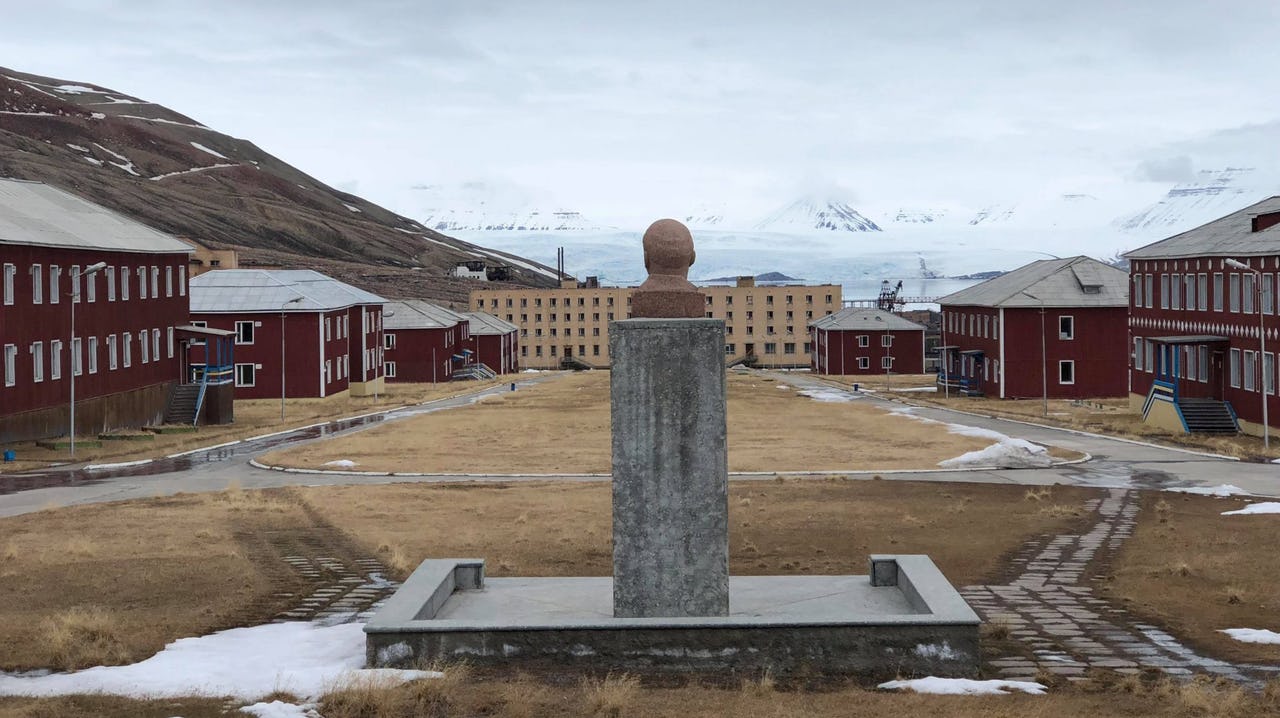
The world’s northernmost Lenin statue looks over the abandoned Russian city of Pyramiden on Svalbard, summer 2018. Photo: Alina Bykova
On the 10th of May 2026, Nord-Troms and Senja District Court in Tromsø gave their verdict on the most recent developments in a drawn-out legal case. For over twenty years, the former shareholders of Yukos Oil Company have been seeking compensation from the Russian Federation. The former CEO Mikhail Khodorkovsky, who led the initial court case, claims that Yukos Oil Company was forced into bankruptcy by Kremlin insiders who wanted “to suppress a domestic dissent and to capture and exploit the gains of the privatised energy sector in Russia.”1) In 2014, the Permanent Court of Arbitration awarded the shareholders $50 billion,2) as well roughly $60 million in legal fees, stating that the Russian Federation had breached Article 133) of the Energy Charter Treaty in a series of targeted attacks that amounted to expropriation. Russia refused to pay, leading to over a decade of legal battles in international courts.
In Tromsø, the shareholders sought to have four properties in the Arctic archipelago of Svalbard (Barentsburg, Pyramiden, Grumant, and Bohemanflya) attached as part of this compensation. Attachment is a legal procedure during which a court orders the seizure of a defendant’s assets. It prevents the defendant from transferring or selling property, therefore ensuring that it is available to satisfy a debt if necessary. In this sense, the assets are “attached” to the debt.
However, in May 2026, the court found in favour of Russia and ruled that, due to their cultural value, the properties could not be used to pay the debt and therefore could not be attached to it. While the overall verdict in 2014 was decisively against the Russian Federation, this recent result fits concerningly well into the mosaic of Russian nationalism around this archipelago.
Ownership of the Svalbard Properties
Firstly, the court established that the Russian Federation should be considered the legal owner of these four Arctic properties,4) in spite of the argument by Russia’s lawyers that the state was not involved.
On paper, Barentsburg, Pyramiden, Grumant, and Bohemanflya are owned by the company Trust Arktikugol, which was founded in 1931 to facilitate Soviet mining on the archipelago. To support the workers, Trust Arktikugol also built surrounding community facilities, such as schools, hotels, housing, and administrative buildings. This style of company town was not uncommon when the mining industry was flourishing on Svalbard. For example, Longyearbyen, now the largest settlement on the archipelago, was run by the Norwegian state-owned Store Norske Spitsbergen. However, what is uncommon is that Trust Arktikugol still dominates the economy. Barentsburg, the only permanently inhabited settlement of the four properties, remains a company town with virtually no independent private companies,5) despite the decline of mining across Svalbard. Longyearbyen, in contrast, has a diversified economy with a growing private sector across tourism and hospitality.
In 2024, the court in Tromsø ruled that, as Trust Arktikugol owns and runs the properties, and the Russian Federation owns Trust Arktikugol, Russia should be considered the owner.6) This distinction was central to the case. Because the Russian Federation was the debtor identified in the 2014 Permanent Court of Arbitration ruling, the court determined that the assets held by Trust Arktikugol could be treated as belonging to the debtor and were therefore, in principle, available for attachment. The ruling thus provided a legal confirmation of the extent to which the Russian state exercises control over its Svalbard settlements. In particular, the case demonstrates that the distinction between Trust Arktikugol as a nominal corporate owner and the Russian Federation as the ultimate owner does not necessarily reflect the reality of state control over Barentsburg.
Cultural Value to Russia
Although the four properties were confirmed to be owned by Russia as the debtor, the decision prevented their attachment because they were determined to be in use for sovereign, non-commercial purposes, thereby qualifying for protection under the customary rules reflected in the United Nations Convention on Jurisdictional Immunities of States and Their Property.7) The ruling found cultural importance to Russia in all four properties, most notably in Bohemanflya, which had previously been ruled as having no Russian cultural heritage. Article 21 of the State Immunity Convention prevents property “forming part of the cultural heritage of the State” from being put on sale. Furthermore, Section 3 of the Svalbard Environmental Act8) describes cultural heritage as “all traces of human activity in the physical environment, including sites associated with historic events”. In this reading, buildings across Barentsburg, Pyramiden, and Grumant are considered as cultural heritage because they are reminiscent of, and thus embody, the Soviet mining history in the region. In Bohemanflya, additionally, there are several Pomor cultural monuments, while Barentsburg is home to the Russian Consulate General, which is further protected by Article 21 of the State Immunity Convention.
This legal confirmation of Russian cultural heritage, in turn, appears to have, intentionally or otherwise, strengthened Moscow’s increasing emphasis on tourism and Russian cultural heritage on Svalbard. To this end, the tourism branch of Trust Arktikugol has recently set up several new tourist attractions, while rooms in Pyramiden’s buildings have been closed for renovation to provide an immersive tourist experience. Another example is the boat, Professor Molchanov, which now carries tourists, as well as scientists between Murmansk and the Arctic Archipelago.
An Insight from State-Aligned Media
Beyond the most eye-catching developments, the legal battle between shareholders of the former Yukos Oil Company and the Russian Federation has received minimal coverage in Russian media due to the underlying implications of Kremlin corruption. And on rare occasions where the ruling was covered, mainstream outlets tended to swiftly dismiss the validity of the 2014 ruling. Vedomosti, for example, shifted the blame by claiming that Russia lost because of a passive legal defense rather than any objective wrongdoing.9) This defensive narrative, moreover, has persisted over the decade as demonstrated by Moskovsky Komsomolets in 2020. The publication cited “expert commentary” asserting that the financial claims against the state were illegitimate, that domestic bankruptcy proceedings complied with federal law, and that the international verdicts served merely as mechanisms for Western geopolitical pressure on Russia.10)
Anti-Kremlin news sources, on the other hand, tell a different tale. Meduza, a Riga-based online newspaper, recalled Khodorkovsky’s claim that the 2014 ruling was “the most powerful blow to Putin’s regime in the legal field”;11) a narrative that mainstream media struggle to convincingly refute and instead opt to ignore.
It is therefore unsurprising that the Russian media has not widely reported on the events in Tromsø, lest readers are reminded of this entire affair. Komsomolskaya Pravda, another news outlet aligned with the Kremlin, is in fact the only mainstream news outlet to report this court ruling with a piece that shows a by-now common attitude of denying Russian wrongdoing both in the Yukos matter and in relations with Western Europe more widely.12)
The report, which centres around life in Barentsburg, describes the failed seizure of Trust Arktikugol’s assets as an attempt by “desperate” shareholders, led by Mikail Khodorkovsky. An asterisk next to Khodorkovsky’s name leads to a footnote reminding readers that he is considered a foreign agent and included in the list of extremists and terrorists.
The article discusses several other topics which elucidate the Russian state’s attitude towards its Svalbard properties. Notably, a report on the Yukos Oil Company is sandwiched between accounts of local cultural activities in Barentsburg: the May 9 Victory Day ‘Immortal Regiment’ march and a victory by a Russian husky farm in a Norwegian sled dog race.” The ruling for the Russian Federation seems to fit in with these messages of Russian nationalist sentiment; whether it is as trivial as a husky race rivalry or as serious as the commemoration of the Soviet Union’s actions against Nazi Germany.
Even more explicitly, elsewhere in the article there is the subtitle Norway has announced a “Silent War” on the Russian Federation. The text below explains that despite a Russian desire to keep the archipelago demilitarised, Norwegian military vessels have been calling in ports and a NATO delegation of several countries visited Svalbard. Additionally, it is claimed that the satellite base in Longyearbyen is used to monitor Russian armed forces in the Arctic. Several more accusations against Norway follow, including their misuse of the Svalbard Environmental Act to restrict Russian activity.
Yet the next headline, Russians Are Not Giving Up, tells readers of Russian perseverance against this European maltreatment. Indeed, Russia is continuing to develop its involvement on the archipelago. For example, a new research centre is being established in Barentsburg with a memorandum of cooperation between Trust Arktikugol, Murmansk Arctic University, and Qingdao University in China. Pyramiden will be developed as a research base for this.
The ruling against the attachment of these properties on the grounds of cultural heritage allows such developments to continue, while also fitting the propagandistic image of Russia as a persecuted state, whether by an individual such as Khodorkovsky or by the wider force of Western Europe. Such a sentiment concerning Svalbard is seen throughout government-orientated media sources. One article refers to NATO as pirates who “howl in terror” at Russia’s show of strength in the Arctic.13) Another discusses the ‘unjust’ closing of the Russian radio station on Svalbard, which aimed, together with the Russian Geographical Society, to document the long history of Russian presence there.14) Norwegian media regulators, however, found the said station to be a tool of Russian propaganda.
Translation into Military Action?
Despite Komsomolskaya Pravda’s claims that Russia wants Svalbard to be a completely demilitarised zone, there have been instances of Russian military presence on the archipelago.
Brian Moscioni, for instance, argues that Svalbard could be considered a “testing ground” for authoritarian countries such as Russia or China.15) After violating international law with the invasion of Ukraine, it is not beyond the realms of possibility that Russia would test the waters in the Arctic too. Indeed, Russia seems to be laying similar groundwork as it did with justifying its “special operation” in Ukraine.
Firstly, the creation of an external threat was a crucial part of Putin’s speech in February 2022 during which he formally announced the start of military action – the so-called “special operation” – in Ukraine.16) His opening paragraphs focused on “NATO’s eastward expansion”; a “military machine” which, despite Russia’s attempts at peace, he claimed had encroached through lies, pressure and blackmail. This evocation of an unjust anti-Russian sentiment from NATO can be seen directly in Komsomolskaya Pravda’s accusations against Norway and NATO in Svalbard.
Secondly, Putin’s speech also reminded Russian citizens of their country’s role in the Second World War, known in Russia as the “Great Patriotic War”, relating this to claims of neo-Nazis operating in Ukraine. The Victory Day march in Barentsburg mirrors this weaponised emotive reading of history. The event has run every year since 2023 and is, unsurprisingly, organised by the Russian Consulate General and Trust Arktikugol. In an article in the Barents Observer, Timofey Rogozhin, former head of the Trust Arktikugol tourism branch, expressed his shock at the state enforced nationalism, which extended to an implicit ban on employees posting any opinions about the war in Ukraine.17)
In July 2022, in addition, Putin published an essay entitled, On the Historical Unity of Russians and Ukrainians.18) The implication was that a historical link justified the present-day attack. A similar dynamic could emerge in Svalbard since the Tromsø court’s recognition of Russian cultural heritage in Bohemanflya legally establishes a pre-industrial Russian connection to the archipelago. This historical link, in turn, leaves Svalbard vulnerable to the same type of narrative manipulation seen in the war against Ukraine.
Most striking of all is that high ranking Russian officials have drawn direct comparisons between state action on Svalbard and this “special operation”. A report by the Deputy Prime Minister on maintaining a presence on Svalbard, for example, equates the work of the government to that of the Russians fighting in Ukraine by characterising both as being a “struggle for sovereignty”.19) Similarly, Vladimir Putin himself has described the effort to celebrate Russian culture and language on Spitsbergen as “just like how our paratroopers work on the battlefield”.20) Put bluntly, such comparisons from the highest ranks of the Russian Federation are hard to ignore.
Conclusion
The ruling by Nord-Troms and Senja District Court in Tromsø in May 2026 allowed Russia to win a battle, despite having ultimately lost the wider legal dispute with Yukos Oil Company. However, while the attachment of the Svalbard properties has been prevented, Russia’s arbitration issues are far from over. In the first week of September 2026, Norwegian authorities seized the Professor Molchanov.21) This was due to Russia’s refusal to pay Naftogaz, a Ukrainian oil company, whose assets were seized during the illegal annexation of Crimea in 2014. The Russian journal, Russia in Global Affairs, has argued that as the vessel did not violate any laws on the archipelago, its seizure is a “direct violation of the powers granted to Norway by the parties of the Spitsbergen Treaty”.22) The episode, thus, represents not only another arbitration dispute, but also another opportunity for Russia to portray Norway as acting unlawfully thereby reinforcing its broader narrative of Norwegian maltreatment and malfeasance.
The decision in Tromsø has reassured Russia of its ownership of properties across Svalbard. This may provide further confidence for the Russian Federation to pursue new research projects, tourism ventures, and nationalistic initiatives on the archipelago. Yet these activities carry wider geopolitical implications. Russia could potentially use the language of science, defence, or national sentiment to legitimise actions that challenge Norwegian authority. The extent of state control over Barentsburg, the similarities between Russia’s justifications for its activities on Svalbard and the narratives used to justify the war in Ukraine, and the hostility towards Norwegian influence on Svalbard constitute significant warning signs. Taken together, these developments demonstrate how a seemingly narrow legal dispute over property can intersect with broader questions of sovereignty, Russian nationalism, and the future of Norwegian authority in Svalbard.
Iona Morgan is a student of Modern Languages at the University of Oxford, where she received the Brettel Grant to research Russian state activity on Svalbard.
References