Middle Power Deterrence: The Strategic Case for a Canada-Nordic Defence and Governance Alliance to Ensure a 21st Century Pax Arctica
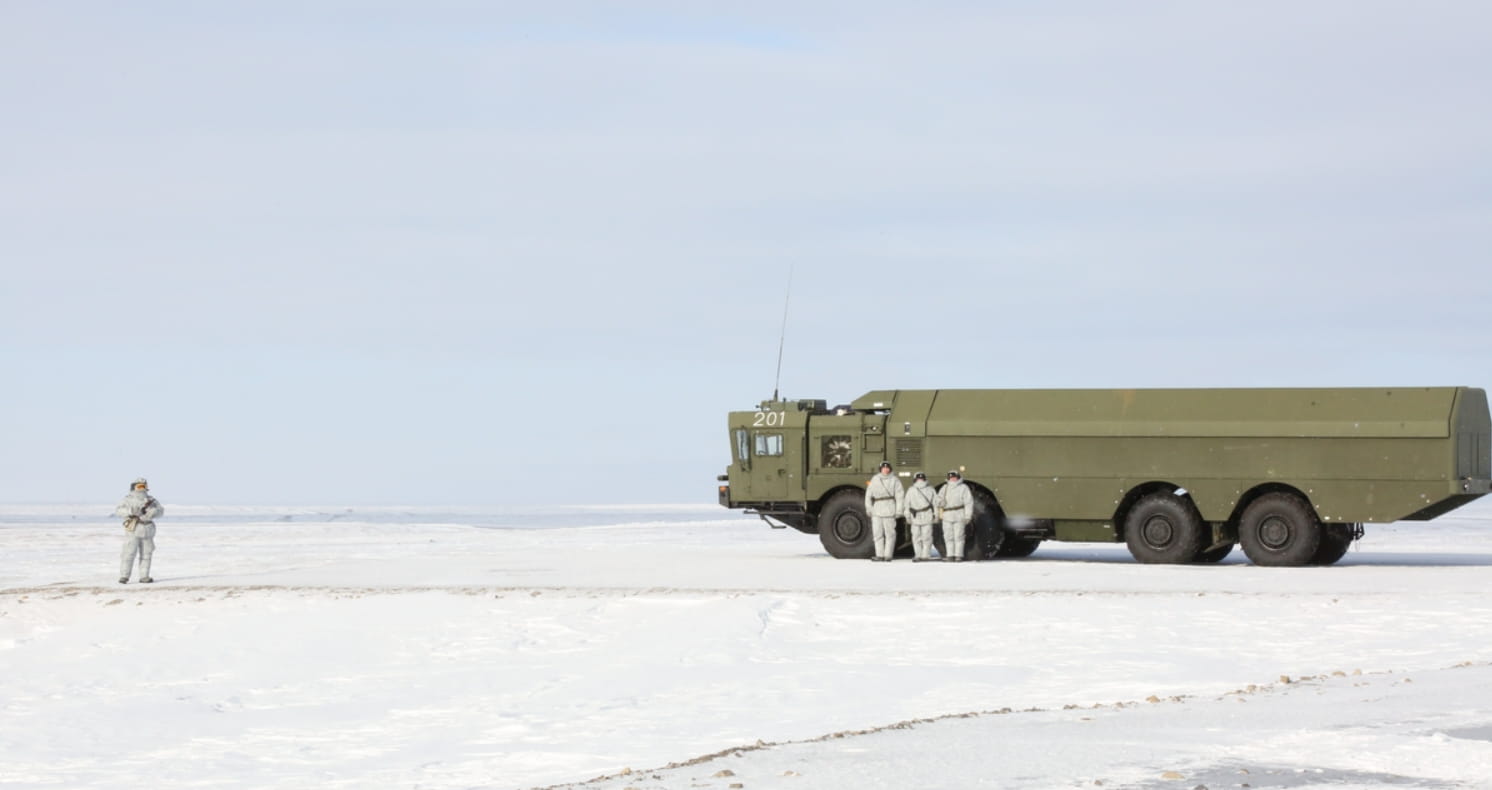
Russian troops stationed at the Northern Clover military base in Russia’s Arctic, standing as a potent security challenge to the Arctic’s democratic middle powers. Photo: Ministry of Defense of Russia
The time has come for Canada and the Nordic states – Norway, Sweden, Denmark, Finland, and Iceland – to assume greater responsibility, stewardship, and active leadership in the Arctic as a region of shared exposure and shared agency. The central question facing the High North is no longer whether the Arctic is changing; that transformation is already well underway. The more consequential issue is whether the region’s middle powers will act collectively enough, and strategically enough, to shape the rules and material conditions under which great powers operate there.
Recent political developments suggest that such coordination is beginning to emerge. In March 2026, the leaders of Canada and the Nordic countries met in Oslo1) and publicly committed to deepen cooperation, meet more regularly, and ground their approach to Arctic affairs in international cooperation based on the rule of law. Their joint statement emphasized resilience, Arctic security, and the need to guard against dangerous economic dependencies. These commitments matter because they convert what had long existed primarily as an analytic proposition – the idea of a coordinated Canada-Nordic strategic posture – into an emerging political orientation among the states themselves.
Yet, the Oslo declaration also revealed the central challenge that must now be addressed. While it articulated shared principles and strategic intent, it deliberately avoided specifying the institutional mechanisms through which such cooperation would operate. The political alignment exists, while the coordinating architecture does not. In a region whose strategic importance is increasing rapidly, that gap cannot remain indefinitely.
The Arctic is moving in precisely the direction that punishes strategic vagueness. The physical environment is changing quickly, and those changes are translating into greater operational activity. Ongoing geophysical shifts in the Arctic – the oldest and thickest multi-year Arctic sea ice has declined by more than 95 percent since the 1980s – are already producing measurable economic effects.2) Between 2013 and 2025, the number of unique vessels operating in Arctic waters increased by roughly 40 percent, while the total distance travelled by ships in Arctic waters nearly doubled.3) As the region becomes more economically relevant and operationally accessible, the probability of incidents rises, the value of regulatory standards increases, and the strategic consequences of miscalculation grow correspondingly.
The diagnosis from recent policy discussions among Arctic states is therefore broadly correct. The Arctic today does not lack institutional density; indeed, it is institutionally dense, but strategically disaggregated. NATO provides the framework for collective deterrence. NORAD anchors aerospace warnings across North America. The Arctic Council remains the central forum for circumpolar governance and environmental cooperation. Nordic states coordinate defence policy through NORDEFCO. Numerous bilateral agreements govern fisheries management, search-and-rescue responsibilities, and scientific research.
What the region requires now is strategic integration at an institutional level. None of the existing frameworks were designed to link deterrence, infrastructure resilience, economic security, and legal governance into a single strategic system owned by the Arctic states most directly exposed to the region’s contours. The strategic rationale for a Canada-Nordic Arctic Coalition lies precisely in closing that gap.
The Recommendation: A Canada-Nordic Arctic Coalition
The most practical response to the emerging strategic environment would be the establishment of a Canada-Nordic Arctic Coalition – a standing political-strategic coordination mechanism linking Canada and the Nordic states across four interlinked domains: security and deterrence enablement, Arctic economic and infrastructure resilience, international law and regulatory standards, and northern and Indigenous partnership.
The coalition would not constitute a mutual defence treaty, nor would it attempt to duplicate NATO or the Arctic Council. Rather, its purpose would be to provide a durable coordinating layer through which Arctic middle powers can align policies and capabilities across domains that existing institutions treat separately.
Such a mechanism should remain deliberately light in its institutional structure. The political appetite among participating states likely favours flexible arrangements rather than heavy supranational bureaucracy. A plausible institutional model would therefore consist of a leader-mandated framework, supported by a rotating chair and a small coordinating secretariat responsible primarily for producing a limited number of recurring strategic outputs.
Such outputs should be catalytic rather than bureaucratic. They might include a shared Arctic risk assessment covering security developments, hybrid threats, shipping activity, infrastructure vulnerabilities, and environmental hazards. They could include coordinated positions for international regulatory bodies governing maritime safety, fisheries management, and environmental protection. They could also include shared approaches to infrastructure investment screening and economic security, as well as formal consultation channels with Indigenous governments and northern communities whose participation remains essential to legitimate Arctic governance.
The objective would not be to create another forum for general declarations. Instead, a Canada-Nordic Arctic Coalition would institutionalize strategic coordination by ensuring that cross-domain issues are addressed systematically and predictably rather than episodically.
Why These States, and Why Now?
The strategic timing for such a coalition is unusually favourable because several structural shifts in the High North and broader global geopolitical landscape have occurred simultaneously.
First, NATO’s northern geography has been transformed by the accession of Finland in 2023 and Sweden in 2024.4) For the first time in the Alliance’s history, the entire European Arctic now lies within NATO territory. This expansion has strengthened the Alliance’s capacity to operate across the High North and North Atlantic. NATO’s launch of enhanced Arctic vigilance activities such as the 2026 “Arctic Sentry” initiative5) reflects this new strategic reality, consolidating allied activities across northern Europe and coordinating them with both US combatant commands and NORAD.
However, NATO’s mandate remains global rather than Arctic-specific. The Alliance must balance commitments across Eastern Europe, the Mediterranean, and the Indo-Pacific. Arctic priorities therefore compete with numerous other strategic theatres for attention and resources. A Canada-Nordic coordination mechanism would ensure that Arctic middle powers maintain a coherent voice within the Alliance while preserving their ability to address regional challenges that fall outside NATO’s core mandate.
Second, Canada itself has begun shifting from rhetorical emphasis on Arctic sovereignty toward large-scale infrastructure and defence investment. In 2026, the Canadian government announced plans6) exceeding 40 billion CAD to modernize northern infrastructure, expand defence capabilities, and strengthen sovereignty in the Arctic. These investments signal a strategic transition away from reliance on geography alone toward building the physical and technological infrastructure necessary for sustained Arctic presence.
Third, dynamics underpinning middle power cooperation are converging. Canadian Prime Minister Mark Carney has repeatedly argued that the current international environment represents a rupture in the post-Cold War order, requiring flexible coalitions among like-minded states prepared to share the costs of resilience.7) Nordic leaders have expressed similar sentiments, describing the emerging Canada-Nordic partnership as an effort by middle powers to navigate what Danish Prime Minister Mette Frederiksen characterized as “uncharted terrain” in the evolving international system.8)
Finally, the Arctic governance environment itself is undergoing institutional strain. Russia’s invasion of Ukraine in 2022 effectively froze many aspects of Arctic Council cooperation, forcing the remaining seven Arctic states to pause formal engagement before gradually resuming project-level activities without Russian participation.9) The Council remains indispensable for environmental governance and Indigenous engagement, yet its mandate explicitly excludes hard security issues. The result is a governance architecture that remains valuable but incomplete in addressing the full spectrum of Arctic strategic challenges.
Norm-Setting as Strategic Leverage
A credible strategic case for middle power cooperation must explain how states without the military mass of great powers can nevertheless shape regional order. In the Arctic, the answer lies in the importance of legal rules, regulatory standards, and infrastructure governance.
Canada and the Nordic states possess structural advantages in all three areas. They control most of the Arctic’s democratic coastline, administer large northern territories, and maintain highly developed regulatory institutions governing maritime safety, environmental protection, and resource development. These characteristics give them significant leverage in shaping the operational environment in which external powers must operate.
There is already substantial precedent demonstrating that Arctic states can successfully establish binding rules for the region. Under the auspices of the Arctic Council, Arctic states negotiated legally binding agreements on search and rescue in 2011,10) marine oil pollution preparedness in 2013,11) and scientific cooperation in 2017.12) These agreements illustrate a recurring pattern: when operational realities create shared risks, Arctic states formulate and accept legal frameworks to manage them.
The Central Arctic Ocean fisheries agreement offers an even clearer example of proactive norm-setting. Entering into force in 2021, the agreement established a precautionary sixteen-year moratorium on commercial fishing in the high seas portion of the central Arctic Ocean before large-scale exploration began. By coordinating policy early, Arctic states and major fishing powers reduced the likelihood of competitive resource extraction and jurisdictional disputes.13)
A Canada-Nordic coalition could amplify this normative influence by coordinating positions within international regulatory bodies. By aligning policies across maritime governance, fisheries management, infrastructure security, and environmental regulation, Arctic middle powers could shape the legal environment within which external powers operate in the region.
Operational Foundations and Strategic Implications
Operational coordination would represent a central component of any Canada-Nordic coordination framework. Yet, its purpose should be understood carefully. The envisioned objective is not to create an Arctic military alliance parallel to NATO, but to ensure that the capabilities Arctic states already possess operate coherently within a shared strategic framework.
Integrated Arctic domain awareness would form the foundation of such cooperation. Monitoring the Arctic’s vast airspace, maritime routes, and subsea infrastructure remains extraordinarily difficult due to environmental conditions and geographic scale. Canada operates extensive surveillance networks across its northern territories,14) while Nordic states maintain sophisticated radar installations, maritime patrol aircraft, and satellite monitoring systems across the European High North.15) Linking these systems through coordinated data sharing and planning could dramatically improve situational awareness across the region.
The implications of improved domain awareness extend beyond military surveillance. Greater transparency regarding shipping movements, environmental hazards, and infrastructure vulnerabilities would reduce the risk of accidents and misinterpretations during periods of heightened geopolitical tension. In a region where distances are vast and communications limited, early warning capabilities serve both security and safety purposes simultaneously.
Operational coordination would also enhance crisis response. The Arctic’s sparse infrastructure makes emergency response particularly challenging. As shipping activity increases and energy development expands, the probability of maritime accidents or environmental disasters rises correspondingly.16) A coordinated Canada-Nordic response framework could enable aircraft, icebreakers, and specialized emergency units to operate across national boundaries during crises, improving response times and reducing environmental damage.
Such cooperation would also produce strategic deterrence benefits. Increasing Russian military activity and growing Chinese economic interest are raising the strategic profile of the Arctic.17) Effective domain awareness and operational familiarity among allied forces that call the region home reduce the likelihood of miscalculation by ensuring that activities in the region remain visible and predictable.
Nevertheless, operational cooperation also presents challenges. Sovereignty sensitivities remain significant in Arctic governance, particularly regarding maritime jurisdiction and territorial waters. A successful coalition must therefore operate on the principle of coordinated sovereignty rather than pooled sovereignty. States would retain full authority over their territory and forces while sharing situational awareness, regulatory standards, and planning frameworks.
Resource constraints represent another challenge. Arctic operations remain expensive, and participating states must balance northern investments with broader defence commitments. For this reason, the coalition’s operational agenda should emphasize cost-effective coordination rather than large-scale new military deployments.
Economic Security and Infrastructure Resilience
Economic cooperation constitutes another domain where a Canada-Nordic coalition could exercise significant influence. Arctic infrastructure – ports, telecommunications networks, energy systems, and transportation corridors – will play a critical role in shaping the region’s future.
The 2026 Oslo declaration explicitly linked Arctic security to resilient infrastructure and economic security, emphasizing the need to avoid dangerous dependencies in supply chains and technology systems.18) Canada’s recent announcements regarding Arctic transportation corridors and critical mineral development19) similarly highlights the economic dimension of Arctic security.
Coordinated policy among Canada and the Nordic states could strengthen supply chains for critical minerals, renewable energy technologies, and advanced materials necessary for the global energy transition. Bilateral agreements such as the 2026 Canada-Greenland cooperation framework on critical minerals20) already demonstrate the potential for collaboration in this sphere.
Defence industrial cooperation also represents an emerging opportunity. The 2026 Oslo leaders’ meeting emphasized strengthening defence industrial capacity and developing interoperable dual-use technologies.21) Arctic-specific innovations – such as cold-weather logistics systems, satellite communications, autonomous drones, and maritime navigation technologies – have applications beyond the region itself. By coordinating procurement strategies and research initiatives, Canada and the Nordic states could strengthen their technological base while reducing duplication and improving interoperability among their forces.
Hedging Diplomacy and Middle Power Order-Building
Finally, a Canada-Nordic coalition would ultimately represent a classic – and much-needed – strategy of middle power hedging between great powers. The Nordic states successfully navigated the US-Soviet rivalry during the Cold War by preserving security ties with the West while maintaining enough diplomatic flexibility to avoid becoming simple instruments of superpower competition.22) Canada and the Nordic countries now confront a comparable structural challenge in the emerging US-China geopolitical rivalry, which is increasingly global in scope and gradually extending into the Arctic. The objective for Arctic middle powers should not be to choose sides between competing superpowers, but rather to shape the strategic environment in which those powers operate.
This logic mirrors the diplomatic strategy long pursued by Southeast Asian states through the Association of Southeast Asian Nations (ASEAN).23) ASEAN’s influence has not rested on military dominance, but on its ability to construct a dense web of institutions, norms, and dialogue platforms that embed major powers within regional frameworks. Through agreements such as the Treaty of Amity and Cooperation and institutions such as the ASEAN Regional Forum, Southeast Asian states have practiced what scholars often described as “omni-enmeshment”: a strategy in which competing great powers are drawn into institutional arrangements that moderate their behaviour and reduce incentives for confrontation.24)
A Canada-Nordic coalition could pursue a similar approach adapted to the Arctic. By coordinating regulatory standards, infrastructure policies, investment screening mechanisms, and diplomatic positions, Arctic middle powers could gradually construct a governance environment that external actors must operate within. Rather than attempting to exclude outside powers from the Arctic – an unrealistic objective in a globalized world – the coalition would shape the institutional terrain in which those powers interact. In doing so, it would influence not only how external actors engage with Arctic states themselves, but also how great powers with interests in the region engage with each other.
Within this framework, the coalition would maintain close security cooperation with the US. Canada and the Nordic countries would continue to fully honour their NATO commitments, procure interoperable equipment from American defence manufacturers, and regularly invite US participation in Arctic exercises and operational planning. Such cooperation would reassure Washington that the coalition complements rather than replaces American engagement in the region. Indeed, the US would remain the indispensable security guarantor for the Arctic’s democratic states.
At the same time, however, a Canada-Nordic coalition should preserve space for pragmatic engagement with China as an emerging Arctic stakeholder. Dialogue channels with Beijing on climate science, maritime safety, shipping regulations, and sustainable development could be institutionalized within broader Arctic governance frameworks. This approach acknowledges a simple reality: China’s growing global presence means it will inevitably play a role in the Arctic’s future.25) The critical question is not whether China participates in Arctic affairs, but under what rules and institutional conditions that participation occurs.
Through coordinated diplomacy, the coalition could insist that Chinese engagement occur within frameworks consistent with international law, particularly the UN Convention on the Law of the Sea (UNCLOS) and any future Arctic codes of conduct. By embedding Chinese participation within transparent regulatory and institutional structures, Arctic states could encourage cooperative behaviour while limiting opportunities for unilateral influence-building. In effect, the coalition would seek to socialize external actors into a rules-based Arctic order rather than confront them through exclusion.
Such calibrated engagement could also serve a broader strategic objective: preventing the consolidation of a durable Sino-Russian alignment in the Arctic. Much of China’s growing cooperation with Russia in the region has been driven by Beijing’s perception that Western Arctic institutions are closed to its participation.26) By maintaining structured channels for legitimate engagement, Arctic middle powers could reduce incentives for China to rely exclusively on Russian partnership for access to northern resources, infrastructure, and shipping routes.
At the same time, the coalition’s collective and military capabilities would provide the hard-power backing necessary to deter revisionist behaviour. Coordinated defence planning, intelligence sharing, and integrated domain awareness would strengthen the ability of Arctic democracies to monitor activity across the region and respond to potential challenges posed by Russia’s expanding Arctic military posture.27) In this sense, institutional enmeshment and credible deterrence would operate as mutually reinforcing pillars of such a regional order.
The resulting strategy would closely resemble the balancing act practiced by ASEAN states in Southeast Asia: cooperating with the US on security while maintaining diplomatic and commercial engagement with China and embedding both powers within regional institutional frameworks.28) The goal is not neutrality, but strategic autonomy – ensuring that middle powers retain the ability to shape the regional order rather than becoming passive arenas for great-power rivalry.
In the Arctic context, such an approach would reduce the likelihood that the region evolves into a theatre of direct great power confrontation. By creating predictable governance structures, encouraging dialogue among external actors, and maintaining credible deterrence against revisionist behaviour, a Canada-Nordic coalition could stabilize the emerging strategic environment of the High North. The Arctic would remain open to institutional cooperation, but its rules, norms, and institutional architecture would be shaped primarily by the states that inhabit the region themselves.
Securing a Disciplined Pax Arctica
The Arctic’s future will not be determined solely by environmental change or by the ambitions of great powers. It will also depend on whether the states that inhabit the region exercise sufficient strategic coordination to shape its governance.
The establishment of a Canada-Nordic Arctic Coalition would translate growing political momentum into a concrete strategic mechanism. By linking deterrence enablement, economic resilience, infrastructure governance, and legal norm-setting, such a framework would strengthen the ability of Arctic middle powers to shape the region’s strategic environment. In doing so, Canada and the Nordic states would demonstrate a modern form of middle power leadership – one combining operational capability, institutional design, and normative legitimacy to sustain a stable Arctic order.
A twenty-first century Pax Arctica will not emerge automatically. It must be constructed deliberately through institutions, standards, and cooperation among the states most invested in the region’s long-term stability. A Canada-Nordic Arctic Coalition represents one of the most practical and effective mechanisms through which that goal can be achieved.
Daniel Lincoln is a Canadian geopolitical and economic policy analyst currently based at the University of Alberta.
References