Sovereignty Below the Threshold: Why Arctic Security Demands a Nordic Economic Strategy
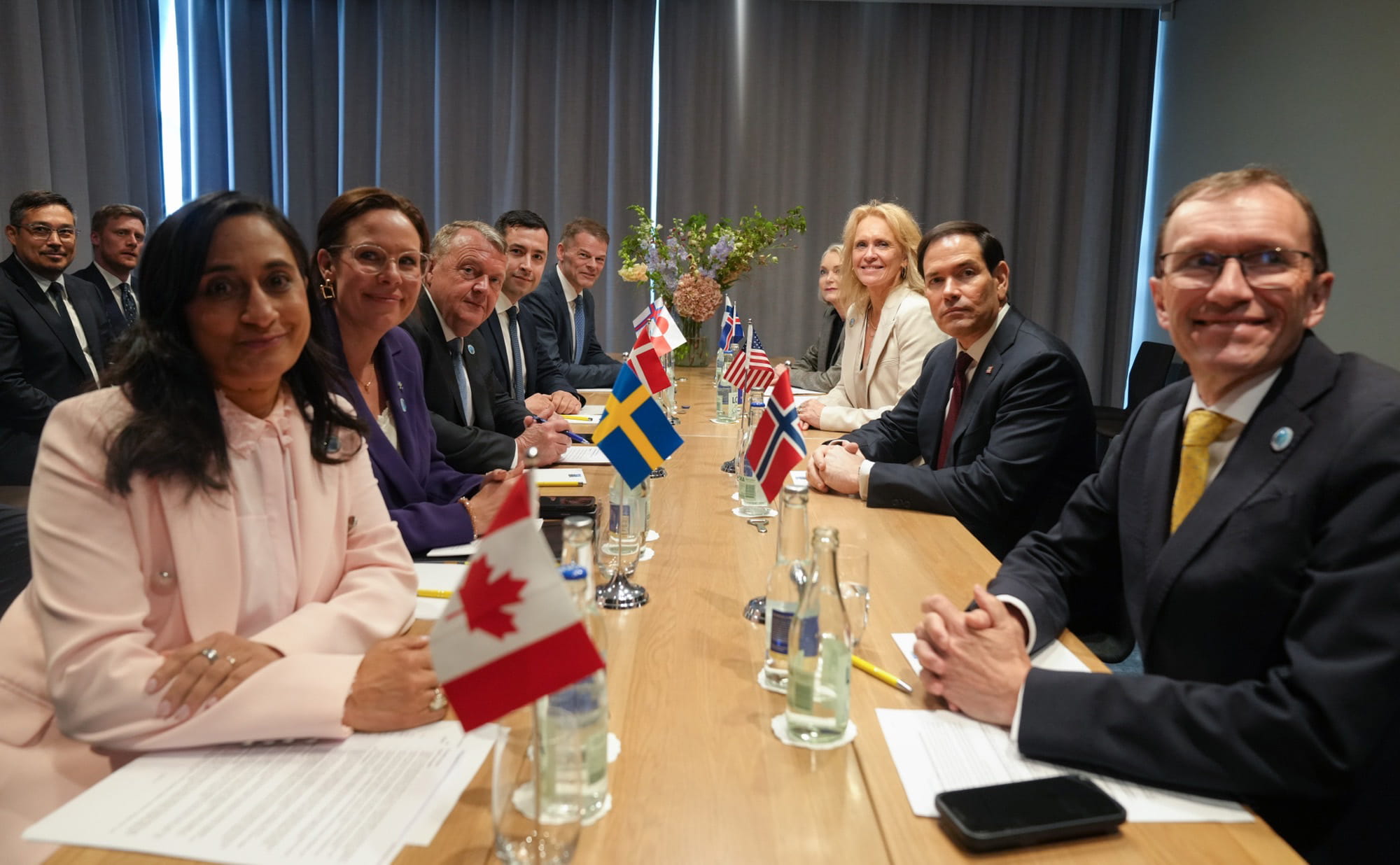
Secretary of State, Mark Rubio, held a meeting with his Nordic and Canadian counterparts while attending NATO’s Foreign Ministers meeting in Helsingborg, Sweden in May 2026. Photo: U.S. Department of State
The ongoing diplomatic saga around Greenland1) is instructive for both the threat it poses and the reflex it reveals. When President Trump entertained the acquisition of Danish sovereign territory last year, the instinctive European and Nordic response was to deploy the language of collective defence, alliance solidarity, and Article 5. While Greenland is, unquestionably, of military importance,2) the episode also exposed a broader strategic reality: external pressure in the Arctic increasingly operates through economic influence, infrastructure, and long-term investment as much as through conventional military power. As such, the challenge is not solely one of territorial defence, but also of safeguarding the economic and infrastructural foundations of Arctic security, including, but by no means limited to, the ownership of critical infrastructure, foreign investment in strategic assets, vulnerable supply chains, investment screening, and the logistical capacity required to sustain both civilian activity and military mobility. NATO, as currently configured, is neither designed nor equipped to address all these dimensions fully. Treating collective defence as the primary instrument of Arctic security, thus, risks placing expectations on the Alliance that extend beyond its core function, while leaving important drivers of long-term insecurity unaddressed.
This article’s analytical point of departure is that Arctic’s strategic significance is not just militaristic but also economic and infrastructural in character: shipping lanes extending as sea ice retreats, emerging undersea cable corridors, and the logistical geography that will partly determine the capacity to project power in the Arctic over the coming decades. Yet the Nordic states remain organised primarily around military deterrence and collective defence, with no coherent framework for addressing the economic and infrastructural dimensions of the challenge. This mismatch between the nature of the strategic challenge and the configuration of Nordic, and by extension European, engagement with it represents a structural gap; a gap which could be conveniently exploited through a combination of influence campaign and patient capital deployment by actors with long investment horizons.
The Ceiling of Deterrence
NATO membership provides meaningful protection against military coercion and, to a degree, hybrid pressure. It does not, however, address economic absorption, infrastructural dependency, or the gradual integration of regional resources into supply chains governed by adversarial actors or strategic competitors. The case for the expansion of Nordic states institutional engagement with Arctic infrastructure within the context of their NATO membership, on the other hand, draws on a commonly agreed upon realisation that civilian infrastructure with dual-use characteristics functions as a force multiplier.3) In fact, NATO’s Cold War Defence Planning Process explicitly incorporated the capacity of roads, rail lines, bridges, fuel storage facilities, and ports into assessments of military mobility and sustainment.4)
The same logic applies to the Arctic, albeit under more demanding operating conditions, and the relevant asset categories are well-known. Polar-capable icebreaking vessels, for instance, support both commercial navigation along opening sea routes and the maintenance of naval access. Small modular nuclear reactors, similarly, could provide reliable power to both civilian communities and forward-positioned military installations, eliminating the logistical and environmental costs associated with extended fuel supply chains. Another example would be the undersea cables and satellite ground stations which support both commercial and military operations.
In the Arctic’s context, it follows, civilian and military infrastructure requirements are so closely intertwined that it is analytically and operationally unhelpful to make a distinction between them. At the same time, the chronic barriers to private investment in the region, including harsh operating environments, sparse populations, inadequate transport networks, and the compounding effects of climate-driven permafrost degradation,5) will not be resolved by market mechanisms at the pace or scale that strategic requirements impose. Addressing them requires public investment, and the Nordic states and the EU collectively possess the financing instruments, the institutional capacity, and the political proximity to make coordinated public investment viable.
What NATO Cannot Provide – and What Europe/Nordics Must
Recognising where NATO’s function, or more accurately utility, ends is not a counsel of pessimism about the Alliance; it is rather a precondition for developing the instruments that can fill the gap. NATO deters military aggression but it cannot, in its current form, generate economic sovereignty and nor can it fund Arctic infrastructure. Similarly, it cannot screen foreign investment in regional assets or align national financing decisions with collective resilience requirements. These are not peripheral concerns, and addressing them requires distinctly Nordic-led European solutions simply because they share the geographic exposure and possess the relevant financing instruments to act with coherence and speed.
Several institutional pathways exist through which Nordic states, in coordination with the EU, could begin to close this gap without requiring a revision of the Alliance’s foundational mandate. NATO’s existing consultative framework already provides a legally established basis for political coordination on emerging security challenges. In particular, Article 4 of the Washington Treaty enables any member to request consultations whenever it considers its territorial integrity, political independence, or security to be threatened, providing an established mechanism through which security concerns can be raised and coordinated.6) Building on this consultative function, a Nordic-European-led initiative within the North Atlantic Council could convene structured dialogues on Arctic economic security while engaging relevant regional and national financial institutions. Such an initiative would not seek to expand NATO’s mandate into economic governance but rather to strengthen coordination between relevant bodies responsible for collective defence preparedness and economic planning/(civilian) infrastructural development initiatives on which defence resilience increasingly depends.
The most consequential step, however, would be for European Arctic states to champion and develop an Arctic Infrastructure Security Framework: a formal political-strategic setting that designates infrastructural development as a component of collective security, identifies priority investment categories, and establishes a mechanism for aligning national and multilateral investment decisions with collective defence requirements. Institutionally, the Framework should take the form of a Nordic-led intergovernmental arrangement operating within the broader political and legal architecture of the EU. Such a model would allow the Arctic states with the greatest strategic exposure to set priorities and coordinate investment while drawing upon EU financing instruments, regulatory capacity, and investment-screening mechanisms. This would preserve regional ownership of Arctic security priorities and eliminate the need for either a formal expansion of NATO’s mandate or the creation of an entirely new supranational institution.
The Framework would also function as a strategic coordination mechanism linking infrastructure finance, investment screening, and long-term resilience planning to the operational requirements of Arctic security. Such a framework would provide political cover for states undertaking major Arctic capital commitments, create a basis for coordination with international financing institutions, and signal to both allies and adversaries that the Nordic members of the Alliance regard Arctic economic sovereignty as a strategic interest and thus they are prepared to give it deliberate institutional attention. Crucially, a Nordic-European framework of this kind would create the conditions for structured EU-NATO cooperation via the The Joint Task Force on Critical Infrastructure Resilience,7) provided that decision-making authority, dispute resolution between member states, and investment prioritisation criteria will be anchored in a European political agreement that can function even when the institutional interface with NATO is constrained. This is important given that the relationship between the EU and NATO has historically been complicated8) while the Joint Task Force on Critical Infrastructure Resilience remains a relatively new and untested mechanism at the scale that Arctic investment would require.
A European Responsibility
The prevailing NATO framework – deter, defend, and reassure – remains a necessary, but not sufficient, condition for Arctic security. Deterrence addresses the threat of military action against territory and assets; it does not generate the economic sovereignty or the infrastructural depth that determines the long-term strategic value of the Arctic. The risk of over-reliance on NATO’s collective defence provisions is not that the Alliance will fail at what it is designed to do, but that its success at those tasks will obscure what it cannot do, and that the gap will remain unaddressed until it is too late to close it on favourable terms.
The United States may provide the Alliance’s ultimate security guarantee, but the task of developing the instruments and institutional arrangements required for economic security in the Arctic is, above all, a European responsibility; one that the Nordic states and the EU are uniquely positioned to lead. The Arctic Infrastructure Security Framework proposed here constitutes an important first step toward that goal; one that treats economic and infrastructural development as a distinctly European contribution to NATO and its role as a security provider in the Arctic. Whether or not such a framework can materialise, in turn, depends on the Nordic states and the EU ability, and willingness, to sustain a high degree of political cohesion and resist the temptation of outsourcing economic security to a collective defence Alliance tasked with military security.
Nima Khorrami is a Senior Associate at The Arctic Institute.
References