A Skier Goes for a Glacier Walk
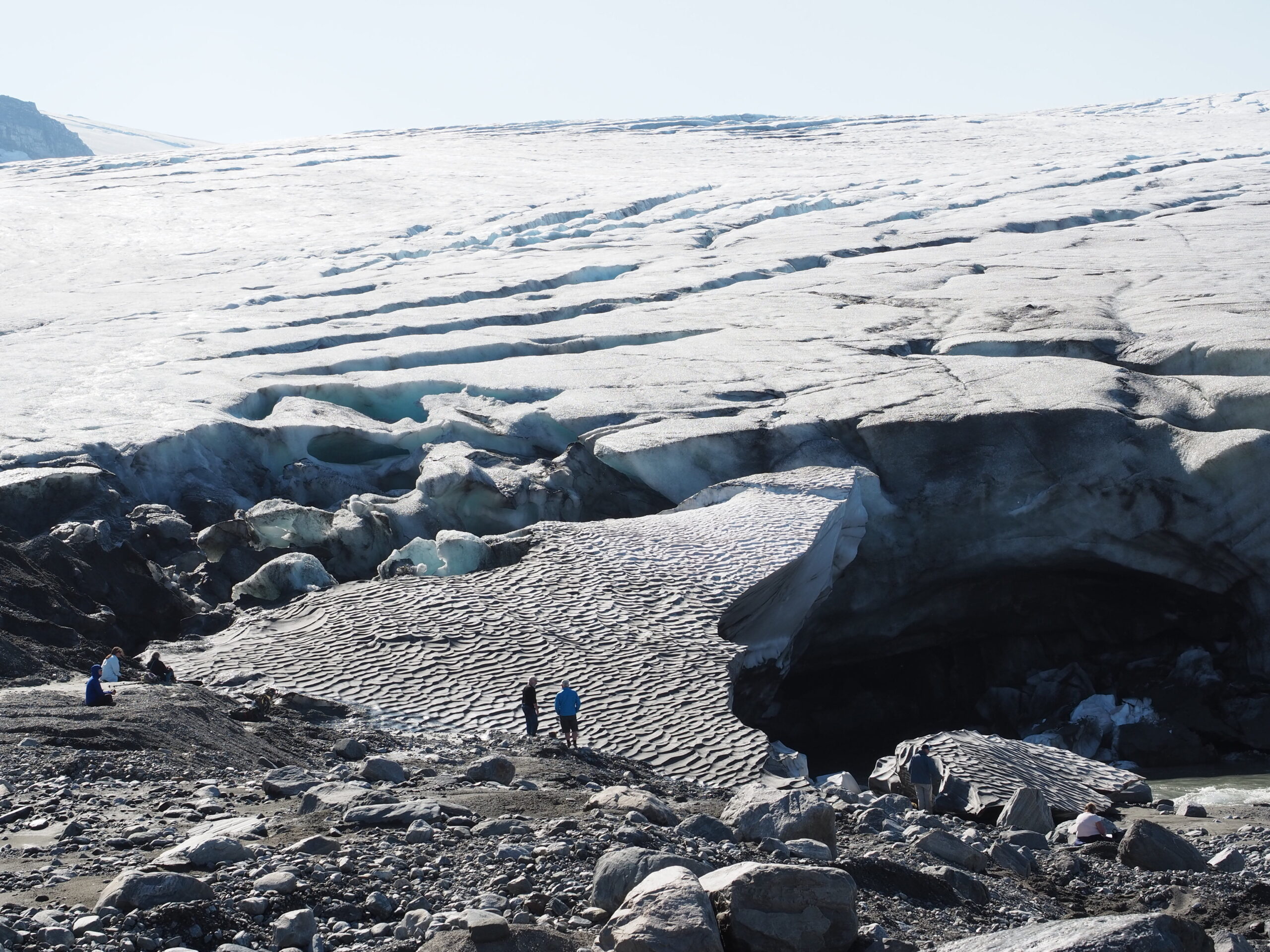
Hardangerjokulen Glacier, Finse, Norway 2019. Photo: Bob Henderson
The Arctic Institute Cryosphere Series 2026
- The Arctic Institute’s 2026 Connecting the Cryosphere Series: An Introduction
- A Map of the Arctic Ocean
- A Skier Goes for a Glacier Walk
- What Rights Cannot Hold: Sea Ice and the Exhaustion of Legal Imagination
I am a skier when on a glacier, first and foremost. In 1984, a twenty-plus day ski tour on Baffin Island’s Penny Ice Cap and its finger-like extensions taught me to love the clean, open white vistas and the gliding. Ah, the gliding.
There had been little grieving on that trip for glaciers in decline. Our grieving and concerns back then were more about specific global environmental hot-spots, acid rain, and threats of nuclear armament escalation. Human-caused climate disruption would come to public attention first as ozone hole issues, as I remember. Eroding glaciers were happening, but strangely, I remember a vagueness to cause and effect – the same goes for global warming, of course. I wonder now if I was just a skier in denial or if there was a cultural ambivalence or ignorance or both I was tapping into. At this point in time, I hadn’t hiked on a glacier in summer months.
In March, 1980, at the Cooper Hut and adjacent glacier high in the Canadian Rockies, I had a magical winter feeling of the hut being part of the glacier. The glacier was uniquely “in your face,” as the expression goes. The hut was on a rocky spur with a parallel view of the immediate glacial creating a feeling of being engulfed; one wrong step and you’d be plummeting into a wind-affected ice tunnel. It was too big to be a crevasse. The glacier, the hut, and I were alive and well and “becoming,” in essence, growing. Healthy! The wind could rise up and blow us away off the glacier, hut and all. You had to rope up to use the outhouse. It was sublime and exciting and, for me, one of life’s pivotal touchstones. No grieving. No melting. The glacier and I were thriving, though potential mishaps were omnipresent. The glacier would always win. Play it safe, very safe. The glacier was a life force, in charge, or so it seemed. The Cooper Hut was soon after decommissioned, deemed unsafe. It was a thousand-foot drop from that outhouse.
A favorite haunt, again in 1980, was the Mt. Edith Cavall glaciers. The Ghost Glacier is a pocket hanging just out of sight of a parking lot and roadway for summer tourists. It is a popular spot in Jasper National Park. I was usually there as a skier: one time, I was there to coordinate a university outdoor education field course. We skied with great joy all around the snow-covered parking lot and adjacent hills. The two glaciers (Ghost and Angel Glacier) were signature pieces overhanging the parking lot.
It was a shock to learn of the August 9-10, 2012 Ghost Glacier calving into the small lake below, releasing 125.000 cubic meters of ice. Thankfully, it calved long after visiting hours. The glacial tsunami flood was a new phenomenon for me. As a skier, I’d never seen it coming. As a summer walker, I should have expected it.
In the 1980s, the Auyuittuq National Park guidebook for that Baffin glacier ski tour was called The Land that Never Melts. Indeed, again, Auyuittaq in Inuktitut loosely translates to “the land that never melts.” In May 1984, on skis, that was our impression. Dr. Frankenstein’s monster’s destination. A place to ponder Nansen’s Greenland crossing or the shaman’s Qitdlarssuaq’s polar migration. Now that land — that glacier/the Arctic — melts. I wonder if the park has felt compelled in recent years to rename the guidebook. Friends have recently been helicoptered off their summer hike up the Akshayuk Pass because of “ impossible” glacial melt rivers off the Penny Ice Cape into the hikers’ pass. There is grieving here. I stick to winter for more than just a love of skiing. I don’t think I was aware that I may be avoiding grieving.
Until Finse, Norway, summer 2019. Hmmm, over 30 years later.
Among summer walkers in 2019, I was among grievers. I had looked forward to the day hike to the toe of the Hardangerjokulen Glacier: the disruptive moraine activity, the demarcations of recession, the solid cold ice turned soft ice, turned liquid. I had not prepared myself for the summer melt. The quiet time on that warm day at the melting glacial edge was sad: so much melting. The hike back to Finse was quiet and still sad. In the lodge lobby, I revisited old summer photographs of this glacier in the 1920s and 1950s. It was much larger. In winter, when I was last in Finse for a ski tour, a few years later, the snowfields and ice-covered lake mask the recession; mask the grieving. In summer, the recession and melt are omnipresent, like gum disease. But the glacier is still standing, so to speak, and still a thing of beauty to behold. One must hang onto that beauty too. Can one celebrate and grieve? I think so.
On that 1984 Baffin Island glacier trip, we hatched a plan to pitch a piece to a popular magazine. My friend Mike Beedell, professional photographer and friend since public school, had stunning photographs, and we wanted to tell fellow skiers about the white forever vistas, the sun and shade contrasts, comfortable ways to haul loads by creating caches of food, the psychological feel of being on a glacier presumed to have spawned in the last ice age. Deep time, that. Ahhh, the quality and joy of such gliding down and the time to ponder when hauling gear and self up.
It was an invitation to look at the place through feelings and learnings and later through expressing our modest, humble adventure narrative. This glacial landscape is too big for any grandeur from us as travellers. The intention of our essay submission was to be place-responsive and poetic. I was proud of the trip and proud of the writing. We were rejected, not because of Mike’s photos or my writing, but because our travels were not “epic enough.” Now, if we had crossed the Penny Ice Cap, A-to-B style in an epic endurance-punishing dash or with some degree of heightened hardship, or a misadventure of some sort, then we would have been in business. Smooth, lyrical, informed (how to enjoy this place comfortably) travel doesn’t sell, doesn’t fit. That is what I was politely told.
I learned from this rejection. I was happy to see the work printed later on in Canada’s Arctic magazine, UP HERE. The rejection has lingered menacingly; not for me personally so much, but for all of us, culturally, including now my fellow Finse grievers, watching a glacier in distress on that fine, hot August day. What does it say about a culture that valorizes and sensationalizes the physical rigor and even the misguided misadventure over the exploration of getting to know a place (or try to) with an aspiration of some intimacy?
What that publisher wanted was a “look at me — you can’t do this” adventure narrative. Something that might start like this: “There I was clinging by my ice axe for dear life to the menacing glacier. Etc, etc.” The “look at me” is a direct message. The “you can’t do this” is more a subtle gesture. What is preferred by publishers for adventure narratives is the grunt-laden, ego-driven, superhero quest fueled at least in part by toxic masculinity. It sells. BUT, are other styles of adventure narratives given a chance? A well-run trip with no major mishaps in a welcoming place isn’t catchy enough. I have read one “superhero” adventure narrator, character builder, self-aggrandizer state: “I revel in the punishment.” There are other kinds of adventure narratives that do mention human disruptive climate change grieving, or the relational learning that can come with embodied engagement with a place, or learning about the place vis-a-vis ecology and/or heritage and even global politics. There is character building in such narratives as well. To serve and strive and yield when the time is right. To BE with/in a place carries qualities of character building as well: how to connect, to become into a feeling of belonging, to care for place and caring for self. Our culture needs to get to this point of joyful, place-aware travel for a relational understanding that fosters ecological being- eco-driven more than ego-driven. Publishers and writers often are not helping here.
I do not bemoan the travels of such would-be superheroes. People can “revel in the punishment” all they like. To each their own. I do bemoan the writing and presentations of such experiences to audiences, giving off the messaging of nature as a sparring partner; the glacier as a menacing conquest of wilderness, a space to endure: to make oneself resilient and known. To show off the self more than grow with the place. There is little use for summer melt glacial grieving for the “look at me” type. The glacier has little personhood. Lots of ego/not much eco. Or, that’s the way it reads and sounds anyway. Western culture needs to evolve towards a culture of ecological connection.
The narrative approach that invites the reader to experience a connection to place through the writer’s muse instills different moral traits and challenges compared to the narrative that is focused on physical rigor. A place-responsive narrative can reveal nature as welcoming; nature as home — home as an inhabited place over centuries, a culturally layered place with a past, present, and future. Nature is shown as a place (not a space) to care about for a lifetime. Again, there is character building here, too. It is a quest for relationality — to be part of or to belong to something and somewhere — not the conventional character-building notion of physicality and all that such hardship can bring. Can the two exist together? I think so. But it is rare to see this in the writing of adventure narratives, which seem formulaic.
After another mountain outing in Norway, a friend of mine, Pete Higgins, once asked me, “Is it better to be a big person on a small landscape or a small person on a big landscape?” I’ve never forgotten that one.
The ego-driven, “look-at-me” narrative in all the punishing, grunt glory gives up a subliminal message that says that the place — the small landscape — doesn’t really matter. Move on to the next sparring partner – big person ego coming through. But now, with glacier skiing and walking, the landscape is truly getting small. The sparring partner is losing. Our collective ego is winning. Time to grieve. We are clinging in Western culture, if we are honest and I generalize, to the colonial messaging of big person/big culture taking on smaller landscapes/small cultures or uninhabited places that can be managed/conquered, ripe for adventure for “firsts” and “discovery” and for prestige.
This is now the wrong message for humanity. Wait, was it ever the right message? But it is confidently perpetuated, and as we move further away from nature and understanding relations to self-willed lands, we more readily accept others who present this narrow view. I’d like to think that, getting close to forty years later, that publisher would accept the story Mike and I pitched. However, the truth is, we are still fed a heavy dose of ego-driven adventure narratives that perpetuate our separation, our fears, our ego, with little space for glacial grieving summer or winter. I appreciate how my position on travel can be viewed as arrogant. What drives my narrative is based on decades of guiding groups with attention to the humble, place-responsive, eco-driven approach and seeing the radiating joy (I’ve called this emancipatory euphoria) in others expecting mostly physically punishing challenges.
In 2023, I stared out over Tsho Rolpo (4552 masl) in Nepal at the head of the Rolwaling Valley. It is an ever-growing lake; an outflow of an ever-shrinking glacier. When Hillary and Tenzing Norgay departed from a post-Everest journey in the 1950’s on a quest to hunt out evidence of the mysterious Yeti, they crossed this significant and noted dangerous glacier. The danger now is mostly an awkward sidecut lakeside walk, with falling moraine rock debris as a pervasive hazard. But the greatest danger is the ever-threatening glacial lake outburst flood (GLOF – important and threatening enough to have an acronym). The grieving here amidst the shockingly stunning scale of the mountainscape is the grieving of a subcontinent. This Himalayan glacier, along with the others in the region, is melting. The shocking scale of future grieving can match the scale of this mountainscape glacier. An earth berm is now raised and reinforced with the help of Dutch and Swiss engineering. Let us hope it holds. Tourists from the subcontinent come here for “last chance tourism”, also disaster tourism. It’s a crazy thought that this has now become a tourism genre. One could call it “grieving tourism.” It is a beautiful, dynamic place. There is celebration and grieving.
We need to grieve. We need to get to know places under stress and why this is so, and at the same time, they can be beautiful.
“Nature as other,” we should now start to see, is problematic. We need to grieve, embrace our relational nature, care with it, and respond where and how we can. Nature as home is a challenge of ecologically centering our journeys. This dynamism with nature is a more accurate, necessary focus for us in the world. Nature is not an opponent or gymnasium. Nature is …well… natural; it is our being, our life force, our spiritual impulse. We need this to be told in adventure narratives.
I’ll continue to ski on glaciers. Ahhhh, the gliding. After summer walking to the Hardangerjökulen glacier, I have a visceral awareness of the grieving that accompanies such intense melting. The skiing will never feel quite the same, and that is a good thing. And I hope to see more and more narratives that invite readers to look at a place through the writer’s informed inquiry and awe. These stories project the cultural messaging we need to advance wisely as we grieve a loss we can work to alleviate. As a skier, I am indebted to that time with the bleeding summer Hardangerjökulen glacier near Finse, Norway. As a skier, it had been all too easy to have rapid glacial decline go unnoticed. As a skier, it is easier to celebrate time with glaciers’ beauty. As a walker, in the summer heat, it is hard for the grieving not to come first. We should have these conflicting feelings and widen our perspectives and thus widen our dialogue. This is our time.
Bob Henderson taught Outdoor Education and Environmental Inquiry for over 30 years at Canadian Universities, mostly at McMaster University. His latest book (edited) is Ways to Go: Reconsidering Travel as told through two Himalaya Adventures, 1971-2023, supported by the related documentary film The Anti Expedition.