Strong Because Weak: Strategic Dependency, Legal Constraints, and Greenland in Contemporary Arctic Geopolitics
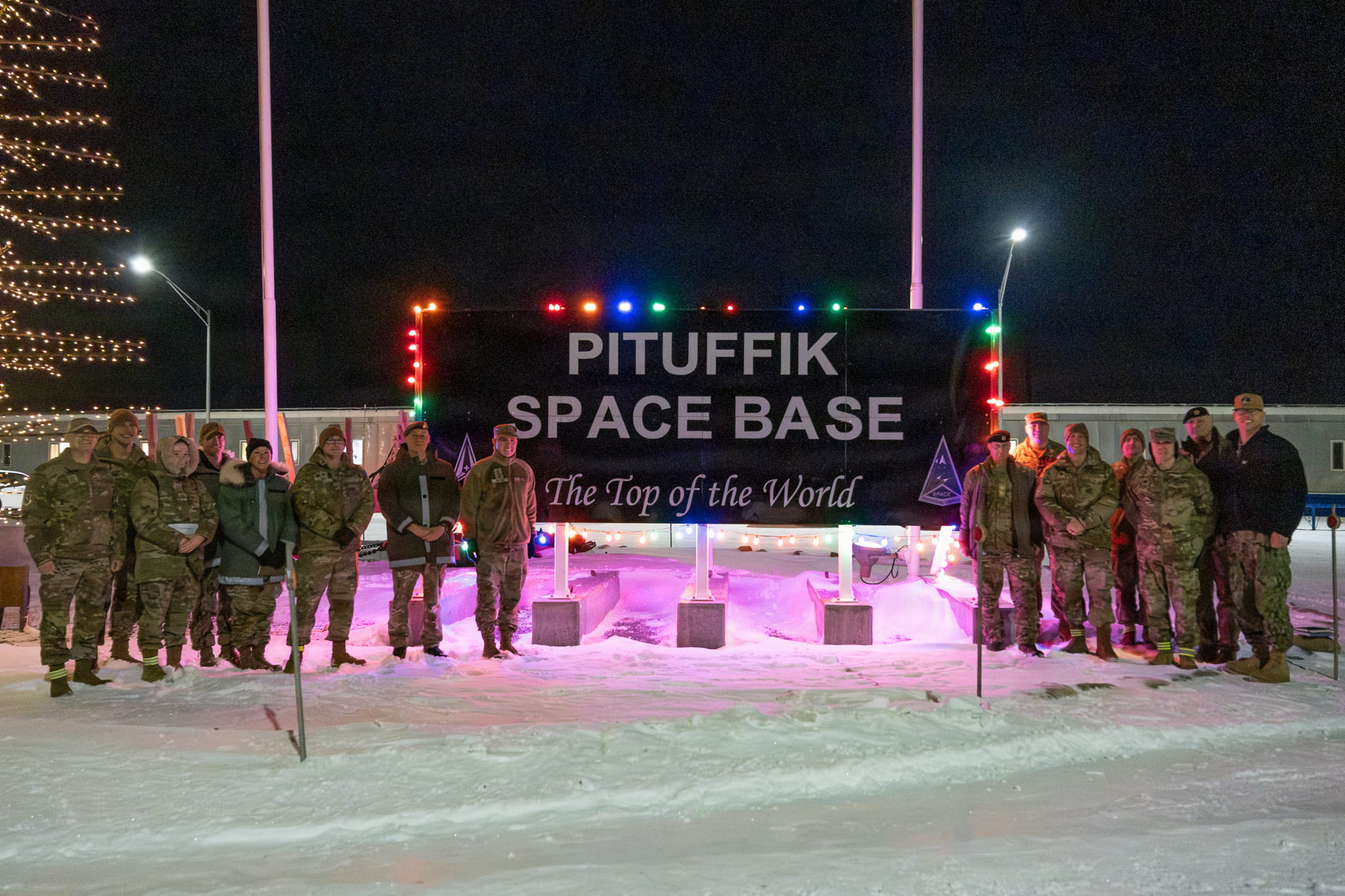
Gen. Stephen Whiting, commander, U.S. Space Command, and personnel from the 821st Space Group pose in front of the Pituffik Space Base, Greenland, December 5, 2025. Photo: U.S. Space Command
In the 1980s, Hans-Georg Wieck, head of West Germany’s foreign intelligence service, articulated a paradox that offers a useful lens for understanding contemporary Arctic geopolitics and strategic dependency: “We are strong because we are weak.”1) He presented this statement not as rhetoric but as an assessment of Cold War Europe’s strategic structure. West Germany’s vulnerability—its position on NATO’s front line, the post-World War II settlement’s constraints on its sovereignty, and its reliance on allied military protection—not only limited its freedom of action but also increased its influence. Because Western Europe’s defense depended on West Germany, NATO and the United States had to account for its interests, giving Bonn leverage that exceeded what conventional measures of material power would predict.2)
This paradox challenges customary assumptions about power in international relations. Military capability, economic size, and formal sovereignty do not alone determine influence. Under certain structural conditions, actors can turn vulnerability into leverage when institutions make them strategically indispensable. Legal frameworks, alliance structures, and geopolitical configurations enable this transformation by turning geographic exposure into political necessity.
This article argues that Greenland occupies a similar position in today’s Arctic security environment. Greenland lacks conventional power. It remains a sparsely populated territory of roughly 56,000 people, possesses limited autonomous military capacity, and depends heavily on Denmark economically.3) Yet Greenland plays an increasingly important role in Arctic geopolitics, NATO defense planning, and international maritime law under the United Nations Convention on the Law of the Sea (UNCLOS). Layered sovereignty arrangements, legal integration, and shifting geopolitical expectations drive this importance.4)
Recent rhetoric from the administration of Donald Trump, suggesting that the United States could acquire Greenland “by force if necessary,”5) does more than provoke diplomatic controversy. It reveals the legal and institutional architecture that underpins Greenland’s strategic importance. Greenland derives its value from its place within systems that require continued access, stability, and legal integrity. To understand Greenland’s position, scholars need to move beyond traditional geopolitical analysis and examine how law, alliance structures, and institutional dependencies shape strategic outcomes. They also need to reconsider how sovereignty operates in contemporary international politics, particularly where legal authority, military necessity, and geographic position converge.
The Frontier of Exposure: Reversing Traditional Metrics of Power
Although Greenland’s geography underpins its geopolitical significance, geography alone does not explain its centrality. Climate change, technological innovation, and renewed great-power competition are reshaping the Arctic. Melting sea ice is opening new maritime routes, including the Northern Sea Route along Russia’s northern coastline and potential transpolar shipping corridors. At the same time, retreating ice is increasing access to hydrocarbon reserves and critical mineral deposits that were previously inaccessible. Within this changing environment, Greenland occupies a uniquely central position.6) It sits at the intersection of North American and European strategic space, forms part of the northern approaches to the United States, and encompasses airspace, maritime zones, and surrounding sea lanes that support early-warning systems tracking missile trajectories across the polar region.
Strategic infrastructure translates this geography into military capability through facilities such as Pituffik Space Base (formerly Thule Air Base). The base supports missile warning, space surveillance, and Arctic monitoring. Rather than serving as a remote military outpost, it functions as a node within a global defense architecture that links satellites, radar systems, and command-and-control networks across the Northern Hemisphere.7) In this respect, Greenland resembles Cold War West Germany despite their different political contexts. West Germany’s location on NATO’s front line made it indispensable to the alliance’s defensive posture. Likewise, Greenland’s location makes it indispensable to contemporary Arctic security architecture. This reality illustrates the paradox of vulnerability. Strategic systems often organize around points of exposure rather than insulated centers of strength. States assign disproportionate importance to territories on the edges of geopolitical systems, because those locations define external boundaries and expose systemic vulnerabilities.
Kalaallit Identity as a Constitutional Shield
Greenland’s geopolitical position remains inseparable from its legal and constitutional status within the Kingdom of Denmark. The Greenland Self-Government Act of 2009 grants Greenland extensive autonomy and recognizes Greenlanders as “a people with right to self-determination under international law.”8) By encoding Kalaallit (Indigenous Inuit people of Greenland) identity into the Self-Government Act, Greenland transforms its domestic quest for sovereignty into an international legal shield, ensuring that great-power security calculations cannot bypass the explicit consent of the Nuuk government. Therefore, Denmark cannot unilaterally transfer Greenland to another state. The arrangement establishes Greenland as a juridical actor rather than a passive object of state authority. It also places Greenland within a framework of conditional sovereignty in which domestic autonomy and international legal recognition jointly shape political authority.
The United States maintains its presence in Greenland under the 1951 Defense Agreement with Denmark. The agreement authorizes U.S. military operations in Greenland while preserving Danish sovereignty.9) By doing so, it separates operational control from legal ownership. More broadly, the arrangement reflects a transformation in how states exercise sovereignty. Rather than concentrating authority in a single institution, modern governance distributes authority across overlapping legal regimes, security treaties, and institutional frameworks.
The Nuuk-Copenhagen-Washington Strategic Anchor
A triangular structure linking Greenland, Denmark, and the United States also drives Greenland’s strategic importance. The United States relies on Greenland for Arctic early-warning systems, missile-defense infrastructure, and space-surveillance capabilities. Denmark relies on Greenland to maintain its status as an Arctic actor and preserve its relevance within NATO. Greenland, in turn, relies on Denmark for fiscal transfers, institutional governance, and external representation in international forums.10) Together, these relationships create a system of mutual but asymmetric dependence. No actor fully controls the arrangement, yet each depends on the others to sustain its strategic position.
External actors—particularly China and, to a lesser extent, Russia—further increase Greenland’s significance through their Arctic strategies. These dynamics add another layer of competition as states vie for infrastructure, investment opportunities, and access rather than pursue territorial conquest in the classical sense. China advances its Arctic interests through infrastructure proposals, resource-extraction projects, and scientific cooperation initiatives.11) Although Greenland is not a major economic hub, its geography makes it attractive for projects with dual-use potential. Airports, deep-water ports, telecommunications systems, and scientific stations can all support military or intelligence activities even when governments or firms present them as commercial or scientific ventures.12) As a result, Greenland derives value from its position within a global competitive system rather than from domestic productivity or industrial capacity. Consequently, contemporary competition in Greenland does not resemble a traditional scramble for territory. Instead, states seek influence through infrastructure development, financing arrangements, and regulatory alignment.
UNCLOS Article 76 and the Battle for the Lomonosov Ridge
International maritime law, particularly the United Nations Convention on the Law of the Sea (UNCLOS), adds a deeper layer to Greenland’s strategic significance. Although states often treat UNCLOS as a technical framework for governing ocean boundaries, it also structures how they extend, recognize, and validate sovereignty in maritime space.
UNCLOS Article 76 allows coastal states to claim an Exclusive Economic Zone (EEZ) extending 200 nautical miles from their coastline. Beyond that limit, states may claim an extended continental shelf if they demonstrate that the seabed constitutes a natural prolongation of their territory.13) Specifically, according to the UNCLOS Treaty, “The coastal State shall delineate the outer limits of its continental shelf, where that shelf extends beyond 200 nautical miles from the baselines from which the breadth of its territorial sea is measured.”14) The Commission on the Limits of the Continental Shelf (CLCS) evaluates these claims through geological and geophysical evidence. Although the CLCS does not resolve sovereignty disputes, its recommendations shape the legal credibility of maritime claims.15) Denmark relies heavily on Greenland to support its Arctic claims. Geological data from Greenland and the surrounding seabed, particularly the Lomonosov Ridge, underpins Denmark’s argument that its continental shelf extends toward the North Pole.16) Without Greenland, Denmark would lose both its status as an Arctic state and the legal basis for its current Arctic claims.
The Lomonosov Ridge illustrates how Arctic competition operates through legal and scientific validation rather than military confrontation. Denmark (through Greenland), Russia, and Canada have submitted overlapping claims and each argues that the ridge forms a natural extension of its continental shelf under UNCLOS.17) Rather than contest sovereignty through force, these states compete by producing seismic surveys, bathymetric maps, and geological data designed to persuade the CLCS.18) Russia funds major Arctic expeditions, while Canada and Denmark conduct extensive scientific missions to strengthen their submissions.19) In this process, scientific credibility becomes a source of strategic advantage.
The ridge therefore represents more than a disputed geological feature. It exemplifies a form of legalized competition in which states pursue maritime claims through geology rather than naval power. Greenland serves as the jurisdictional anchor that enables Denmark to extend sovereign rights into Arctic maritime space. Because Greenland provides the physical and geological foundation for Denmark’s claims, its absence would sharply reduce Denmark’s role in Arctic maritime delimitation. Greenland’s significance therefore extends beyond geography. States transform geological, oceanographic, and cartographic knowledge generated in and around Greenland into legal authority and geopolitical influence.
The Logic of Strategic Indispensability
Greenland’s position illustrates strategic indispensability: actors derive influence from their embeddedness within overlapping systems of law, alliance politics, and geography.20) This concept extends beyond both realism and liberal institutionalism. Realists typically define power through material capabilities such as military strength and economic size. Liberal institutionalists explain the role of rules and organizations but often treat them as background conditions rather than sources of power asymmetry. Greenland reveals a different logic. Even without substantial conventional power, it gains leverage through its position within multiple systems of dependency.
Three overlapping factors generate this leverage:
- Material geography (Arctic location, missile trajectories, maritime routes)
- Legal architecture (UNCLOS, Danish sovereignty, self-government arrangements)
- Institutional dependency (NATO basing, U.S. defense systems, Danish fiscal support)
Together, these factors produce a form of power that no single dimension can explain. The Greenland case also challenges conventional understandings of sovereignty. Denmark retains formal external sovereignty, Greenland exercises extensive internal self-government, and the United States maintains functional military control through the 1951 Defense Agreement. Meanwhile, institutions such as the CLCS shape maritime entitlements through technical evaluation. Rather than concentrating authority in a single actor, these arrangements distribute it across multiple institutions while preserving overall coordination.
The Arctic also demonstrates anticipatory geopolitics. States compete not only over current conditions but also over expected future value. Climate change, technological development, and emerging trade routes create uncertainty about the Arctic’s long-term strategic importance, and states actively plan for those possibilities. As a result, Greenland derives part of its value from anticipated future accessibility and militarization rather than present economic output alone. Expectations about future space shape power as much as control over present space.
Covenant and Coercion: NATO’s Internal Legal Commitments
NATO’s institutional architecture provides the broader framework within which U.S. and Danish interests converge. Analysts often focus on Article 5 of the North Atlantic Treaty and collective defense, but Article 1 carries equal significance. It requires members to resolve disputes peacefully and to refrain from threats or uses of force inconsistent with the United Nations Charter.21) Any attempt by one NATO member to seize territory from another would therefore create not only a bilateral dispute but also a direct challenge to NATO’s legal foundations. Because Denmark helped found the alliance, coercive action against Danish territory would generate an alliance-wide legitimacy crisis.
This dynamic highlights an often overlooked feature of alliance politics. NATO functions both as a military coalition and as a legal community. Its cohesion depends on shared security interests and compliance with internal norms that prohibit coercion among allies. Although the North Atlantic Treaty contains no expulsion mechanism, Article 60 of the Vienna Convention on the Law of Treaties allows parties to suspend or terminate obligations following a material breach.22) In an extreme scenario, intra-alliance aggression could therefore destabilize NATO’s legal foundations. Although such an outcome remains highly unlikely, the underlying legal logic demonstrates how deeply Greenland sits within Western security institutions.
Comparisons with other Arctic governance arrangements further underscore Greenland’s uniqueness. The 1920 Spitsbergen (Svalbard) Treaty grants Norway sovereignty while allowing signatories broad economic rights.23) Iceland remains fully sovereign but embeds itself within NATO and U.S. defense structures.24) While Alaska Native Tribes retain inherent powers of self-government and political self-determination, and tribal, state, and federal authority may overlap in practice, Alaska is a U.S. state under federal constitutional sovereignty.25) By contrast, any external attempt to acquire Greenland operates under a fundamentally different legal framework, where Indigenous self-determination and human rights norms dictate that the territory’s status cannot be altered or transferred without the explicit consent of its inhabitants.26) Greenland also differs from all of these cases because it combines four features simultaneously:
- Internationally recognized Indigenous self-determination
- Sub-state autonomy within a European constitutional monarchy
- Strategic integration into NATO defense architecture
- Jurisdictional significance under UNCLOS
These features make Greenland unique in contemporary international relations. It functions neither as a disputed territory nor as a simple basing arrangement. Instead, it operates as a multi-layered jurisdictional space where different forms of authority coexist and interact. Therefore, President Trump’s statements suggesting that the United States could acquire Greenland through coercion confront several legal barriers:
First, international law prohibits such action. Article 2(4) of the United Nations Charter bars threats or uses of force against the territorial integrity of states.27) International law recognizes Greenland as part of Danish territory.
Second, NATO obligations reinforce this prohibition. Article 1 requires members to resolve disputes peacefully and refrain from force inconsistent with the UN Charter. Any use of force within the alliance would undermine NATO’s core legal commitments.
Third, U.S. constitutional law constrains executive action. The president cannot unilaterally acquire territory through force without congressional authorization. The Constitution and the War Powers Resolution limit executive discretion in initiating such actions.28)
Fourth, Greenland’s own legal framework requires Greenlandic consent for any change in sovereignty under the 2009 Self-Government Act.
Together, these constraints create a dense legal barrier. They do not merely make coercive acquisition politically implausible; they place it outside the existing international, alliance, and constitutional order. Greenland therefore illustrates a broader feature of contemporary geopolitics: the same legal and institutional systems that enable state power also constrain its use. Greenland sits at the center of this tension because law, alliance commitments, and strategic necessity reinforce one another.
Conclusion: Beyond Wieck’s Paradox
Hans-Georg Wieck’s observation that “we are strong because we are weak” captured an important feature of Cold War Europe, but Greenland requires a more refined formulation. Greenland does not derive influence from weakness alone. Rather, vulnerability generates influence when legal, geopolitical, and institutional structures render a territory strategically indispensable. By grounding its foreign policy in an internationally recognized Indigenous right to self-determination, Greenland ensures that its domestic identity functions as a meaningful strategic constraint.
Greenland’s significance stems from the convergence of several factors. Its geography anchors critical Arctic defense systems, its legal status underpins maritime jurisdiction through UNCLOS, its governance arrangements distribute authority across multiple political actors, and alliance structures depend upon its continued stability. As a result, Greenland is more than an object of great-power competition. The United States could not simply “take” Greenland without disrupting the alliance relationships, legal frameworks, and operational networks that rely upon its existing political status.
Understanding Greenland therefore requires more than traditional geopolitical analysis. Contemporary power emerges through the interaction of geography, law, identity, and institutional interdependence. Nuuk has demonstrated a notable capacity to leverage its post-colonial and Indigenous political identity in ways that shape the terms of engagement among Western actors, illustrating how cultural and political legitimacy can be transformed into tangible diplomatic influence.
Martina Sprague is an independent scholar and an International Relations PhD alumna of Salve Regina University in Newport, Rhode Island.
References