What Rights Cannot Hold: Sea Ice and the Exhaustion of Legal Imagination
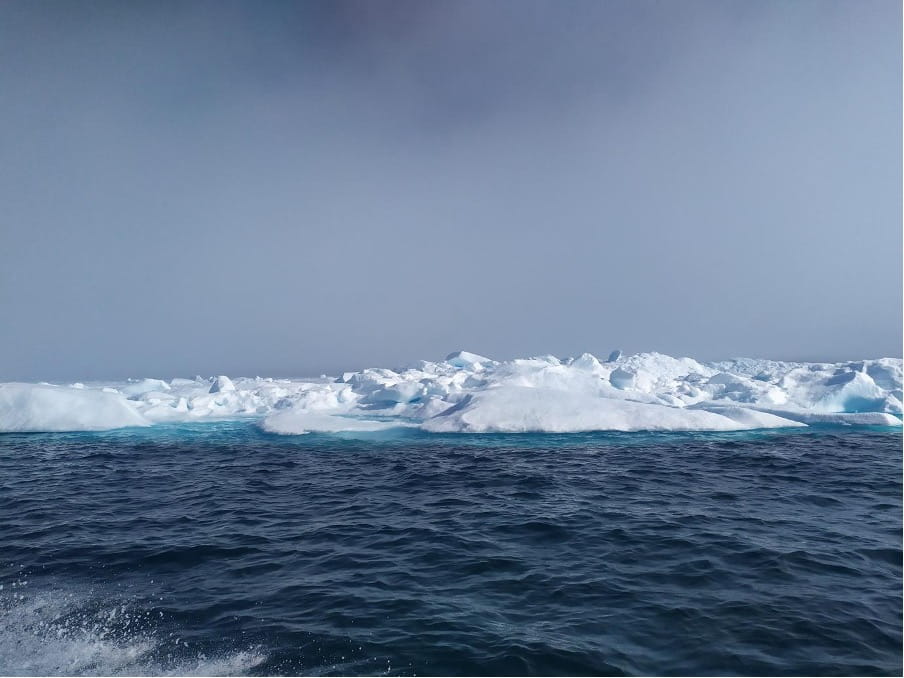
Sea ice near Pikialasorsuaq, Greenland. Photo: Apostolos Tsiouvalas
The Arctic Institute Cryosphere Series 2026
- The Arctic Institute’s 2026 Connecting the Cryosphere Series: An Introduction
- A Map of the Arctic Ocean
- A Skier Goes for a Glacier Walk
- What Rights Cannot Hold: Sea Ice and the Exhaustion of Legal Imagination
The cryosphere is under significant threat, with the Arctic experiencing a rapid decline in sea ice at a concerning rate of 12 percent per decade.1) Projections suggest that summers in the Arctic could be ice-free as early as the 2030s, regardless of efforts to curb emissions. This dramatic loss of ice is causing profound transformations in Arctic ecosystems and serves as one of the clearest indicators of climate change with far-reaching impacts on ice-dependent species and associated human communities. This alarming transformation has garnered significant academic attention, not least within legal scholarship.
In a recent academic article in the Yearbook of Polar Law,2) we proposed a critical reimagination of polar law by applying a Rights of Nature (RoN) framework to Arctic sea ice. The article sought to challenge state-centrism and advocate for the recognition of sea ice’s intrinsic value to develop a transformative governance model that addresses ecological, cultural, and legal gaps derivable from UNCLOS Article 234. We did not expect our theoretical argument to gain so much traction. In The Atlantic’s coverage of our work,3) Sara Olsvig, chair of the Inuit Circumpolar Council, called the idea of rights of nature a “worrying development.” The very phrase, she argued, presupposes a separation between “nature” and human life that simply does not exist in Inuit thought. The environmentalist movement, she reminded us, has a long and painful history of elevating its idea of nature above the interests of Indigenous Peoples, banning whale and seal hunts, devastating cultural continuity and health across the circumpolar North. While we disagree with the assertion that RoN inherently bear the risk of undermining Indigenous interests in the name of environmentalism, we take this critique with the seriousness it deserves. If the conceptual architecture of RoN reproduces the very dualisms it claims to transcend, then the question is not whether to refine the framework but whether to move beyond it altogether. As Merino reminds us, “the institutionalisation of [RoN] cannot be seen as a way of depoliticising Indigenous struggles for self-determination and territorial rights, but as a political space for ongoing negotiations between national developmental goals, Indigenous rights and nature’s interest.4) This article attempts that very movement. Building on and departing from our earlier work, we explore what RoN of sea ice actually entails and what it means to think with and against the materiality and urgency of the disappearance of Arctic sea ice.
Our original argument proceeded from the observation that international law has no adequate framework for addressing sea ice. Under the 1982 United Nations Convention on the Law of the Sea (UNCLOS), sea ice appears only once, in Article 234, where “ice-covered areas” figure as an obstruction to navigation, a hazard to be managed within the limits of the exclusive economic zones of coastal states (and arguably applicable to the territorial sea as well). Whereas the materiality of the Arctic Ocean, like all inorganic substances, manifests in three existential states (i.e., gas, liquid, solid), UNCLOS does not distinguish ice from water in any meaningful sense. It treats the frozen state as a spatial anomaly, a temporary inconvenience for the projection of different levels of state sovereignty seaward. While Article 234 is often perceived as one of the most controversial provisions of the Convention due to the lack of consistency as to its interpretation, as noted in the Virginia Commentary on the Law of the Sea,5) Article 234 perceives sea ice to broadly encompass “all” types of ice found in the marine environment. However, the provision grants coastal states additional power to regulate shipping in ice-covered areas of their maritime zones, but it says nothing about sea ice as an ecological foundation, a cultural medium, or a material condition of planetary stability. It is entirely silent on the fact that sea ice is neither land nor water but a liminal entity, one that forms, drifts, fractures, and melts in patterns that refuse the categorical tidiness upon which the law of the sea has been built.
With some limits, RoN contests this silence. Drawing on legal developments in Ecuador, Aotearoa New Zealand, Colombia, and elsewhere and scholarly works pushing these thoughts further,6) we suggested that recognizing sea ice as a legal entity with inherent rights could challenge the anthropocentric and state-centric premises of existing Arctic governance and give normative expression to what Indigenous knowledge systems have long understood: that the ice is not a thing to be governed but a relational presence that sustains life. The argument attracted some media attention,7) and it provoked the kind of sharp engagement that any serious theoretical proposal should welcome.
These objections crystallized a discomfort that runs deeper than any particular legal theory. RoN carries within it a specific metaphysical architecture: it presupposes that “nature” is a domain separable from human existence, and that the appropriate remedy for its degradation is to extend to it the same legal standing that Western law has historically reserved for individuals, sovereign states, and international organizations. But, as we understand it, for Inuit, this ontological separation is precisely the problem, not the starting point for a solution. Sea ice, in Inuit worldviews, is not an object awaiting legal recognition. Rather, it is a constitutive element of identity, mobility, subsistence, and spiritual life, inseparable from the people who live with it and upon it.8) The Inuit Circumpolar Council has stated plainly that the Inuit are “a people of the cryosphere.”9) This was emphasized by Sara Olsvig herself, at an event organized by the Norwegian Chairship of the Arctic Council at UNFCCC COP29 in Baku in 2024 titled, “A Message From the Frozen World – the Global Impact of a Changing Cryosphere.”10)
“You cannot talk about the cryosphere, you cannot write about the cryosphere, and you cannot decide on declarations or resolutions on the cryosphere if Indigenous Peoples are not part of it and if Indigenous Peoples’ rights are not fully recognized in those texts.”
Olsvig continues:
“Cryosphere for us translates to rights. Cryosphere translates to our infrastructure, … The fact that our land is frozen makes our land our infrastructure. The fact the sea ice is there in the winter makes our sea part of our infrastructure. When it melts, it is literally the ground under us that is melting.”
The argument about RoN of sea ice, from this viewpoint, therefore, might fail to translate this relationship and potentially perform a kind of epistemic violence, which, in turn, forces a relational ontology into the categories of a possessive one. What it might imply is that sea ice must become a legal subject before the law can take it seriously, when a more accurate interpretation is that the law’s inability to take it seriously reveals a deficiency in the law, not in sea ice’s (lack thereof) legal personhood. Equally, Olsvig’s reference to the history of environmental campaigns against sealing and whaling should not be brushed off.11) It points to a structural pattern in which Western environmentalism, animated by its own conception of “nature,” has repeatedly overridden Indigenous self-determination. The risk of RoN, applied uncritically to the Arctic, is that it reproduces this pattern in legal form, granting the ice rights that could then be mobilized against the worldviews and rights of Indigenous Peoples. Yet, as we explain below, this is not what our contribution argued for.
A second line of critique, raised by legal scholars such as James Salzman in the same Atlantic piece,12) targets the operational coherence of rights for sea ice. Even if one accepts the ethical premise that sea ice possesses intrinsic value, the translation of that premise into enforceable legal norms runs into stubborn difficulties. Who would hold the rights? Who would enforce them, and against whom? Furthermore, the issue of representation adds another layer of complexity: who is entitled to speak on behalf of sea ice, and how can we ensure that such representation is both legitimate and inclusive, particularly in contexts where multiple stakeholders may have differing perspectives and priorities? A similar critique was raised by Arne Riedel in the Frankfurter Allgemeine Zeitung article too.13) If sea ice has a right not to be harmed, what constitutes harm, and is the primary threat not global greenhouse gas emissions, which cannot be locally managed and which implicate every industrial economy on the planet? In every jurisdiction where natural entities have been granted legal personhood, the practical architecture of guardianship has required human intermediaries who interpret, represent, and advocate on nature’s behalf. This arrangement, whatever its symbolic power, does not escape the anthropocentric logic or subjectivity it claims to contest. After all, we are all humans trying to make sense of our relationship to and with nature. For sea ice, these difficulties are amplified by its material characteristics. Unlike other naturally occurring phenomena, which occupy a relatively stable geographical space, sea ice is radically dynamic.14) It forms, moves, fractures, and dissolves across millions of square kilometres, spanning multiple sovereign jurisdictions and the high seas. Its extent varies dramatically with the seasons and as a result of climate change. Multiyear ice is disappearing at rates that outpace governance. To fix rights upon such an entity is to ask the law to do something it has difficulties with and think of materiality and agency15) that resists the very notion of fixity.16)
These critiques, one ontological, the other pragmatic, tell us something important about the conceptual limits of the rights framework itself, limits that become visible when applied to a material entity as singular and plural as Arctic sea ice. The difficulty is not that rights have not yet been extended to the cryosphere writ large, but that the extension of rights may be structurally inadequate to the task. This becomes particularly problematic in the context of the cryosphere, whose existence is not that of a bounded entity, but a set of relational processes distributed across space and time. To understand why, it is worth pausing on what “rights” actually do within Western legal traditions. While in the Classical Natural Law school, rights are considered immutable, intrinsic and just (lex justa), grounded in a moral order ordained by a divine power and preexisting social relations (which could arguably connect to the concept of “intrinsic value” within the RoN movement), in the consolidated and dominant paradigm of legal modernity, Lockean rights are subjective and individual constructs of human reason and social contract. Modern liberal rights are thus specific instruments forged within a particular political economy, one that constitutes subjects as autonomous individuals bearing claims against other individuals or against the state. To grant rights to a natural entity runs the risk of conscripting the entity into this framework and making it legible within liberal subjectivity. The entity becomes a person in law, with all the metaphysical baggage that personhood entails. Grear has warned against precisely this danger, noting that extending human-style rights to nature risks reproducing the hierarchies of domination that environmental law ought to contest.17) Nature, conscripted into legal personhood, remains subject(ed) to the human.
However, at its core, RoN does not build on the liberal subject of rights in Western traditions, despite its terminological sameness. It is indeed difficult to express “RoN” without using the word “rights.” RoN, however, directs us toward a solidary and materialist ethic, grounded in the recognition of shared vulnerability, mutual implication, and non-substitutable interdependence. Understood as such, RoN operates through a logic of entanglement and care.18) It begins from the acknowledgement that the fate of one is bound to the fate of another, not because of a legal subjectification and legal relationships but because of the material conditions of existence itself. For instance, sea ice regulates the planetary albedo, reflects solar radiation, moderates oceanic and atmospheric circulation, and sustains the food chains upon which both Arctic and non-Arctic life depends. Its disappearance would accelerate warming and raise sea levels across the globe. RoN therefore is a solidarity argument. It does not argue that the ice deserves liberal rights because it has intrinsic value, although it seemingly does, but that of all of humanity and the ice share a condition of mutual dependence that no legal fiction of separability can undo. RoN qua Solidarity recognises that suffering and vulnerability are structurally produced by the same systems. The industrial modernity that warms the Arctic is the same modernity that has dispossessed and continues to dispossess Indigenous Peoples of their sovereignty and degrades planetary habitability. These problematics are not confined to the Arctic cryosphere but can be encountered elsewhere across land, sea, and any other colonized geographies.
What would a solidarity-inflected RoN jurisprudence look like in the Arctic? It would begin by refusing the gesture that liberal rights require. Instead, it would ask what obligations flow from the recognition of shared material conditions, obligations that do not depend on the prior conferral of personhood but which the RoN creates an aperture for. This is not as radical a departure from existing law as it might appear. International environmental law already contains, in embryonic form, principles that approach solidarity all but in name: the precautionary principle, intergenerational equity, the common heritage of humankind, the duty to prevent transboundary harm, the principle of common but differentiated responsibilities, the principle of sustainable development, among others. What it lacks is the conceptual architecture to link these principles to the specific materiality of the cryosphere. It would recognise that sea ice, in its planetary function and its cultural significance, exceeds sovereign geography, that it belongs, if it “belongs” at all, to a commons that is localized (i.e., it exists somewhere) but not separated from broader planetary dynamics (i.e., it exists everywhere) as a relational field that precedes and exceeds regimes of appropriation. It demands that Arctic governance be reconceived as a collective response to a shared condition of planetary vulnerability. To quote, posthuman feminist scholar Rosi Braidotti’s relational ontological lens “we-are-all-in-this-together-but-we-are-not-one-and-the-same.” In that sense, we all are people of the cryosphere, though not equally situated within it, nor equally responsible for destabilisation, and we are all entangled through and with sea ice. When the Inuit Circumpolar Council declares that “the sea ice never stops”,19) it articulates something that resonates with what solidarity, as we use the term, aspires to as a relationship of co-constitution in which human life and ice life are not separable domains but entangled processes that challenge any legal framework premised on their separability.
We are aware that theory, however precise, does not by itself stop the retreat of sea ice. The Arctic is warming at nearly four times the global average,20) and the physical processes driving ice loss are indifferent to our conceptual refinements. Theorizing in a world on the brink of collapse may prove even less useful than the liberal rights frameworks that we sought to depart from, and a purely theoretical argument risks the charge of irrelevance when measured against the speed of the crisis. We accept this charge in part but insist on its incompleteness. Concepts shape institutions, and institutions shape outcomes. However successful it has been, RoN, after all, is a legal concept. Current laws have not failed simply because they were poorly implemented. Rather, law failed, and it keeps failing because it was designed against a background assumption of ecological stability and with the idea that sea ice was permanent and its ecological functions could be taken for granted. That world, to the extent it ever did, no longer exists. RoN qua Solidarity has concrete implications for how sea ice is being cared, even when challenged by emerging technological ways of “caring” for it through sea ice geoengineering, which is now being actively tested and which raises hard questions about intervention, consent, and harm, and for Arctic Ocean governance at large.21) In each of these domains, the question is not whether sea ice has been given or granted rights but whether the institutions that govern human conduct in the Arctic are adequate to the mutual dependencies that sea ice embodies or whether they continue to obscure them.
We should be clear about the scope of our claim. We are not arguing that RoN is either a failed project or that it must be adopted in the Arctic because it has produced tangible protections and shifted political discourse elsewhere. What we are arguing is that sea ice is a test for legal imagination because its radical materiality, its dynamism, its liminality, its planetary function, make visible the gap between what rights can hold and what the situation demands. Solidarity, as we conceive it, is not the abolition of rights but their contextualization within a larger ethical horizon. Rights may serve as transitional instruments, as Tugend has argued elsewhere, but they cannot be the horizon itself.22) The horizon is a changed relationship between human governance and planetary materiality, one in which the law ceases to be the instrument to exercise sovereignty over nature and becomes a practice of care and mutual obligation rooted in the material conditions of coexistence. Whether such a change is achievable within the existing architecture of international law, or law itself, or whether it requires a rupture that we cannot (yet!) name, remains an open question.
The disappearance of sea ice and its cascading planetary effects are not awaiting new legal theories or strategies. Sea ice melts according to physics (specifically thermodynamics and heat transfer), not jurisprudence alone, and the window in which governance can make a material difference is closing. This urgency requires us to ask what very human laws owe to a material entity whose existence conditions our own. RoN answers by extending legal subjecthood to that entity. While generative, such an understanding of RoN is ultimately clearly insufficient in that it carries within it the very dualisms and hierarchies it seeks to overcome. We therefore agree with critics that its application to Arctic sea ice risks reproducing patterns of epistemic and political alienation and domination. RoN qua Solidarity, by contrast, does not ask what status the ice deserves within law. Rather, it asks what law must become in order to be adequate to the entanglements in which we already find ourselves. And it insists, with a stubbornness that the ice itself might recognize, that the task of governance is both to grant standing to the voiceless and to acknowledge that the voice was always there, in the crack of the ice, in the practices of those who live in a cultural and material relationship with it, in the planetary systems that depend upon it. This is the language of our planetary solidarity.
Romain Chuffart is the Nansen Professor at the University of Akureyri, Iceland, and President and Managing Director of The Arctic Institute. Apostolos Tsiouvalas is a Postdoctoral Researcher at the Norwegian Centre for the Law of the Sea (NCLOS), UiT – The Arctic University of Norway, and Senior Fellow at The Arctic Institute. Mana Tugend is a Researcher at the Norwegian Centre for the Law of the Sea (NCLOS), UiT – The Arctic University of Norway.
References