Geomorphology of Self: a Glaciological Exploration of Cultural, Feminine, and Queer Identity among the Landscapes of Svalbard
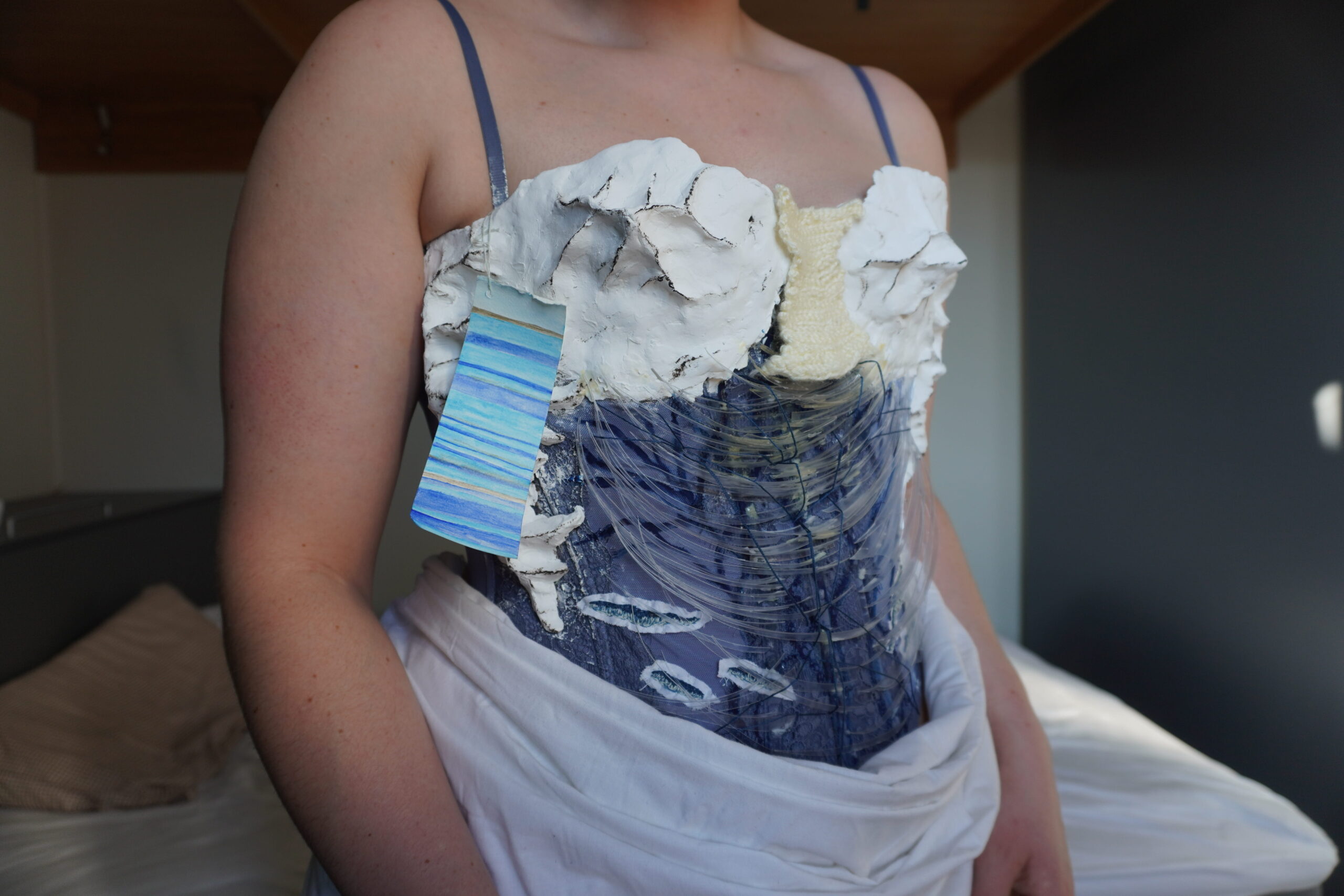
A sculpted corset embodying the glaciated landscapes of Svalbard through the feminine form. Photo: Keeya Beausoleil
The Arctic Institute Cryosphere Series 2026
- The Arctic Institute’s 2026 Connecting the Cryosphere Series: An Introduction
- A Map of the Arctic Ocean
- A Skier Goes for a Glacier Walk
- What Rights Cannot Hold: Sea Ice and the Exhaustion of Legal Imagination
- Collective Memory of C’ulc’ena’ Łuu’ / Gulkana Glacier
- Geomorphology of Self: a Glaciological Exploration of Cultural, Feminine, and Queer Identity among the Landscapes of Svalbard
This auto-ethnography documents a four-month journey of self-exploration in Svalbard, examining how landscape, time, and embodiment shape my identity as a feminist, queer, Indigenous glaciologist. Accompanying this written work is a multi-textile piece titled Body of Ice, a physical depiction of the construction, navigation, and preservation of self through place. The artwork takes the form of a wearable model resembling a glacial landscape fitted to a corset, interweaving elements of the geological environment, dynamic ice, and the feminine body to articulate my shifting yet grounded positionality as a researcher. Through intentional metaphor, I navigate unfamiliar ice-scapes by anchoring my inquiry in the known terrain of my own body.
As an example of engaging with practices of embodiment, this piece reflects how identity emerges through presence, history, and place. It interrogates how these narratives can be sustained or disrupted through anti-colonial paradigms. Both pieces are grounded in two temporal domains, deep geological time and a lived, melting time, engaged through practices of deep mapping of my own geological bed and glacial body. Guided by questions of how inherited narratives and perceptions of the past shape the embodiment of place and belonging to the land. This piece asks how “in situ measurements” of glacial change might also serve as measures of self, and how such observations can be translated, unsettled, and preserved within critical, decolonial frameworks of thought.
Context
Elfenbeinbreen watches me back. I feel captivated by their presence, a feeling lying between mutual understanding and caution, a demand for humility I did not expect. They have been alive for longer than me, longer than the existence of my discipline, longer than human civilization, and yet colonial academia treats them as objects to be exploited, extracted, and manipulated. As I look out among Nordmannsfonna, the icy body extends beyond my perception. It resembles a sense of intimacy and unfamiliarity that I recognize from my own body, but cannot yet articulate. I become acutely aware of the simultaneous measurements being observed in that moment, those by scientific instruments, my own body, and by the landscape itself.
I am a queer, feminist, Métis glaciologist. I acknowledge this not as a contextual preamble, but as a methodology. I am rooted in the lands and guided by the waters of Treaty 6 Territory in Canada, growing up west of Amiskwaciwâskahikan (Edmonton, Alberta) and currently studying glacial geophysics among the stolen homelands of the Nimiipuu, Palus, and Schitsu’umsh tribes at the University of Idaho. This project was completed in Longyearbyen, Svalbard, an archipelago situated above the Arctic Circle, colonized by Europe with little to no documented Indigenous history. To exist as a Métis scholar in a landscape that holds no Indigenous memory felt disorienting in an unexpected way. I often feel at peace exploring new landscapes, yet here it felt as if the terrain’s true topography was shifting beneath me, with no oral land-based traditions, relational accountability, or generational footsteps to guide me. My own relational methodologies are grounded in specific mountains, specific waterways, and specific silences between my family and the lands we have been deliberately displaced from, connections I have had to learn without generational ties. In Svalbard, these values felt silenced once again without a community to protect them or a landscape layered with personal memory. Articulating these ways of knowing to my peers felt isolating, as if the quietly radical part of me could not be translated. Eventually, I found that this rootedness had become a methodology in itself, and that knowing how to be in relation, even among lands that do not recognize this practice, restructured how I engaged with colonial coursework and extractive field research. The absence of Indigenous presence did not erase this part of who I am, which felt hard enough to reconcile in familiar places; it revealed ways of knowing that transcend any single landscape or lived experience, practices that deserve to be shared and uplifted. During these four months, I began to understand that my identities are not instrumentation, something isolated that I can carry into and out of the field like a seismometer or ice drill to extract data and preserve a moment in time. They are unconsciously created and dismantled, evolving and shapeshifting, rediscovered and abandoned. This is an auto-ethnography capturing that unmaking and becoming. Maarsii (Thank you)!
This piece confronts the colonial legacies of glaciology, demonstrating that the methods and theory used to understand glaciers are also ways to understand the self. I draw parallels between how glaciers preserve history and knowledge within their bodies of ice, just as I do. Ice will not simply replicate themes of identity, but construct them. The glaciologist and the glacier exist as equals, both subject to the power dynamics of constantly evolving, eroding, and melting away. Ultimately, this work explores how autonomy might be reclaimed by bodies themselves, both ice and human alike.
This written work is accompanied by a wearable corset transformed into glacial topography, called Body of Ice, documented in photographs throughout. Each piece stands as an equal, a complementary pair pursuing the same inquiry through different means. Together, they make the embodied claim that the feminine body and glacial landscape are not simply metaphors for one another, but unified, both formed by the accumulation of memories and carved by time and pressure. Both inhabit two temporal domains. First, deep geological time, representing the preserved, the unknown, the preconceived. The second, lived, melting time, the freedom to understand glacial change through my own body. This work disrupts the separation perpetuated between researcher and subject, woman and wilderness, self and landscape.
I employ frameworks of auto-ethnography, embodied inquiry, and critical cartography.1) Body mapping is a creative avenue for building awareness of embodied experiences of place to effectively create and share knowledge through anti-colonial frameworks of cartography.2) This approach has been adopted as a research method in geography to encourage auto-ethnography alongside traditional mapping practices.3) As a Métis researcher, I am attentive to how inherited narratives shape perception, how this land is named, what knowledge is valued, and whose body is welcome in the field. In this work, anti-colonial paradigms are not approached from the outside, they are the foundation I have been built upon.
The glaciers are melting under the constraints and expectations of academic colonialism. In many ways, as am I. What follows cannot stop this, but it interprets what is left behind. A loss of ice has sparked a reclaiming of self.
Intentional Artistic Key
This corset took over two weeks to construct, often working late into the night after full days of class or skiing. Art supplies in a town of a thousand people, high above the Arctic Circle with a single grocery store, are incredibly limited. This project required creativity, resourcefulness, and tolerance for uncertainty, common in most research. I gathered many materials in advance with little vision of how they could come together. The corset was shaped by what the place offered and what the experience inspired.
Although the corset accurately reflects components common to glacial landscapes, they are intended to evoke a deeper narrative. This employs deep mapping, a technique of spatial storytelling to represent a more meaningful understanding of place.4) Below, I describe each component of the glacial landscape through its artistic composition, bodily equivalents, and the embodied narrative it carries.
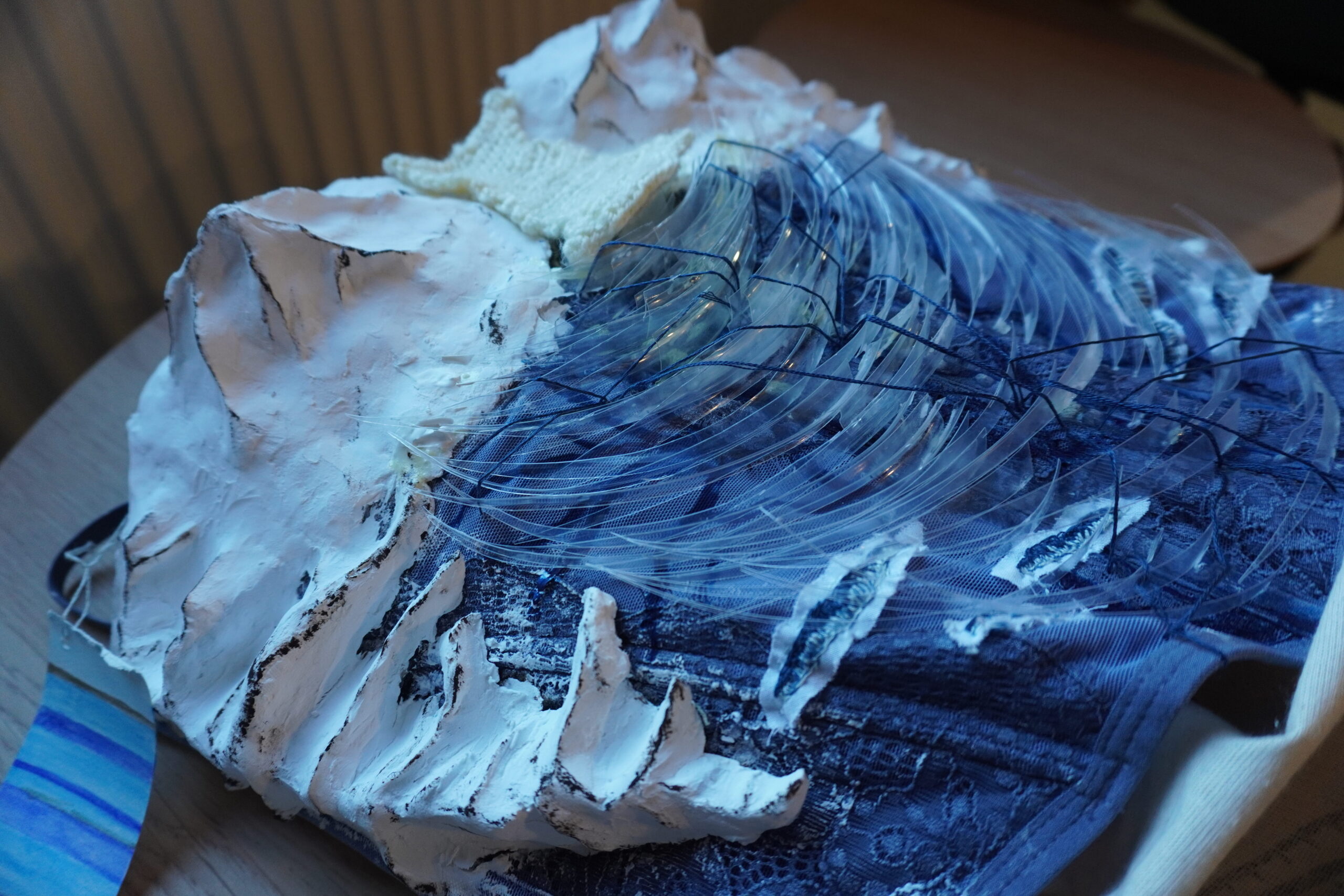
| Glacial Feature | Bodily Element | Material Construction |
|---|---|---|
| Mountains and Ridgelines | Bust and Ribs | Air-dry clay molded to adorn the cups and emphasize my ribs along each side of the corset. The features were shaded with acrylic paint. |
| Glacier Ice | Belly | Plastic from recycled water jugs cut into shards, oriented in a lobbed structure, and fastened to the corset using glue and thread. |
| Crevasses | Stretch Marks | Embroidery using various blue threads on an old bed sheet. |
| Snow | Cleavage | Small crocheted square of white yarn. |
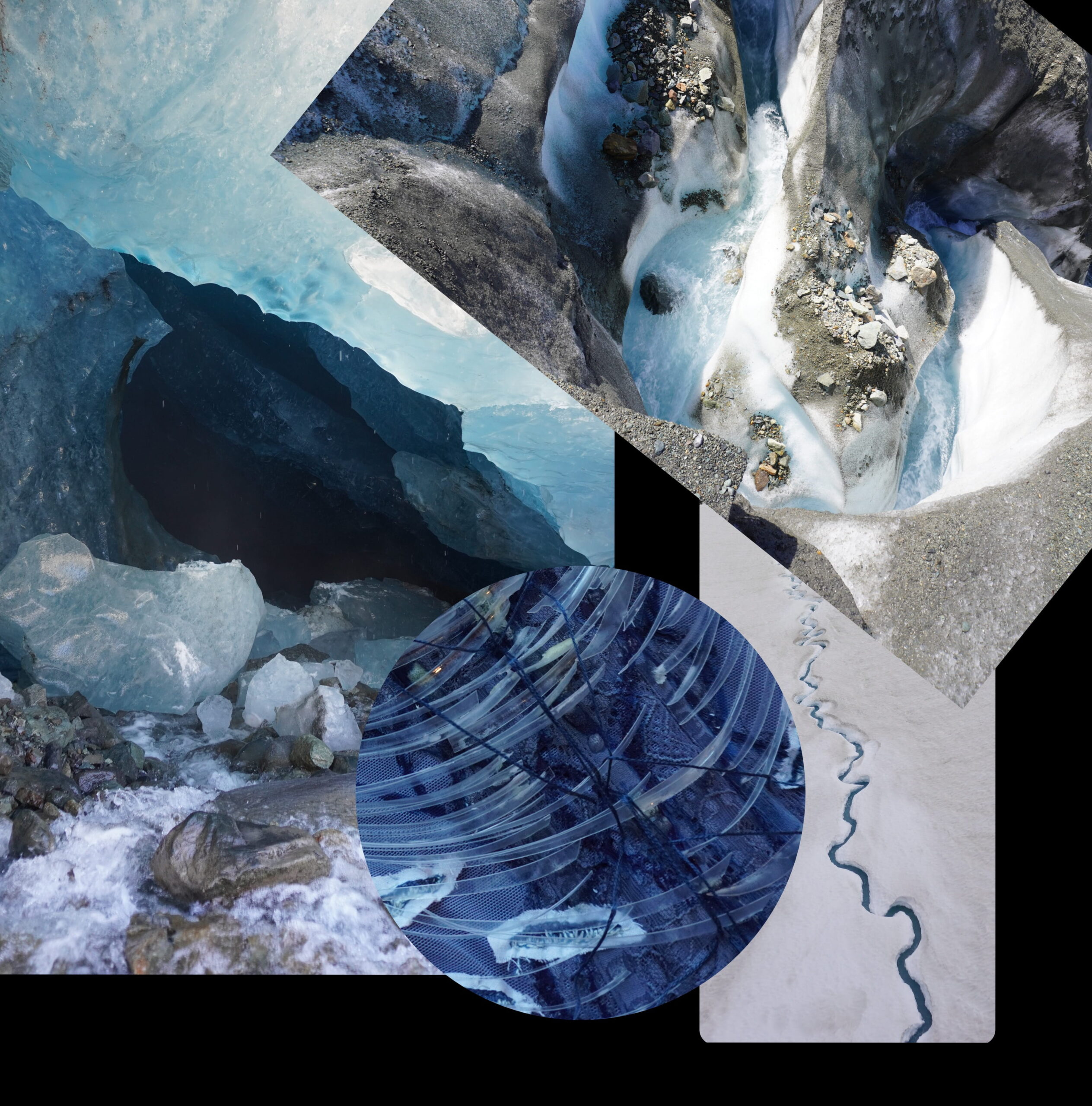
| Water | Veins | Acrylic paint along the boning of the corset and dark blue string woven above the glacier ice, entering spaces between plastic shards. |
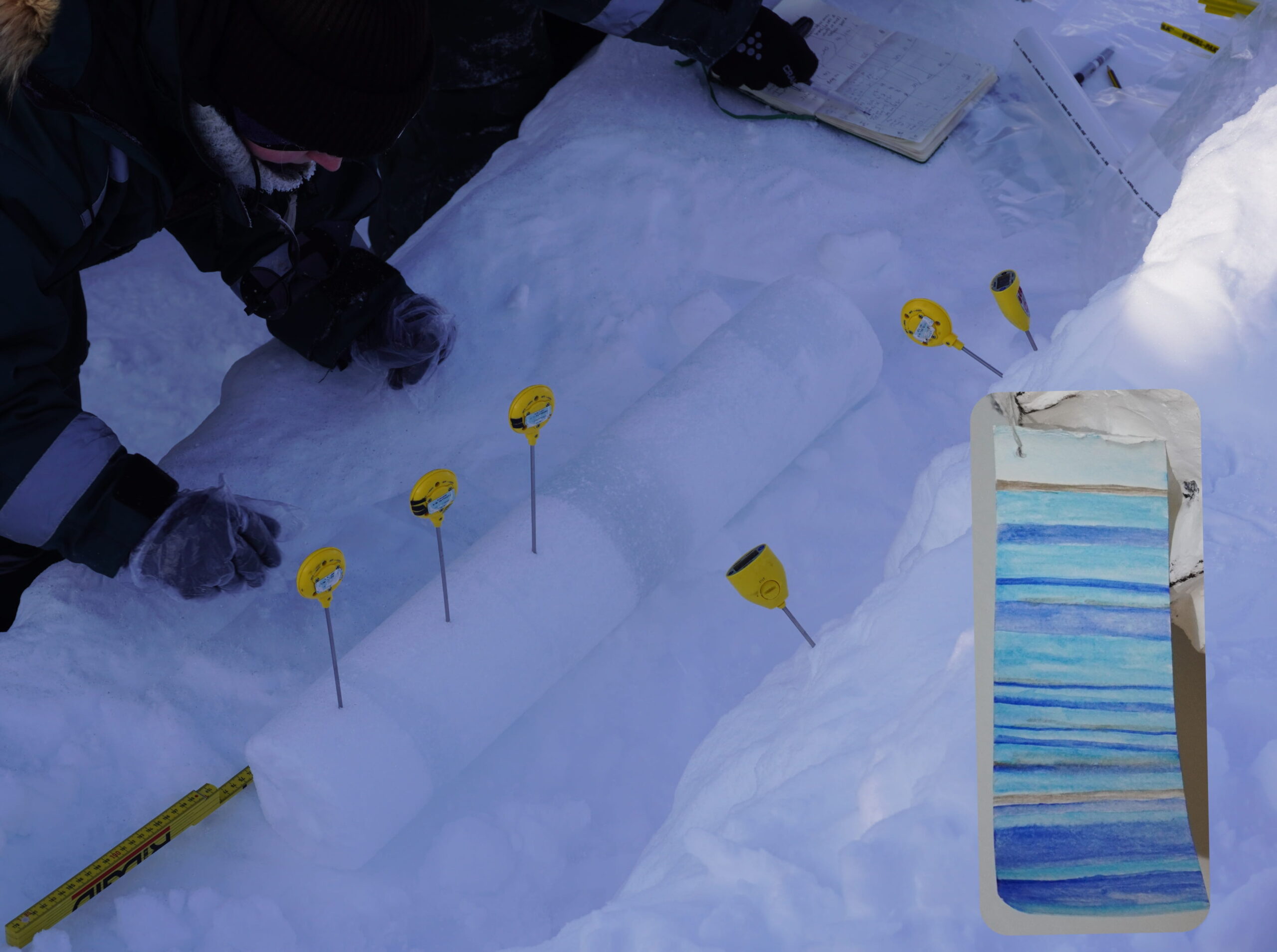
| Ice Stratigraphy | Tag | Watercolour paint on paper. |
| Terminal Moraine | Stomach Wrinkles | Draped bed cloth around my waist. |
The corset acts as the geological bed with clay sculpted as large mountain peaks on the breast cups, towering among the landscape, imperfect and asymmetrical. The couloir valleys, distinctive to the glacially carved massifs of Svalbard, perfectly replicate rib bones. The rock is made of sediments, as if memories of the past, metamorphosed and cemented to construct a worldview. They do not decorate the body; they ground it.
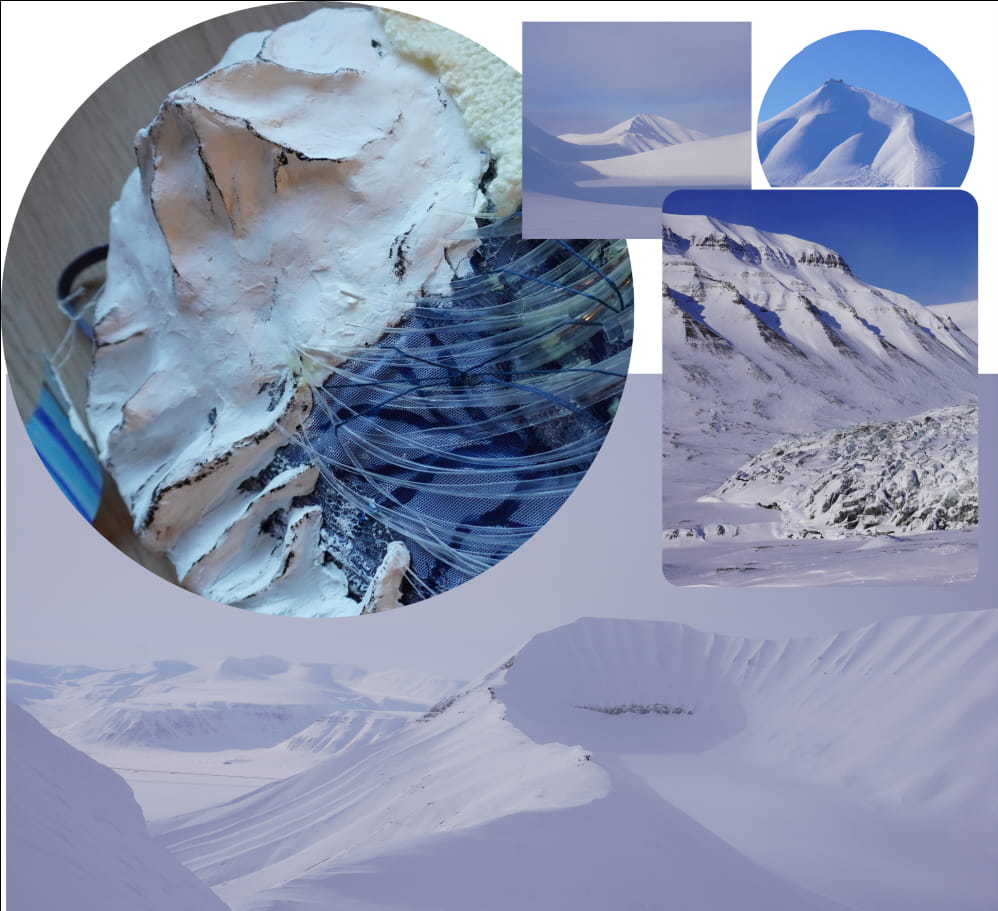
The curving, supple features of a waist and stomach resemble the flowing nature of glacier ice. The plastic behaves in a brittle manner, just as ice fractures. The rounded curves of the shards match the lobed shape of the glacier due to friction with the bed and valley walls. The glacier does not hold symbolic resonance as much as a reminder that in-situ measurements actively shape my identity and interpretation of my surroundings. This is a mirror to a body part that I have often found uncomfortable embracing, conditioned by structures like corsets that have historically concealed and misformed women’s bodies to meet colonial expectations of beauty. This discomfort is a form of data within itself. Western scientific narratives and colonial beauty standards are not the only paradigms capable of holding knowledge, value, or beauty.
Snow gathers at the cleavage, appearing blank and clean, molded and marked to project the visions others have forced upon it. Whiteness in the Anthropocene holds much power. This field is dominated by white men, a dynamic perpetuated by the narratives of unconquered, vast, mysterious Arctic landscapes passed down from the colonial explorers and scientists who came before me. I feel as if an imposter, an impurity among the sea of cold whiteness. This is only made more complicated by the climate crisis consuming the landscape around me, making snow anything but pure.
The crevasses are positioned along the hips, resembling stretch marks. They trace the most unstable, dynamic area of the glacier. Ice experiences this fracturing due to stress as the glacier moves, just as our bodies are shaped under the pressures around us.
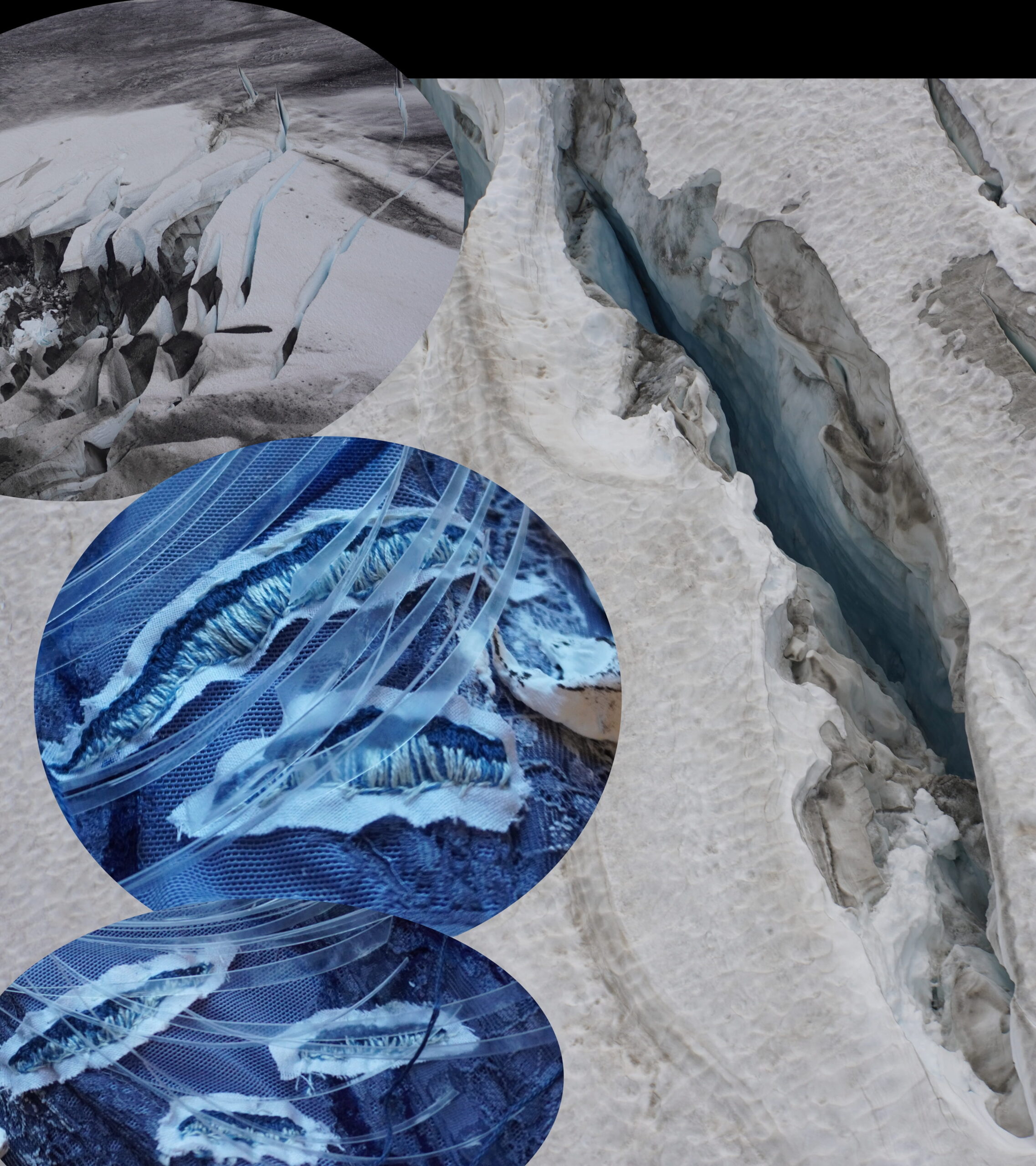
Water runs as veins. Paint traces subglacial channels along the boning of the corset, while embroidery at the ice surface connects the supraglacial streams above. Water is the life force of Mother Earth, relating these massive bodies of ice to every person sustained by them. The subglacial channels carry a sort of blood-like quality, pulsing beneath the surface, under pressure to carve new paths. Meanwhile, the supraglacial hydrology fosters relationships between systems, between ice and land, between researcher and what she studies.
The tag shows the stratigraphy of an ice core, as if to identify the glacier’s origin, history, and value to society. This is a method of field observation used in my field course in Svalbard, offering a snapshot of the local history of the region, with the layers preserving the glacier’s past conditions. Our interpretation of the past informs how we understand and interact with our surroundings. An example of engaging in extraction with little regard for reciprocity.
The moraine is the accumulation of sediments eroded, transported, and deposited by the glacier. This preserves a record of transformation, just as the body does. Just as different ways of knowing and experiencing the world have reshaped my identity and research paradigm here.
Geological Bed
Guiding Questions: What role does the past and perceptions of history (e.g. oral stories, geological evidence, books/maps) play in the embodiment of place (both in space and time)?
The geological bed is largely tied to situating myself as an Indigenous, queer woman, student, and researcher. The notion of positionality recognizes an “inherent situatedness and partiality of knowledge”5) identifying how lived experience and relational context (e.g. place) inform a researcher’s identity and approach to their work. Situatedness is a practice of contextualizing knowledge “as coming from somewhere(s) and someone(s)” and identifying oneself within a broader collective.6)
In Haa Leelk’w Has Aani Saax’u, Dr. Thomas Thornton describes how the human body is often used as a metaphor for the Earth in Tlingit culture.7) Our bodies are the first, most innate landscapes we inhabit. This intimate connection guides how we perceive and engage with our surroundings through embodied experience. Growing up, I had the privilege to foster a meaningful relationship with the alpine landscapes of Alberta’s Rockies. As I entered academic spaces, I became tied to my research aspirations and performance outcomes, suppressing ideas of non-conventional science and relational practices in hopes of gaining credibility within a system that was not built for me. I struggled to claim femininity or queerness, with internalized societal expectations quietly steering me away. I felt undeserving to even call myself Indigenous when my family has been so far removed from our culture due to genocide.
These are not confessions. They are the assumptions, the biases, the perceptions, the histories that inform my interpretations of the world around me. They create the wide-eyed wonder that allows me to co-exist among glaciers without expectations of how the landscape can serve me, or be manipulated for twisted motives. Instead, we are mutual beings, both let down and oppressed by the same colonial system, stripped of control over our outcomes, and forced to melt into molds that were never made for us. In that recognition, autonomy is returned, and with that, a power to embrace one’s identity as it navigates through these unfamiliar landscapes.
Glacial body
Guiding Questions: How can “in situ measurements” of a sense of place guide the discovery and navigation of one’s identity? How can these observations be transformed and preserved through anti-colonial frameworks of thought?
August 7, 2023 – Returning from the Juneau Icefield: A Female Prophecy
One of my good friends from the program observed that the crevasses of the icefield reminded her of stretch marks and cellulite. Understanding such a remote and seemingly untouched environment through the eyes of femininity and vulnerability was something completely foreign to me. I had perpetuated nonsensical rules about being a woman in natural science by suppressing this side of myself to meet the expectations of academia. I was constantly reminded that young, queer, Metis women don’t historically make it far in a field dominated by men in both research and exploration. For example, textbooks that were sprinkled among the icefield camps had titles like “Man and His Physical Environment” or “Man’s Role in Changing the Face of the Earth”. In that moment, I felt as if I had become part of this landscape, the stretch marks of my hips one with the ice’s stress stripes. We embodied the changes the ice experienced and carried them forward as a part of us. I witnessed the mutual role of glaciers in our lives and us in theirs, not as researchers, but as women.
That memory began to fracture something within me that I had frozen over. This idea of embodying place stayed with me, unresolved. Years later, during grad school, I took two courses centered in geohumantities and Indigenous research methods, granting me the freedom and space to finally explore these ideas. It quickly became complicated being physically in Svalbard, surrounded by European colonial narratives and academic requirements even more intensely than ever. Yet somehow, at another glacier thousands of kilometres away from this original story, I was finally forced to confront those daunting powers and shatter open.
April 26, 2025 – Women of the Snow
The boys in my program always draw penises in the snow. One day, a friend of mine asked, “how come there are never any vulvas?” I had become so conditioned to being part of the boys’ club that I was embarrassed by my body, silencing everything about myself that could be associated with weakness to appear equal and deserving. I had forgotten what equality meant at its core. I am fighting for women’s bodies to be beautifully drawn in the fresh snowfall. Not as a sign of objectification, but as a reclamation of pride and genuine humour, so we can stop debating whether women belong in the field and simply welcome them. Our bodies belong in these landscapes, not to conquer or exploit, but to connect and relate, as we did on the Juneau Icefield many years ago. I want scientists to be among glaciers and see something sentient, responsive, and reciprocal, awakening our responsibility to honour them. We have the immense privilege to be a part of landscapes on Earth that so few people will ever see, places that may not exist for much longer. That demands we show up differently than those who came before us.
As the fastest-warming region in the world, Svalbard’s glaciers are quickly disappearing, destroying layers of history and beauty that cannot be recovered. I understand this sort of loss intimately, not just as a metaphor, but as experience. The conditions that produced these silences in me are the same conditions that have treated glaciers as objects for the extraction of knowledge and resources, rather than relationships to be fostered and sustained. Glaciology perpetuates these values as if they are acceptable, and I am not the only one who has carried them into the field. But I may be the one to change it. In order to do that, I must know myself first.
Keeya Beausoleil is a first-year PhD student at the University of Sheffield studying subglacial hydrology in West Greenland using geophysical methods.
References