Inuit Sovereignty and the Future of the International Order
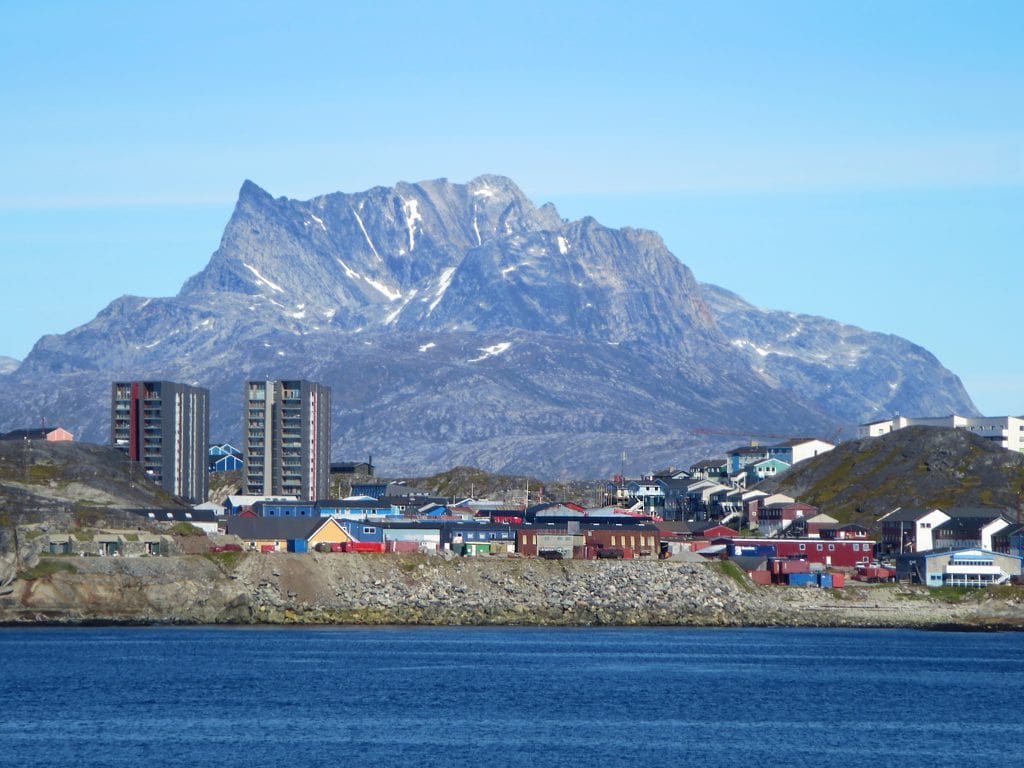
Sermitsiaq (Saddle) Mountain forms a backdrop for Nuuk, capital of Greenland. Photo: David Stanley
Inuit Circumpolar Council (ICC) Chair Sara Olsvig puts it plainly: “The Arctic is our homeland. We continue to reject the premise that our lands or peoples are commodities that can be bought or sold.” This is not rhetoric, this is the reality for approximately 180,000 Indigenous Inuit people across Alaska, Canada, Greenland, and Chukotka whose claim to Inuit sovereignty over these lands predates every state now competing for them. The past year has brought unprecedented pressure from a number of geopolitical actors treating the Arctic as a valuable asset resource rather than recognizing it as the home of thousands of people who have governed these lands for countless generations.
President Trump’s threats to use force against Greenland, a territory under the sovereignty of fellow NATO member Denmark, exposes the fragility of the international system when great power competition takes precedence. The United States justifies this through realist logic: Greenland would secure access to rare earth minerals, establish dominance over emerging Arctic sea lanes opened by climate change, and prevent Russian and Chinese influence from growing in the region.
But Trump’s reasoning completely disregards what ICC Vice Chair Marie Greene articulates: “For us, the Arctic is not just a strategic asset. It is our homeland where we have survived and governed for generations. Inuit human rights and self-determination should not be compromised to address shifts in geopolitics.” When states treat territories solely as places to be taken, it renders invisible the people who live there.
The international system is an anarchic system. It operates without a central authority to enforce rules, making institutions like NATO and norms like sovereignty crucial for maintaining order. When one of the most powerful members of a defensive alliance threatens to use force against another member’s territory, it doesn’t just violate international law, it undermines the entire foundation of the international system.
European allies initially hesitated to confront Trump directly, wary of losing US support for Ukraine and risking economic tariffs. But as threats escalated, they recognized the important precedent at stake. If territorial expansion through force becomes acceptable, the principles of sovereignty and self-determination that prevent endless conflict become meaningless. European leaders have warned that military action against Greenland would trigger a response, with some suggesting they would reconsider hosting US military bases.
ICC Vice Chair Herb Nakimayak emphasizes that “our future, the future generations of Inuit, depend on Arctic cooperation, and on our region to remain peaceful.” Climate change is transforming the Arctic incredibly quickly. The communities bearing these changes need investment in sustainable development, not military conflict over sea lanes and mineral rights.
The protests in Greenland, which drew record numbers rejecting US control, demonstrate what ICC Vice Chair Hjalmar Dahl emphasized: “Our right of self-determination is not up for negotiation.” Yet the very fact that such protests occurred in the first place shows how quickly international norms erode when powerful states prioritize strategic interests over human rights and international law. Greenlanders have made their position clear–many seek greater autonomy or eventual independence, not trading Danish control for American authority. Self-determination means their consent is required for any change in sovereignty. Taking territory without consent always violates international law, regardless of strategic rationale–a point that the Arctic Institute has argued in detail, noting that historical precedents like the Louisiana Purchase predate today’s system built around Indigenous rights and self-determination. As ICC Vice Chair Valentina Leonova noted, “Any discussions on this matter should be conducted with the full participation of the legitimate government and representatives of its people, and with respect for existing sovereignty.”
The alternative to respecting self-determination is a militarized Arctic where territorial ambitions supersede human rights, international law, and long-standing norms. Russia has already expanded its Arctic military infrastructure, and China has invested heavily in polar projects. If the United States pursues Greenland through force, it legitimizes exactly the behavior it claims to oppose from competitors.
The ICC has stood united for nearly five decades, defending Inuit rights across state borders. As Dahl concluded: “The time to stand shoulder by shoulder for our rights is now.” The international community faces an important choice: uphold the principles of sovereignty and self-determination that prevent endless conflict, or watch those principles dissolve when powerful states find them inconvenient. This tension was on full display in July 2026, when Trump used a NATO summit in Ankara to renew his demand that the United States take control of Greenland, brushing aside Denmark’s objections even as the alliance tried to appease him with billions of dollars in new arms deals. That the world’s most powerful military alliance is accommodating one member’s territorial ambitions instead of confronting them shows that the old norms are weakening. What happens in Greenland will determine whether international law, institutions, and norms actually mean anything.
Thomas Rivier is a student at Colgate University studying political science and international relations.