Ecologies of Collaboration: Art–Science Methodologies in the Arctic
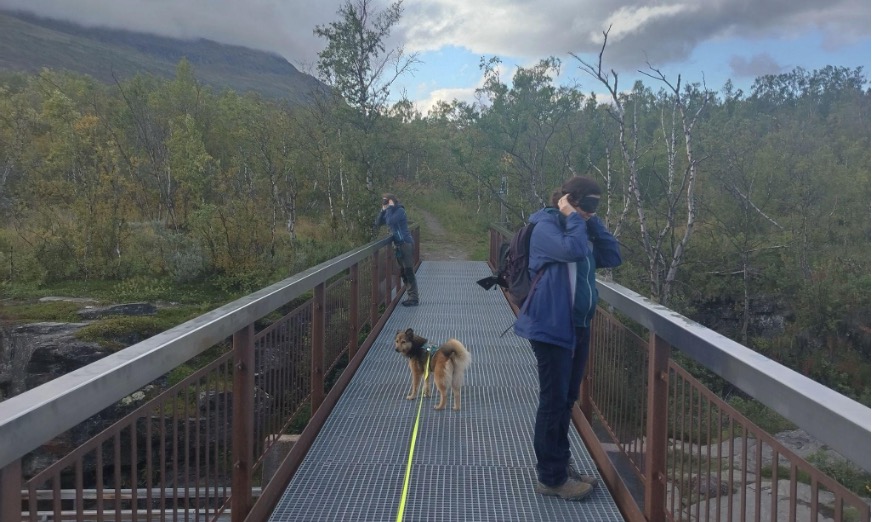
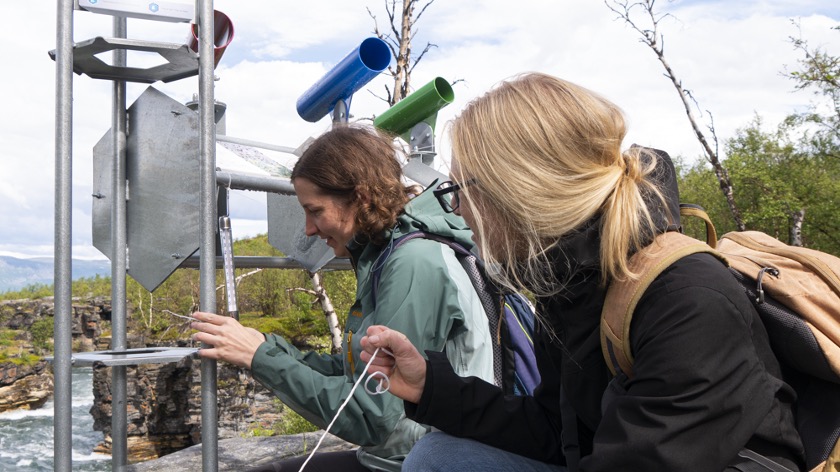
Gehrmann, Lindt and dog Susi experiencing Joost’s listening walk by the Abiskojokk, Ábeskoeatnu in 2024. Photo: Mari Keski-Korsu
The Arctic Institute Cryosphere Series 2026
- The Arctic Institute’s 2026 Connecting the Cryosphere Series: An Introduction
- A Map of the Arctic Ocean
- A Skier Goes for a Glacier Walk
- What Rights Cannot Hold: Sea Ice and the Exhaustion of Legal Imagination
- Collective Memory of C’ulc’ena’ Łuu’ / Gulkana Glacier
- Geomorphology of Self: a Glaciological Exploration of Cultural, Feminine, and Queer Identity among the Landscapes of Svalbard
- Ecologies of Collaboration: Art–Science Methodologies in the Arctic
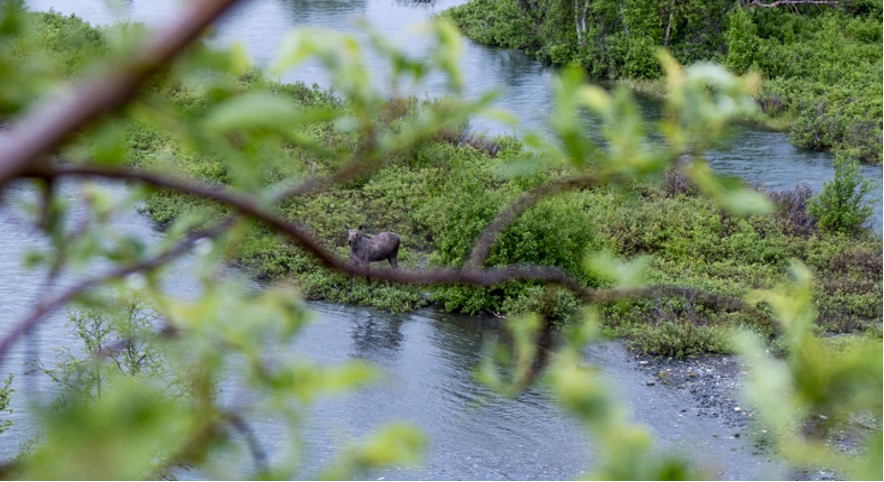
The cryosphere of water bodies store time in compression and fracture under shifting pressure. All watery bodies – moose, pine, human, lake – are bound within this delay, release and return of liquidity, where collaboration takes shape like water itself: forming through contact, pressure, and patience, and reshaping everything it touches.
As climate-driven environmental changes in the cryosphere intensify alongside geopolitical and societal tensions, the need to connect diverse knowledge systems and communities has become more urgent than ever. Understanding human-nature relations has become as critical as monitoring physical processes, as it reveals how remote cryospheric landscapes are experienced, valued and contested. Transdisciplinary collaboration offers an important framework for bringing together scientific, artistic, and lived forms of knowledge to address the complex social and environmental challenges shaping the cryosphere today. In response to this challenge, the Swedish Polar Research Secretariat invited multidisciplinary research proposals under the Access Abisko 2019-20 call, aiming to foster new forms of interaction at the Abisko Scientific Research Station.
Located within Ábeskovvu, Sápmi, the research station has been a central hub for Arctic research since 1913. This area exemplifies the multiple, sometimes conflicting, human relations within a more-than-human world through tourism, industry, research, Indigenous land-use forms such as reindeer herding, and everyday residential life, which are present in many remote regions of the cryosphere. We assembled an international, multidisciplinary group of three scientists and three artists to conduct the project, “Changing perspectives – nature’s contribution to people in a changing world,” aimed at exploring the relational values of nature to humans. In this article, we reflect on our shared experiences of transdisciplinary work: perspective shifts and learning, non-directed interactions and synergies. We then disentangle how these organic processes lead to the overcoming of epistemological differences and communication barriers, while fostering trust, openness, and mutual learning. We found that by prioritizing relationality, reflexivity, and inclusivity, a collective experience and dialogue evolved, which resulted in the co-construction of knowledge.
The Valuation of Nature Beyond Instrumental Approaches
Since the publication of the Millennium Ecosystem Assessment,1) there have been many rebuttals on whether estimating the value of ecosystem services provided by a non-human nature to sustaining life on Earth is meaningful, ethical, or helpful.2) In response, the Intergovernmental Science Policy Platform on Biodiversity and Ecosystem Services (IPBES) expanded the largely quantitative and instrumental valuations of nature to include diverse, plural knowledge systems and relational, context-specific values within ‘nature’s contribution to people’ (NCPs).3) Relational values pertain to the “preferences, principles, and virtues associated with relationships, both interpersonal and as articulated by policies and social norms”.4) The meaning of relationships to non-human nature is central, rather than the process or outcome of evaluation.5) There is a strong consensus that including relational values is important for informing nature conservation policies, environmental ethics, ecosystem services valuation, and environmental psychology.6) Relational values are important because they capture some of the meaningful ways people relate to the rest of the natural world, such as care and reciprocity. These relations can be important sources of cultural identity and a sense of belonging, which often strongly motivate environmental protection beyond economic or purely ethical considerations. If these values are excluded, the legitimacy and acceptance of policy decisions become weak, especially those concerning conservation.7)
A call for transdisciplinary collaboration
The diversity of disciplinary perspectives in studying the relational values of nature highlights the complexity of the topic.8) Discipline-specific research risks epistemological narrowness9) and communication barriers, for instance, brought by the use of discipline-specific language and conceptual frameworks.10) It also fails to incorporate the diverse perspectives, especially from Indigenous Peoples, needed to address interconnected societal and environmental challenges.11)
Transdisciplinary thinking is often cited as essential to tackling the multiple, interwoven, complex crises of the climate emergency, biodiversity loss, rising inequality, and more.12) Transdisciplinary collaborations integrating art-based methods, artistic research, and art-centred transdisciplinary approaches have emerged recently to explore and articulate the relational values of environmental stewardship and sustainability.13)
Cross‑Disciplinary Participation
To explore the complex relational values of nature in the Abisko region and address the challenges mentioned, five sub-projects were initiated, each led by a team member with the active participation of the others. Conducted over three years (2022-2024), these sub-projects used visual, listening, movement, somatic, analytical, imagination, and conversational participatory activities, inviting Sámi Indigenous and non-indigenous locals, visiting researchers, and tourists to explore and share their relationships with the local landscape. Whenever possible, different group members met in Abisko, creating frequent opportunities for social exchange, discussion, inspiration, and mutual support.
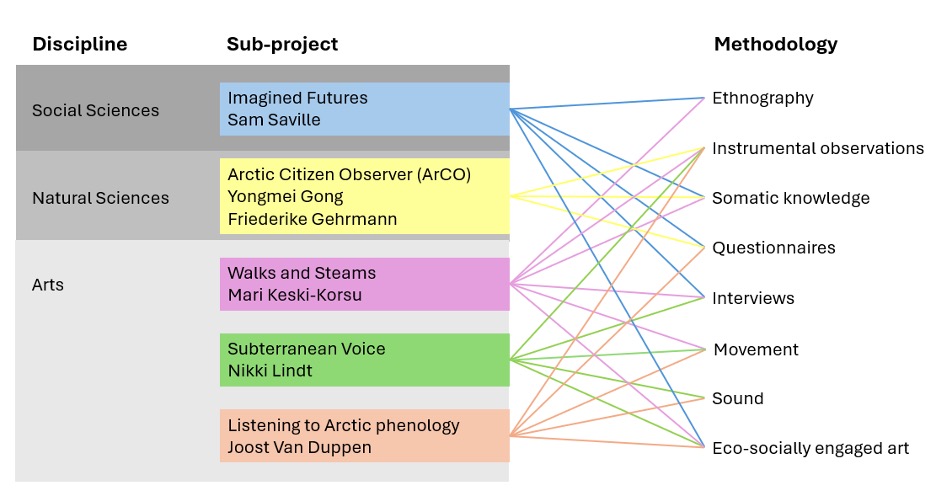
| Sub-project title | Description | Lead researcher |
|---|---|---|
| Walks and steams | Sensory ethnography and walking methodologies to ritualise with intuitive and empathic acts. The focus on the changing conditions of palsa mires, the ancient microbes of the permafrost thaw, and the means of walking with them. Develops and proposes more-than-human ritualisation as a part of ecocultures: permeating art, science, technology, geopolitics, and (more-than-) human communities as well as raising awareness of engagement in the context of planetary polycrisis change. Participatory performances (walks), installations, and a video artwork. | Mari Keski-Korsu |
| Listen to Arctic Phenology | Combines long-term acoustic observation, participatory listening walks, soundscape survey questions, and public performances to explore how seasonal change in ecosystems can connect environmental listening with human experience. | Joost van Duppen |
| Subterranean Voice | Artistic research project investigating how sound moves through soil, ice, and geological formations. Recording underground in Abisko, the project studies the transmission of sound through space while also approaching sound from the perspective of the ground and the ecosystem itself. Field recordings and interviews with local residents, researchers, Sámi knowledge holders, and visitors reveal the sonics of a rapidly changing planet. Sound library, public art installation (Abisko National Park), album, and exhibitions. | Nikki Lindt |
| Arctic Citizen Observers (ArCO) | “Citizen observers” are asked to record the temperature measurements on thermometers installed at several locations in nature in an online survey. Survey questions also invite them to “sense” the surroundings and imagine a changed future landscape. The comparison between “sensed” and measured temperatures is used to explore people’s perceptions of environmental change. | Yongmei Gong, Friederike Gehrmann |
| Imagined Futures | Exploring values of nature around Abisko through workshops creating postcards of the future, visitor surveys, and interviews. | Sam Saville |
Reflexivity as a method
Reflexivity is an important methodology for qualitative research, which can impact attitude, understanding, and interpretation of the research experience.14) In Changing Perspectives, it served as a lens through which we distilled our shared experience of transdisciplinary work. Together, we explored personal relationships with nature, methodological exchanges across disciplines, and the collaborative construction of knowledge. After the primary research phase, group members wrote individual reflections, examining their experiences of working together. We collectively analysed our reflections into four interrelated themes:
- Framing the Journey: Expectations, openness, and transdisciplinary grounding
- Immersion and intra-action
- Cross-pollination of practices
- Nature’s relational values in transdisciplinary practice
Framing the Journey: Expectations, Openness, and Transdisciplinary Grounding
The project was intentionally structured with minimal hierarchy to allow for autonomous project development and to create an atmosphere where each member’s expertise was equally valued and respected. The principal investigator of the research group Friederike Gehrman (FG) encouraged members to define their sub-projects within the shared theme and adapted her guidance according to individual personalities and needs: “The group came together organically… As there was no (exact) pre-conceived idea about who the group should consist of, I was very open to anyone interested in the topic.”
Transdisciplinary collaborations are often described as fragile, fraught with conflict and challenges.15) However, our project – exploratory from the start – was characterised by openness and curiosity, where group members did not rigidly stick to their known disciplinary tools but sought to stretch their comfort zone and learn from each other, as exemplified in section 3.
Entering this project as researchers and artists with decades of disciplinary experience, group members carried deeply embedded methods and epistemologies that shaped their professional identities. Combined with the individual personalities, this created occasional points of productive tension that generated new ideas, directions, and collaborative growth. For FG, her internal conflict between scientific method and more relational understandings was a key motivator for initiating the project.
FG: “As a natural sciences researcher, I have always measured natural processes using precise, pre-defined scales and tools. […] I found two problems with this approach: First, the classic a priori definition of hypotheses or research questions can narrow our view and certainly limit the possible answers we can get […]. Second…, I have always felt that my personal perception of nature is not reflected in my scientific approaches.”
As the launch of the project coincided with the COVID-19 pandemic, the official start was delayed for two years. What seemed like an unfortunate consequence at the time became a strength, as group members were able to form relationships slowly and begin learning from each other’s methodologies before officially starting the project.
Artist Nikki Lindt (NL): “[…] Looking back, this extra time gave us a chance to get to know each other more deeply before beginning our work…All six of us started regularly meeting online.” As Campbell et al. (2024) discuss, trust is essential in transdisciplinary projects, and this longer lead-in was, in hindsight, a key factor in building trust in our team.
This experience can be expanded to the relationships with the participants of our project activities. As FG had been living in Abisko for four years prior to the start of the project, existing relationships with local participants, fostered over several years, facilitated their participation in the project. For multi-disciplinary projects at large, building trust and understanding with stakeholders and participants, especially if preceded by preconceptions or previous negative experiences, can only be achieved with time. It is also the only way by which dialogues on sensitive socio-environmental issues can be truly open and inclusive.
Although the project at times appeared to lack structure, a novel organizational framework was in fact emerging. The non-hierarchical atmosphere fostered a collaborative environment characterised by openness, allowing space for all voices and disciplines to be represented. For example, glaciologist Yongmei Gong (YG) felt a freedom to contribute: “I feel like my opinion and suggestions were well received, even if I was not an expert in the field. I am very happy with our openness. This is the unique thing about our project, that we were not acting according to ‘the playbook’.”
Abisko itself played an essential role in the project, not merely as the site of our research, but as a slow-unfolding presence that shaped our collaborative dynamics. Place was not static but relational16) with Abisko an active co-constituent in our work and thinking. This relational dynamic between people, disciplines, and place parallels calls to understand the environment as agential, dynamic, and responsive. Lantto Klein, Dixon & Williams17) for example, speak to the value of making space for the uncertain, unfamiliar, and unexpected qualities that surfaced over time in our research. An approach of dynamic interaction with and guided by the place itself felt appropriate given the “experienced and inherited knowledge”18) of Indigenous and local people on the value of nature in this area which harbours tensions between the environment, the community and the industry.
Immersion and intra-action
Throughout the project, group members reported various instances of shared immersion that can also be described through feminist physicist Karen Barad’s concept of intra-action.19) According to Barad, intra-action challenges the notion that separate entities precede their relations. Instead, subjects, objects, and agencies emerge through material-discursive entanglements that form us.
One interface of such immersion and entanglement was the active participation in each other’s project activities, through which everyone expanded their methodological repertoires and deepened their understanding of diverse approaches to valuing nature. Experiences such as the collective listening walk and cross-disciplinary interviews created opportunities for curiosity-driven learning and mutual appreciation. For example, the listening walk by artist Joost Van Duppen (JVD), developed to build a connection to the acoustic side of nature, was joined by FG, YG, and artist Mari Keski-Korsu (MKK). YG reflected that “it is a very nice learning experience. Coming from a natural sciences background, all these methods are new and refreshing.” Another example is the interviewing of FG by NL on FG’s connection to the nature in Abisko, which resulted in one component of the Subterranean Voice; Abisko project.20)
These interactions not only broadened individual perspectives but also revealed the limitations of single-discipline methods, particularly in capturing the relational and experiential dimensions of human-nature connections. FG found “many more possibilities in which people can access and describe their relationships to nature, for example through visual, audio, and participatory methods. This helped [her] understand that research methods from natural sciences will never be able to access people’s inherent knowledge of nature’s value to them.” Similarly, in walking ritualisations with locals facilitated by MKK, the experiences of the participants on the changing environment matched with the findings of natural sciences but reached beyond: to the embodied and emotional.21)
The interaction with each other’s project activities was based on genuine interest and curiosity, facilitating mutual understanding and learning. This immersion also led to a deepening of the discussions around the project, which, in turn, led to new ideas and even co-creation, as NL reported: “We experienced Joost’s listening walk together as a group, and it led to more conversation. This was very representative of our circular way of working. We deepened ourselves through working together and then dove in again and again, growing together all the time.”
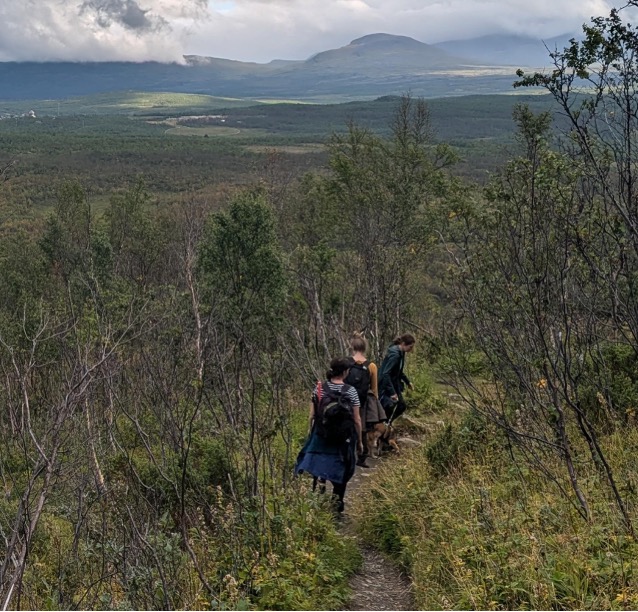
Some of the immersion occurred in more subtle ways through co-presence in shared time and space. Being physically present in Abisko at the same time, the group spent a lot of informal time together while cooking, eating, walking, or going to the sauna, something that was noted by all participants. SS reflected “it takes time to communicate and ‘be with’ each other […] and it is worth investing in that,” and JVD states that throughout the social interaction, “ideas flowed naturally, shaping the trajectory of our work in ways that online meetings could not.” NL reported how working together during a longer period of time slowly influenced the group: “It’s hard to pinpoint exactly when and where these deep influences came from, but I think the extensive conversations we had been having during meals and walks that seemed ‘just social’ were igniting all our thoughts and changing perspectives.” Over time, this sustained togetherness gradually shaped individual thinking and creative practice, often in ways that were difficult to trace to specific moments but were nonetheless transformative.
Immersion – both intentional and incidental – served as a catalyst for co-creation, reflexivity, and evolving perspectives. This experience underscores the importance of investing time in shared experiences and relational processes as foundational elements of successful transdisciplinary work.22).
Cross-pollination of Practices: Collective Synergies and Shared Affirmations
Nature’s Contributions to People acted as a loose conceptual thread and boundary object: it being expansive and adaptable in allowing and encouraging different forms of knowledge and values to be accounted for.23) Artistic research methods can also be conceptualised as boundary objects that straddle the arts-science divide by producing knowledge that goes “beyond words”,24) or indeed beyond numbers. Our exploration of the plurality of nature’s values resulted in both the expansion of our own methodologies as well as their affirmation, centred around shared embodied and sensory experiences.
For example, the attention, listening, recording and production of artistic pieces and participatory experiences involving sound had a direct and circular impact on the rest of the group. The citizen science project used the somatic experience of temperature as a reflective act – not to collect accurate meteorological data but to connect bodily sensation with environmental imagination. Similarly, SS incorporated questions about sensory experience and soundscape impressions into her visitor survey, inspired by the artists’ embodied practices.
Inspired by the methodology introduced by SS, the artists reflected more deeply on the function, structure and length of interviews. For example, in Subterranean Sounds,25) NL “…was inspired to dig deeper into the gathering of local information through interviews and conversations. Sam helped me understand how interview questions can touch on different bodies of knowledge and how to access this.”. MKK conducted in-depth interviews on walks with locals as co-researchers combining sensory ethnography and walking methodologies, both as art and research “to add to the creative process of developing participatory performance as a ritual and an artistic tool..” within polycrisis.26) JVD realised that across the listening walks,27) the year-round audio stream and recordings,28) including in the urban setting 29) the recurring questions on seasonal soundscape change enabled the documentation of shared human experiences, adding a relational dimension to his practice.
The reciprocal influence between all the group members often led to a re-examination of individual perspectives and deeper reflexivity. For example, SS welcomed being questioned on her interpretations: “I had quite a realization that my ‘research brain’ is trained to look for, and be interested in, tensions, conflicts, or ‘hot moments’ as these are often where different values are exposed or become easier to read. FG’s perspective was that such conflicts are not so inherently interesting, rather, we should present different perspectives side-by-side without judgement … a different lens that led me to some different questions”.
For MKK, working and sharing space with scientists brought “inspiration and friction”, whereas YG reached an understanding of how art can reach beyond science in connecting people to climate change: “I think my perspective has changed drastically! When I started to work together with artists in Abisko, I realised the big gap between scientific findings and what ordinary people register in their minds… But glacier melting, permafrost thawing seem to be so far away from the day-to-day lives of urban dwellers. Art projects like the Underground Sound Project (NL) bring these faraway climate change indicators closer to people[…]. They can strengthen people’s connection with nature and spark emotions.”
Implications for Research on Nature’s Relational Values
Abisko village is located in Northern Fennoscandia, on Indigenous Sámi land (Sápmi), and is home to various other-than-Indigenous Northern communities such as Kvens, Lantalaiset, namely Tornedalians. Within these Northern ecological knowledge traditions, nature and culture are not understood as a binary; rather, they form what can be described as an ecoculture— reciprocal and inextricable relationships among humans, the ecological systems they dwell-with, and individual psychology and spirituality.30) This relational ecoculture of Abisko was intrinsic to this research and intertwined with the situated knowledges31) of the researchers and artists involved in the study. Transdisciplinary research exploring values of nature, we argue, benefits from approaches that challenge anthropocentric standpoints32) and that should pay deep attentiveness to local contexts, applying decolonial, inclusive, sustainable, and participatory research and art practices.33)
Our findings suggest that studying relational values requires methodologies that are themselves relational and open to transformation. Art-based and artistic research approaches are particularly well suited to this task, as they make relationality perceptible through participation. Collaborative and transdisciplinary approaches foster multiple ways of knowing. By facilitating inclusive platforms for participation, such methods help reveal values that might otherwise remain invisible. Furthermore, these platforms operate across scales: from local engagements in Abisko – such as walks, workshops, and exhibitions at Abisko Naturum, Abisko Scientific Research Station and in the Abisko National Park – to artworks and publications presented elsewhere.34) In this way, the project contributes to the various ways of knowing and lived experience of local communities while also extending beyond the locality into broader academic and everyday contexts.
The project also underscores the need to actively address the challenges inherent in transdisciplinary collaboration, including differences in language, knowledges, methodological approach, culture, expectations, and evaluative criteria that shape the situated knowledge base, all of which were present in our project. Sustained dialogue, mutual learning, and reflexive practice are essential for navigating these complexities and translating diverse insights into meaningful contributions to sustainability research and practice.
Toolbox for Transdisciplinary Collaboration
Based on our collective experience, we identify several enabling factors for successful transdisciplinary research on nature’s relational values:
- Adequate time for relationship-building, including informal and unstructured interactions.
- A minimal but supportive framework that balances openness with shared thematic grounding.
- Non-hierarchical working structures that value all forms of expertise equally.
- Reflexivity as an explicit methodological component, rather than a post-project reflection.
- Place-based immersion, allowing environments to act as co-constituents in knowledge production.
- Plural methods, combining analytical, sensory, imaginative, and embodied approaches.
Together, these elements form a methodological orientation rather than a prescriptive model. They offer a flexible toolbox that can be adapted to different contexts while remaining grounded in the relational ethos required to meaningfully engage with nature’s diverse values.
This collaboration demonstrates that transdisciplinary methodologies not only enrich empirical understandings of nature’s relational values but also reshape how research itself is practiced. By prioritizing relationality, reflexivity, and inclusivity, such approaches can bridge epistemological divides and support more holistic, ethical, and actionable engagements with changing human–nature relationships.
Dr. Friederike Gehrmann is a plant ecologist and writer and works as a managing editor of a plant science journal. She explores her connection to nature from both a scientific and an innate artistic perspective. Dr. Yongmei Gong is a geophysicist now working as a senior science officer for the IPCC Working Group I Technical Support Unit. Her Ph.D. and research looked into the interaction between the climate and glacial systems using computer models and field observations. Nikki Lindt is an interdisciplinary artist whose practice centers on listening to the normally inaudible subterranean sounds within Arctic and other changing environments. Working collaboratively with scientists, Indigenous knowledge holders, and local communities, she translates these encounters into sound installations, paintings, and participatory projects that explore climate change and our interdependence with the more-than-human world. Mari Keski-Korsu (M.A, Doctor of Arts) is an artist and artistic researcher whose current postdoctoral research in Umeå University, UmArts & Arctic Centre addresses the role of art in more-than-human decision making, Rights of Nature and Northern traditional ecological knowledge. Dr. Sam Saville is a social scientist, Senior research fellow at Ecologos Research and Senior Lecturer in Sustainability at the Centre for Alternative Technology. Her work explores values, ethics and human-nature relationships. Joost Van Duppen is a sound artist working at the intersection of sound, ecology and science, using field recordings to create sound-based works that explore environmental change and the connections between tundra, forest and urban environments through listening.
This project was financially and logistically supported by the Swedish Polar Research Secretariat (Access Abisko call 2020-2022).
References