The Teetering State of Norwegian-Russian Management Cooperation of Northeast Arctic Cod Stocks
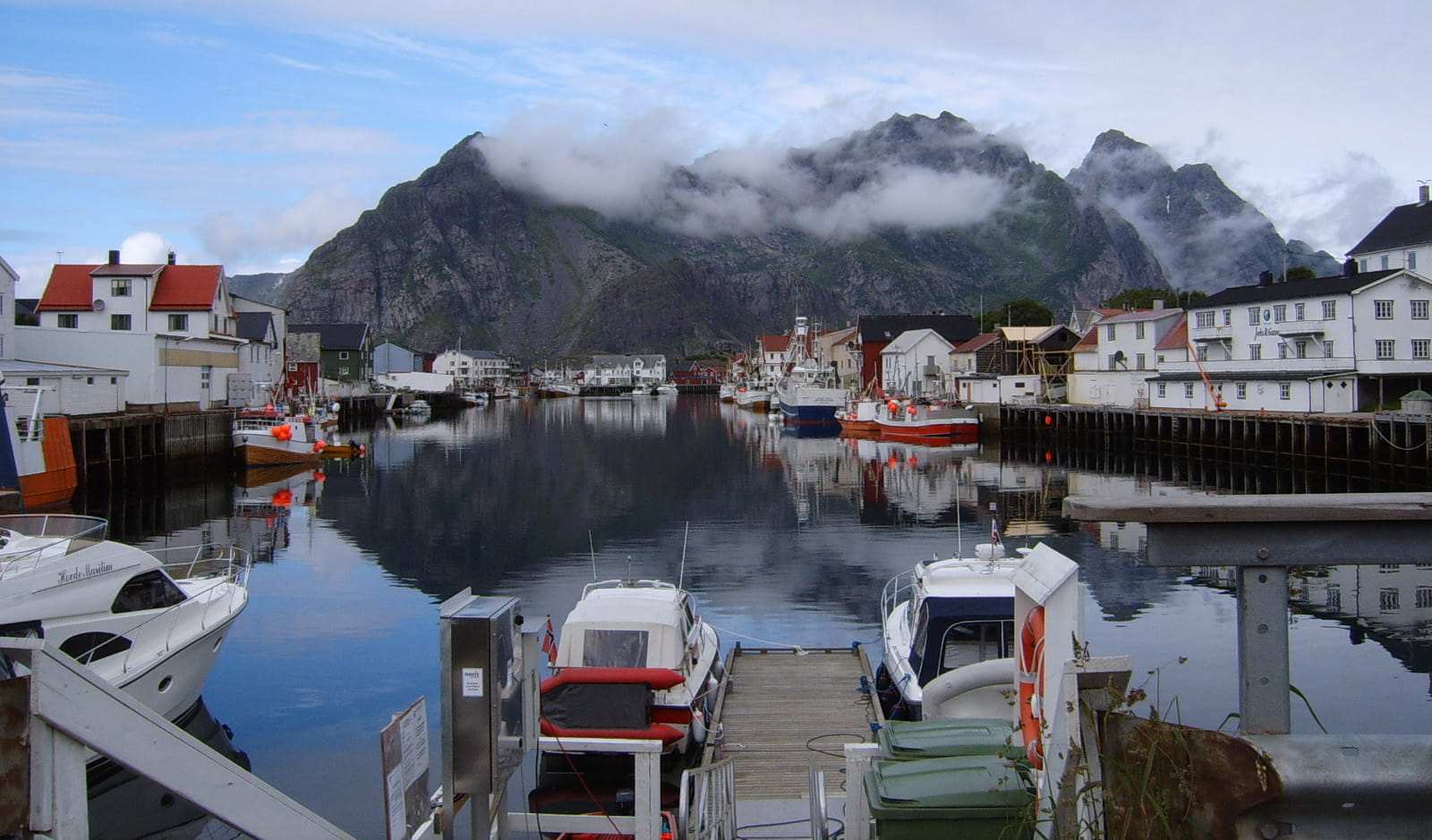
Fishing boats in Henningsvær harbour, Lofoten, northern Norway. Photo: Vberger
The Northeast Arctic cod fishery, located in the Barents Sea between Russia and Norway, has been a remarkable success story of trans-boundary fisheries management. The industry, estimated to be worth nearly $3 billion annually, is regarded by both commercial and recreational fishermen as the world’s premier cod fishery.1) This is due to the highly competent management of the fishery by two countries that are otherwise political adversaries – Norway and Russia. However, the health of this fishery is in severe jeopardy as political and natural forces align to create a “perfect storm” for its decline.
What is the history of this relationship and where does it risk heading?
The history of Norwegian-Russian fisheries cooperation on Northeast Arctic Cod
The Northeast Arctic Cod population, which calls the Barents Sea home, is divided roughly into two parts between the waters of Russia and Norway.2) Juvenile cod grow and feed in Russian waters and then mature and move into Norwegian waters to spawn. Every year, the Joint Norwegian-Russian Fisheries Commission (legally based on the 1975 Agreement on Cooperation in the Fishing Industry and the 1976 Agreement Concerning Mutual Relations in the Field of Fisheries bilateral treaties) sets quotas, allocates shares, and coordinates scientific research between the two countries.3) Historically, Russian vessels have been permitted to fish in Norwegian waters in order to take pressure off the smaller sized cod which reside in Russian waters and allow for a more sustainable harvest.4) Russian vessels are also allowed in Norwegian ports (specifically Kirkenes, Båtsfjord, and Tromsø) — among the very few European ports (the Faroe Islands being another interesting case of continued fisheries management with Russia) which they still have access to after Russia’s full-scale invasion of Ukraine.5) Russian vessels use Norwegian ports to refuel and offload their catch, while these visits also allow Norwegian officials to monitor adherence to catch quotas.6)
Since its establishment in 1975 and throughout the cold war, the modern framework for Norwegian-Russian fisheries cooperation has managed to withstand all manner of political pressure.7) Four years after the start of Russia’s war in Ukraine, it may finally be showing signs of cracking. The cod, the fishermen whose livelihoods depend on them, and the billion dollar industry they form together have been caught in the crossfire of politics.
What happened after Russia’s full-scale invasion of Ukraine?
After Russia’s 2022 invasion of Ukraine, the Arctic’s status as a potential “hot” front between the West and Russia intensified.8) Critical Western gas, telecommunications, and military infrastructure were lucrative targets for Russian espionage, and the country’s fishing fleet, already having access to EU and British waters, proved the perfect vessels for such operations.9) In response, the United Kingdom banned all Russian vessels from its ports on March 1, 2022.10) Norway, however, continued to allow Russian fishing vessels in its Exclusive Economic Zone (EEZ) even as Norwegian authorities became increasingly aware of the pervasive presence of Russian state security officers on board fishing vessels.11) The Norwegian government has justified its policy by citing the importance of keeping fishing pressure on the mature cod stock in Norwegian waters as opposed to the juvenile cod stock residing in Russian waters, allowing for a more sustainable catch and easier enforcement of fishing regulations by Norwegian authorities.12)
In July 2025, following the EU’s 17th sanctions package against Russia, and citing Russian actors engaging in espionage aboard Russian fishing vessels, Norway banned two Russian fishing companies, Norebo JSC and Murman Seafood, from fishing in Norway’s exclusive economic zone (EEZ).13) Combined, these two companies accounted for 40% of Russia’s cod catches in the Barents Sea.14) The Russian Ministry of Foreign Affairs and Russian Federal Agency for Fisheries in turn reacted in fury, threatening to completely end fisheries cooperation with Norway.15) However, they did not act upon this threat not least because cod’s status as one of Russia’s most valuable fish products meant that doing so could have harmed Russia’s own vital commercial interests. For instance, Russia exported $389.2 million dollars worth of frozen cod to China in 2024.16) This episode, nonetheless, brought Norwegian Russian cooperation on managing this fishery to the brink, and although the dust on this specific instance has now been settled, new threats to this relationship have only continued to emerge.
EU pressure and reactions
At the beginning of May of this year, the EU Commissioner of Fisheries, Costas Kadis, told the Financial Times that the fishing cooperation between Norway and Russia should be “scaled back,” appearing to be the first time such a senior EU official has expressed publicly this tension between Norway’s reliance on its fisheries cooperation with Russia and the EU’s security concerns.17) The FT notes that presumably, this was done in the context of the EU revisiting its Arctic Strategy to bring it in line with ever increasing security threats from Russia.18) Famously, fisheries independence played a key role in Norway’s two-time rejection of EU accession, via referendums in 1972 and 1994.19) Experts on Russian-Norwegian fisheries cooperation, such as the Fridtjof Nansen Institute’s Geir Hønneland, are quick to sound the alarm when this cooperation comes under attack.20) In quotes to Norwegian Broadcasting Corporation (NRK), he stresses both the logical nature of jointly managing these cod stocks and the legal obligation, under the UN Law of the Sea, of both countries to do so.21) Russian experts and officials have made remarkably similar arguments for the preservation of cooperation between the two countries. In a quote to Russian state news agency Interfax, the head of the Russian Federal Agency for Fisheries, Ilya Shestakov, stated that:
The actions of the Norwegian side will inevitably lead to the destruction of the effective system for managing and regulating fisheries in the North Atlantic, which has been built over many decades and is intended to ensure the long-term, rational exploitation of shared aquatic biological resources.22)
This was in response to the aforementioned July 2025 ban by Norway on two Russian fishing companies.23) Although politicized language will inevitably be used by public officials like Shestakov, fundamentally, both Norway and Russia seem to value the practical benefits of jointly managing this fishery and thus are reluctant to see it permanently terminated.24)
Declining cod stocks in the Arctic
These increased political pressures on Norwegian Russian fisheries cooperation come at a difficult juncture. Cod stocks in the Barents Sea are currently declining.25) Scientists believe this is primarily a result of weak recruitment, meaning fewer cod survive their early years to reach harvestable age.26) Cod fishermen are already feeling the pain; according to the All-Russian Association of Fishery Enterprises, Entrepreneurs, and Exporters(VARPE), Russian fishermen reported catching 147,400 tons of cod from January 1 – June 15 of 2026, marking a 12.3% decline from the previous year.27) A March 2026 study on the weak recruitment in the fishery by Johannesen et al. outlines three main hypotheses for this weak recruitment: that the Barents Sea has reached carrying capacity; that overfishing has depleted the spawning stock; or that climate change has decreased the food supply for cod larvae.28) Subsequent agreed cuts to the fishing quotas by Norway and Russia have been dramatic.29) The 2024 cod total allowable catch (TAC) was about 453,000 tonnes, the 2025 TAC about 340,000 tonnes (a roughly 25% reduction), and the 2026 TAC about 285,000 tonnes, marking another 16% reduction, and which is the lowest quota since 1991.30) Such sensible declines in the catch quotas, and potential future scientific cooperation to identify next steps in stabilizing the situation, are only possible if the two countries continue to work together.
The nightmare scenario and historical lessons
If Norwegian-Russian fisheries cooperation were to collapse, then the combination of poor management and worsening natural conditions may prove to be insurmountable for the cod stocks.The expert community warns that in a nightmare scenario, Russia may look to supplement its diminished fishing capacity in the case of a ban by Norway of Russian fishing vessels in its waters by allowing Chinese vessels to target the cod as well, sending the fishery into a death spiral, as more fishing pressure would pile on Russian waters.31) The supplementing of Russian fishing capacity with Chinese vessels is a scenario Russian fishermen and policy makers are equally eager to prevent. Russia launched reforms in 2016 with its инвестквота (investment quota) system designed to encourage Russian built vessels, domestic processing, and production ownership in the fisheries sector, and seems keen to protect its sovereignty in the Arctic from China for as long as possible.32) One can look to the Northwest Atlantic cod population as a cautionary tale for what happens when cod stocks collapse.33) Industrial, unsustainable fishing during the 20th century led to their infamous 1992 destruction, where stocks were estimated to be at 1% of their historic abundance.34) Canada imposed a total moratorium, but more than three decades later, stocks have not nearly returned to historic levels.35) Coastal communities were devastated and billions of dollars lost.36) The annihilation of the Northwest Atlantic cod population completely changed the ecosystem they once inhabited, making recovery incredibly difficult.37) If the Northeast Arctic cod stock collapses, the Atlantic case suggests that it is far from guaranteed that it would be able to recover.
If Northeast Arctic cod stocks were to become unfishable, then certain Norwegian coastal communities would be economically devastated. For 2023, the Norwegian government stated that fisheries and the wild-fish industry accounted for 80% of private-sector employment in the municipalities of Røst, Værøy, and Gamvik.38) The Norwegian government has acknowledged that cod in particular is the fish keeping many such coastal communities economically afloat.
Cod is the most important whitefish species, both in terms of landed volume and value… cod therefore has great importance for the fish-processing industry and for many fisheries-dependent coastal communities.39)
Not only would a lack of cooperation ecologically hurt the cod population, but the institutional knowledge and partnerships that go into successfully managing such a fishery would undergo generational harm.40) After Russia’s invasion in 2022, the Biden Administration ordered all US government environmental agencies to cease their contact and cooperation with Russian partners, the effects of which eventually trickled down to the NGO. sector as well.41) In her June 2025 publication, the Belfer Center for Science and International Affairs’ Margaret Williams outlines the dismal effect that ending formal Arctic environmental cooperation by the U.S. with Russia has had.42) Hundreds of joint projects and institutional knowledge stemming from partnerships on climate monitoring, fisheries science, wildlife conservation, and ecosystem management are all gone.43) She notes that many Arctic environmental issues are simply impossible to address without some sort of cooperation given that Russia occupies roughly half of all Arctic coastline.44) This type of breakdown in environmental cooperation now threatens to extend to Norway.
Undeniably, it is vital that Norway implements measures and articulates policies aimed at protecting its own interests, as well as those of Europe, in the Arctic in the face of an increasingly unpredictable and hawkish Russian security apparatus. At the same time, however, cooperation between the two countries remains necessary to address the growing threats facing Northeast Arctic cod stocks. Were these stocks to collapse, the consequences would likely far outlast current tensions between Russia and the EU and would severely affect Norwegian and Russian fishermen alike. As such, Norway’s most prudent course of action is not to choose between fisheries cooperation with Russia and addressing broader European security concerns, but to balance these competing interests as carefully as possible. Norway should continue to support practical cooperation on fisheries management where it remains in its national interest, while also acknowledging that Russian hybrid tactics and the increasing militarization of civilian infrastructure may place limits on the extent to which such cooperation can be insulated from wider security considerations. Rather than assuming that Russia will cease these activities, Norway should establish clear boundaries around what forms of cooperation remain acceptable while coordinating with its European partners on emerging security concerns. If Norway and Russia can preserve a degree of pragmatic cooperation despite these broader tensions, Norwegian-Russian fisheries cooperation can continue to provide an important example of how transboundary resource management can be maintained even amid significant geopolitical disagreement.
Savva Brown is a Programme Officer at the University of Central Asia.
References