For the first time during this year’s Arctic Frontiers conference, we conducted a series of short interviews with some of the many speakers and participants at the conference. This project is a collaboration between The Arctic Institute, Arctic Frontiers, and the GeoNorth program. In this interview, we hear from Geir Johnsen, a professor of marine biology at the Norwegian University of Science and Technology and at the University Centre Svalbard. His enthusiasm for using new technologies to help improve our understanding of marine life is infectious, as is his strong belief in the value of sharing ideas and research with other disciplines. The podcasts are available on iTunes via The Arctic Institute, as well as on the Arctic Frontiers website. You can find a list of all podcasts here.
Thursday, May 23, 2013
Arctic Frontiers - Geir Johnsen
For the first time during this year’s Arctic Frontiers conference, we conducted a series of short interviews with some of the many speakers and participants at the conference. This project is a collaboration between The Arctic Institute, Arctic Frontiers, and the GeoNorth program. In this interview, we hear from Geir Johnsen, a professor of marine biology at the Norwegian University of Science and Technology and at the University Centre Svalbard. His enthusiasm for using new technologies to help improve our understanding of marine life is infectious, as is his strong belief in the value of sharing ideas and research with other disciplines. The podcasts are available on iTunes via The Arctic Institute, as well as on the Arctic Frontiers website. You can find a list of all podcasts here.
Monday, May 20, 2013
The Arctic This Week: 11 May 2013 – 17 May 2013
The Arctic This Week 2013:19
Not a subscriber yet? Sign up here.
Thanks for joining us this week! We hope you find TATW useful and fun to read. If you find TATW valuable, please spread the word.
If you haven’t yet done so, you might want to give our PDF version a try. It’s easy to navigate directly to the sections you’re interested in, and this week’s edition is illustrated with beautiful photos from Céline Clanet’s gorgeous “Máze” series, photographed in Norwegian Lapland over the past few years.
As always, all editorial choices, opinions and any mistakes are the authors’ own. To comment, to point out an error or to request a back issue, feel free to contact Tom, Kevin or Maura directly.
Reads of the Week
The Arctic Council meeting in Kiruna and its various satellites justly occupied much of this week’s news. In our estimation, the best reads to emerge from the swirl of headlines are the following.
Begin with outgoing chair of the Arctic Council Carl Bildt, whose opinion piece in the New York Times – Why the Arctic Council Matters – is an argument both heartfelt and logical for the value of the forum in today’s world. Follow with the best of many available introductions to the incoming chair, Leona Aglukkaq, from Maclean’s in Canada.
For conference wrap-ups, we’ve chosen two in particular. In her blog post for Foreign Policy, Mia Bennett shows a talent for surgically extracting the need-to-know from the gab. And the historian in you – we assume there is one – will love Andrew Stuhl’s piece for Active History, which helps to jog our memories as to the context in which this transition takes place.
Thursday, May 16, 2013
Reflections on Canada's Vision for the Arctic Council
By Matthew Willis Canada has now replaced Sweden as chair of the Arctic Council. While only time will tell what sort of leadership it will provide, or how it will shape the Council’s activities, the programme for chairmanship it outlined in January has received mixed reviews. Several Arctic governments have openly backed it [1], but others have been more reticent. Media coverage, though generally balanced, has sometimes implied Canada is out of step with the times.[2] Most strikingly, Iceland’s president, Ólafur Ragnar Grímsson, chose the 15th of April – exactly one month before this week’s summit in Kiruna, Sweden – to announce the establishment of a new forum, the Arctic Circle, whose vision appears diametrically opposed to the Canadian one.
This article summarises the Canadian chairmanship programme and reflects on the vision behind it. Without claiming to offer an exhaustive analysis, it argues that Canada’s programme represents something quite novel: not a traditional Canadian vision of the Arctic, but rather an Arctic indigenous Canadian one – something that has seldom, if ever, borne the imprimatur of the federal government. To understand why this is special, one must realise that despite its nickname, the Great White North, Canada is a country whose political centre of gravity is wholly southern. The country’s tiny Arctic population has long been kept on the sidelines of the Canadian political arena, and what has usually passed for a ‘Canadian’ take on the Arctic has in reality been very much southern Canadian.
While acknowledging that, carried to the extreme, Canada’s vision could exclude and alienate, this article contends that the Canadian programme is on the whole an even-keeled proposal. Combining steadfast backing for the inhabitants of the Arctic and a cautiously open attitude towards extra-regional actors, it could be just what is required to ensure the Arctic’s development occurs in a balanced fashion.
Wednesday, May 15, 2013
The Arctic Institute's Reaction to the Arctic Council's Decisions on Permanent Observers
In response to the Arctic Council decision to grant permanent observer status to six applicants, including China, Malte Humpert, Executive Director of The Arctic Institute, said:
"During the ministerial meeting in Kiruna, the eight Arctic Council members decided to grant China, India, Japan, South Korea, Singapore and Italy permanent observer status. The European Union's application was also officially accepted, although the EU will not become a permanent observer until it has resolved some final disagreements with Canada, primarily concerning the EU's ban on the import of seal products."
"China's successful bid comes on the heels of a flurry of political and economic efforts in the region over the past two years. The country’s growing partnerships with some of the smaller Arctic states, especially Iceland, appear to have paid off. While the decision to grant China permanent observer status changes little in terms of decision-making power, the symbolic importance for China should not be understated. China has identified the Arctic as a strategically and geopolitically valuable region and aims to project its influence through regional political and economic partnerships. Having a seat at the table, albeit only as a permanent observer, has long been an essential part of the country’s regional strategy," concluded Humpert.
With regards to the EU's application Andreas Østhagen, a Senior Fellow at The Arctic Institute elaborated:
"During the run up to the Council meeting, it appeared possible that Canada might block the EU’s application, citing its lack of respect for traditions of indigenous communities, as demonstrated by the Union’s ban on seal products. The EU has worked vigorously over the last few years to legitimize its role as an Arctic actor, but its import ban on seal products has been a constant blemish on its aspirations to a permanent observer seat at the Arctic Council. However, given the EU's impact on the Arctic at large, and in particular the European part of the Arctic, one could ask if it would not be better to include the Union sooner rather than later. It will be interesting to see how long Canada chooses to delay giving the EU the rights of a permanent observer and what this means for Brussels-based interest in Arctic affairs."
"The EU's interest in the Arctic is not a reliable constant, and Canada, as well as the other Arctic states, would probably benefit more from its inclusion, rather than its exclusion," concluded Østhagen.
Mihaela David, Fellow at the Arctic Institute, added:
"Granting these countries permanent observer status was a way to appease critics and signal that the Arctic Council is an inclusive forum that gives voice to interested parties. The move was probably seen as politically shrewd, perhaps to obviate the creation of alternative forums for discussing Arctic issues."
"There were, however, hidden costs to the debate over permanent observers. Much effort was devoted to this comparatively symbolic matter, when that time could have been better spent addressing the many pressing challenges the region is facing. While the Arctic Council completed the work of finalizing a binding oil spill preparedness and response agreement, the negotiations over admitting permanent observers distracted media attention from the actual work of the Council. Rather than highlighting the cooperative atmosphere the Arctic Council has been operating in for many years, this debate was often used to paint a picture of potential conflict in the Arctic."
"Moving forward, the Arctic Council needs to focus its time and energy on a host of challenges that lie ahead, such as fisheries management and protection and maritime navigation safety. It also needs to focus on the implementation of the two agreements – to test, evaluate and improve the capabilities and coordination mechanisms for both search and rescue and oil spill preparedness and response."
"The Arctic Council should also be aware of possible pitfalls of the more “internationalized” forum. Now that more parties are given a seat at the table, Arctic states should make a concerted effort to take into account the interests and concerns of indigenous groups, who fear their voices will be diminished within the Council."
"Successful Arctic governance will reconcile competing interests in a way that benefits the people living in the Arctic, Arctic states, and non-Arctic actors with legitimate interests," concluded David.
Contacts:
Mihaela David, Washington, D.C., mihaela.david@ thearcticinstitute.org, +1 518.491.8398
Malte Humpert, Washington, D.C., malte.humpert@thearcticinstitute.org, +1 202.656.6258
Andreas Østhagen, Brussels, andreas.osthagen@ thearcticinstitute.org, +32 485.414.367
Malte Humpert, Washington, D.C., malte.humpert@thearcticinstitute.org, +1 202.656.6258
Andreas Østhagen, Brussels, andreas.osthagen@
Monday, May 13, 2013
U.S. National Strategy for the Arctic Region: Strong Foothold or on Thin Ice?
![]() |
| Patrick Kelley, U.S. Coast Guard |
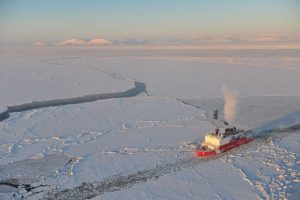
By Mihaela David The White House revealed the much anticipated national strategy for the Arctic region less than a week before Secretary of State John Kerry heads to the Arctic Council ministerial meeting in Kiruna. The document lays out the administration's strategic priorities for the region with the stated goal of positioning the U.S. "to respond effectively to emerging opportunities – while simultaneously pursuing efforts to protect and conserve this unique environment."[1]
Why is the strategy important?
Until this document was released, U.S. policy-making in the Arctic was guided by a rather brief and vague presidential directive (NSPD-66) adopted in 2009 in the waning days of the Bush Administration. Arctic policy observers and stakeholders have long called on the U.S. to start thinking strategically about this rapidly changing and increasingly important region. In a July 2012 letter to President Obama, Alaska senators Begich and Murkowski pressed the administration to deliver a formal strategy document that guides future Arctic development and "ties together all the individual agency policies and visions."[2] Articulating such a strategy is also a necessary first step in a much needed process to coordinate and streamline the activities of the more than twenty federal departments and agencies involved in Arctic policy-making.[3] Lastly, the risk of inaction looms large. In the strategy document, the administration acknowledges that an "undisciplined approach to exploring new opportunities in this frontier could result in significant harm to the region, to our national security interests, and to the global good."[4] In other words, this strategy is long overdue.
The Arctic This Week: 04 May 2013 – 10 May 2013
By Tom Fries, Kevin Casey & Maura Farrell
The Arctic This Week 2013:18
Not a subscriber yet? Sign up here.
Thanks for joining us this week! We hope you find TATW useful and fun to read. If you find TATW valuable, please spread the word.
If you haven’t yet done so, you might want to give our PDF version a try. It’s easy to navigate directly to the sections you’re interested in, and most editions are illustrated with outstanding Arctic photos from novice and professional photographers.
As always, all editorial choices, opinions and any mistakes are the authors’ own. To comment, to point out an error or to request a back issue, feel free to contact Tom, Kevin or Maura directly.
Reads of the Week
If you’re pressed for time this week, we’d suggest you spend your time on these stand-out items.
Start this week with a video, produced by the Arctic Monitoring and Assessment Programme (an Arctic Council working group), covering Arctic Ocean acidification. It’s about 12 minutes, nicely produced, clear and informative. Stay in the natural sciences with a great article on narwhals from Isabelle Groc – the first of what promises to be an excellent series.
On the political side, we’re glad to point to an article from Tim Querengesser, a prolific commentator on Canadian politics, society and culture. His article “Decision Time on Aboriginal Issues” is a thoughtful reflection on the false dichotomy between success for Canada’s Aboriginal communities and success for the country as a whole. Follow that with a fascinating and fresh look at Russia’s “pivot” to the North. The article from Salma Yusuf in Eurasia Review argues that in a few decades, if it works to integrate itself in global commercial and financial networks and welcome international business, Russia could become “a new geographical pivot among the great powers”. Try to ignore any ads for Russian dating websites.
Saturday, May 11, 2013
The Arctic Institute Reaction to U.S. National Strategy for the Arctic
In response to the release of the U.S. National Strategy for the Arctic Mihaela David, Fellow at The Arctic Institute, said:
“The U.S. National Strategy for the Arctic region represents a good faith effort at articulating policy priorities, but without a clear budgetary plan, this strategy becomes nothing more than a lengthy wish list. In the absence of a comprehensive implementation strategy and a long-term plan to invest in Arctic infrastructure and capabilities, a true U.S. Arctic strategy remains as elusive as a mirage on the Arctic ice-sheet.”
“The strategy does not lay out specific initiatives or projects that might be pursued to achieve the various objectives identified within. It remains to be seen if the administration is willing to back up its strategy with adequate fiscal resources.”
“There is no mention of specific plans to upgrade the inadequate and outdated icebreaker fleet; to build physical infrastructure such as deep-water ports; or to invest in facilities and equipment for the Coast Guard's operations in Alaska's northern region. No budget information is included, nor a timeline for implementation.”
“What the strategy does succeed in doing is signal to U.S. citizens, other Arctic states, and the international community that the U.S. acknowledges its roles and responsibilities in the Arctic, that it thinks strategically about the future of the region, and that the administration intends to make Arctic policymaking more of a priority than it has in the past.”
“If in the next decade the administration fails to streamline the implementation process and provide the fiscal resources to support its policy objectives, the result will be a fragmented, unfocused, and inadequate policy through which the U.S. cedes leadership in the region and forgoes many of the opportunities that other Arctic and non-Arctic states will be prepared to seize,” concluded David.
Contacts:
Mihaela David, Washington, D.C. mihaela.david@thearcticinstitute.org, +1 518.491.8398
Malte Humpert, Washington, D.C. malte.humpert@thearcticinstitute.org, +1 202.656.6258