Choosing the Bear: Navigating Spectacular Risks in Longyearbyen
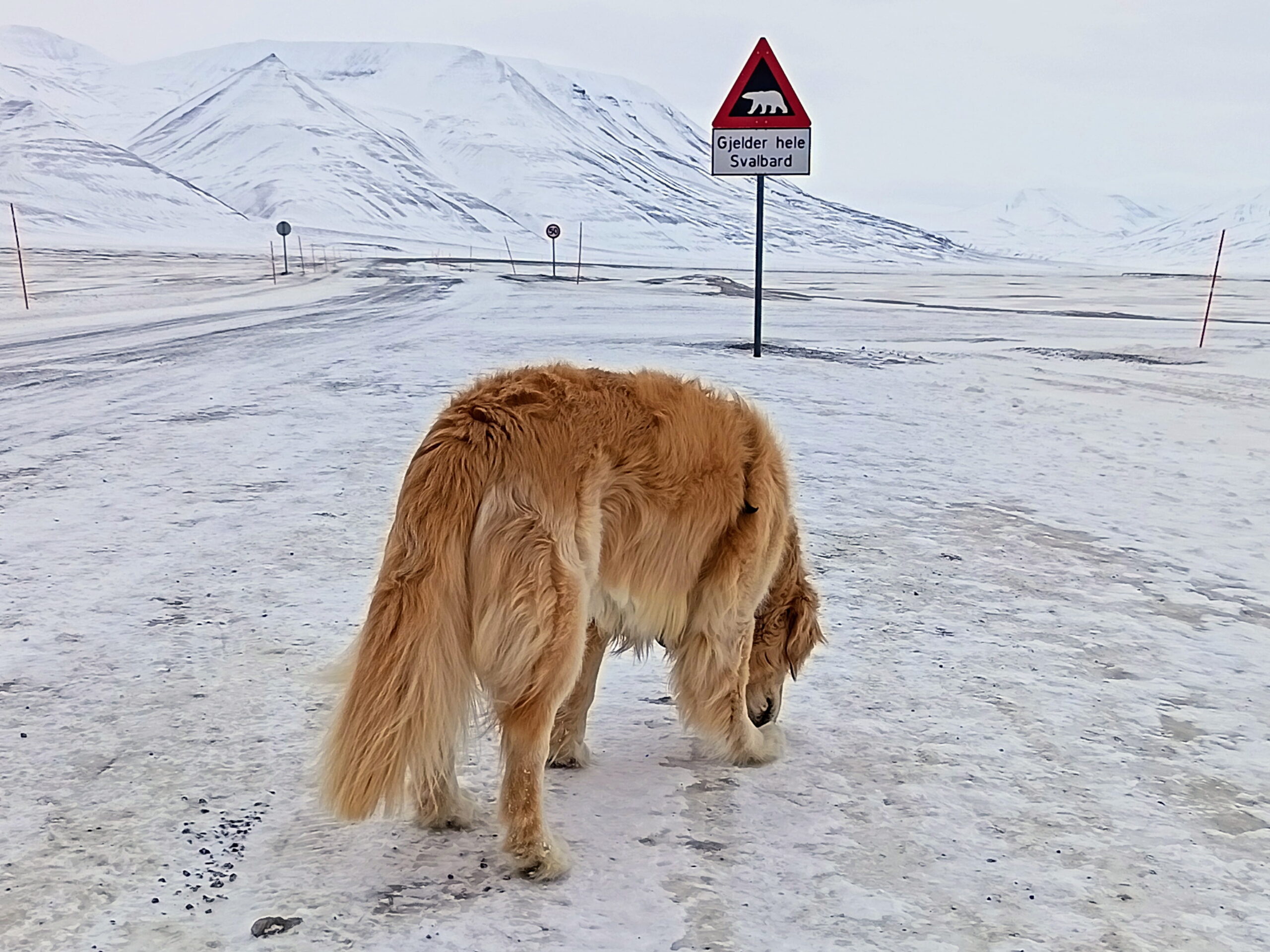
A polar bear warning sign reading “Gjelder hele Svalbard” (Applies to all of Svalbard) stands on a snow-covered road. Environmental hazards are publicly mapped and securitised by the state, contrasting with the approach to gender-based violence within domestic and social spheres. Photo: Cherry Jackson
The Arctic Institute Polar Disaster Series 2026
- The Arctic Institute’s 2026 Polar Disaster Risk Reduction and Response Series: An Introduction
- Crisis Management in Arctic Communities: Principles of Crisis Response
- Disaster Risk Reduction and Response: Greenland
- Risk Analysis of Infrastructure Vulnerability and Sustainable Resource Exploitation in the Arctic
- Ships in the Arctic Need to Plan to Survive Until Help Arrives
- From Pandemic to Permafrost: Legal Pathways for One Health Preparedness in Arctic Communities
- Icebergs and Navigation Safety in Antarctica: Possible Impact of new Sea-Ice Regime in the Southern Ocean and South Atlantic Ocean
- Legal Preparedness for One Health in Polar Regions: Strengthening Disease Surveillance
- A Framework for Avoiding Polar Disasters
- Keeping an Eye on Iceland: Volcanoes and Climate Change
- Choosing the Bear: Navigating Spectacular Risks in Longyearbyen
- Local Perspectives in Disaster Risk Reduction: Visualising Disaster Risk in Svalbard
- The Arctic Institute’s 2026 Polar Disaster Risk Reduction and Response Series: A Conclusion
In the Norwegian settlement of Longyearbyen on the Svalbard archipelago, disaster does not always arrive with a roar. Sometimes, it quietly stains the fabric of everyday life. Responding to the call for greater attention to rarely considered hazards in polar disaster risk reduction—and amid a global erosion of women’s rights—this piece asks what it means to “choose the bear” in a landscape where danger is both environmental and intimate. Drawing on feminist theories and almost two years of ethnographic fieldwork, I reflect on informal survival strategies, protective knowledge-sharing, and the quiet violences that structure life in Longyearbyen. As climate change, geopolitical machinations, and social precarity increasingly converge in the Arctic on the whole, and acutely in Longyearbyen, this contribution reconsiders what is allowed to count as a disaster, and—crucially—who is expected to survive it.
In June 2016, the pianist Ludovico Einaudi performed an elegy on a floating platform in the Arctic Ocean, a calving glacier behind him.1) The image distilled climate catastrophe into beauty and collapse, sound and silence. It was a disaster as spectacular, as a bounded, photogenic, and grievable event.
But disaster also arrives without a roar. It seeps into daily life as a locked door on a freezing night, as bags packed and stacked at the door, as the low hum of vigilance that never switches off. This harm is not an event. It is an atmosphere. And in Longyearbyen, the main settlement of the Norwegian archipelago of Svalbard, it is everywhere unspectacular.
This piece asks what it means to “choose the bear” in a landscape where danger is both environmental and intimate, where a woman may know exactly what protocol to follow if she meets a polar bear on the road, but has no equivalent for the man she lives with. It is a call to reconsider what is allowed to constitute as a disaster, and who is expected to survive it.
“It Doesn’t Rise to the Level of Crisis”
The Sámi feminist scholar Rauna Kuokkanen has spent years documenting how violence against Indigenous women is systematically excluded from what governments and institutions treat as urgent. In Alaska, she has shown that gendered violence is routinely relegated to the status of a “soft” social issue, a private matter that, as one of her interlocutors put it, “doesn’t rise to the level of crisis that other situations would.”2) Sovereignty disputes, resource extraction, geopolitical strategy: these are “hard” issues that mobilise state attention. The woman beaten in her home is not.
Kuokkanen’s argument is that this exclusion is not incidental. It is a structural feature of how colonial states have organised their relationship to Indigenous peoples, and, by extension, to women. The relegation of gendered violence to the private sphere, the refusal to treat it as a crisis, is a mechanism of governance. It preserves the fiction that the state is peaceful, egalitarian, and in control.
This dynamic is not confined to Alaska. It operates wherever the spectacular is privileged over the atmospheric, wherever “hard” security concerns crowd out the quieter registers of harm. As such it operates with particular intensity in Svalbard.
Exceptionality and Svalbard
Svalbard’s self-image is braided from three myths. There is Nordic exceptionalism, the global brand of flawless egalitarianism that tops international rankings while masking persistently high rates of violence against women.3) There is Arctic exceptionalism, which frames the region as a peaceful wilderness governed by cooperation not conflict.4) And there is Svalbard exceptionalism, the ultimate frontier, a place where anyone can prove their mettle against the elements.5)
This self-image, however, depends on a particular act of exclusion: the externalisation of threat. In Longyearbyen, the avalanche is a public emergency, mapped with precision by the Norwegian Water Resources and Energy Directorate, its risks colour-coded.6) The polar bear is a securitised threat, governed by strict protocols requiring residents to carry rifles beyond the settlement perimeter. Geopolitical encroachments are monitored by the Norwegian Coast Guard.7) Research on disaster governance on the archipelago catalogues the avalanches, maritime incidents, polar bear attacks, and coal mine collapses meticulously, yet nowhere in this catalogue does intimate violence appear.8)
The coercive partner, the locked door and the slow accumulation of atmospheric control remain private matters. They are not disasters. They are not even, in the official grammar, risks.
Choosing the Bear
In 2024, a question for women spread across the internet like wildfire: would you rather meet a bear or a man in the woods?9) The question was hypothetical, but the responses revealed something stark: for many women, the calculus of danger is so familiar that the bear seemed the safer choice. The bear has known qualities. Its danger is acknowledged, mapped, and governed by protocols. The man is not.
In Longyearbyen, this question is not hypothetical. When female tourists ask, “Will I be safe walking around town?” the pause before the answer contains a knowledge that they are not talking about men. But they should be. The requirement to carry a rifle beyond the settlement perimeter is necessary, but the female tourist’s mind only thinks of the bear, that is, the mapped danger, the one with protocols. And yet I have heard of male visitors walking alone and unarmed from the airport into town, not out of recklessness but from the quiet certainty that they would be fine. The bear’s danger has a script; the man’s does not.
But for many women living in Svalbard, the real calculations around safety have less to do with polar bears and more to do with navigating the threat of gendered violence. In a settlement of roughly 2,500 people, women learn the names to avoid. They learn which men use alcohol to lower a woman’s capacity for refusal. They learn which men have reputations that circulate quietly between women.
Kuokkanen’s work on violence against Indigenous women identifies a mechanism at play here: the failure to treat gendered harm as a crisis is not simply a matter of neglect, but an active process of devaluation.10) She argues that this devaluation is rooted in the interlocking systems of colonisation, patriarchy, and capitalism, systems that have long positioned certain bodies as disposable and certain harms as unremarkable. In Svalbard, a settlement built on extractive industry and polar mythology, these systems converge with particular force.
The Architecture of Exile
The harm that accumulates in Longyearbyen’s domestic interiors is often not a spectacular physical assault. It is a slow, grinding attrition that weaponises the structural precariousness of the settlement itself.
Consider a woman I came to know whose partner exerted control through periodic, manufactured crises of displacement. He would lock her out of the flat on a freezing night and force her to shiver in the building’s communal hallway. On other occasions, he would pack her belongings into bags and stack them outside the front door, ordering her to leave. The precise mechanism was less important than the structural message it carried: you are never securely housed. You are always one argument away from exile.
This is not merely the threat of a dissolving relationship. Because Longyearbyen lacks crisis infrastructure like women’s shelters, and because residency is legally contingent upon self-sufficiency and employment, to be locked out into the Arctic landscape is to be pushed directly toward the airport.11) The partner does not need to raise a fist; he simply leverages the legal and economic architecture of the settlement to turn home into a weapon.
Over coffee one morning, another woman described the cumulative toll of monitoring her partner’s emotional state: “Even when nothing’s happening, I’m waiting for something to happen. It’s like I’m on shift all the time.” In a settlement built on extractive labour, she had internalised the logic of the archipelago’s economy and applied it to her intimate life. Her body was the site of extraction; her attention, the resource being mined.
This exhaustion is structural. A woman who leaves a partner in Longyearbyen often leaves her housing, her employment, and her social network simultaneously. As such, to leave is to exit the settlement itself. Faced with this calculus, many women stay. This is not passivity. It is a rational assessment of the options available.
Gossip as Infrastructure
In response to this atmospheric threat, women do not simply endure. They build.
The sauna is one of the few spaces in Longyearbyen where women can be warm, unguarded, and briefly illegible to the masculine gaze, if they go together as an all-women’s group. It was in this setting that a woman told us, quietly and without fanfare, about a man who had deliberately intoxicated her and then raped her. She did not announce it as a testimony. She let it surface, testing whether the room could hold it. We held it. The sauna became a container for something the settlement has no official container for.
Not all containers are so obvious. I learnt of another assault when I gave away a beauty item to a woman who was looking for one. The old second-hand shop in town, where everything is free, has deteriorated, and the item in question costs triple what it should in the supermarket. So, we met, two women exchanging a small object, in a transaction that was partly about economy and entirely about something else. In that space, domestic, informal, laced with the shared understanding of how the settlement’s scarcity works, she told me about another woman whose drink had been spiked, who had been raped so badly she needed hospital treatment, and who did not want to prosecute because the police response had been so poor.
The beauty item was the pretext. The sharing of survival was the product.
These spaces are not decorative. They are the physical and relational condition for a counter-cartography: a map of which men to avoid, which places not to go alone, and which institutions cannot be trusted to respond without causing further harm. As such, what circulates here is the primary security infrastructure for many women in the settlement, a distributed early-warning system that operates below the threshold of formal reporting. As Silvia Federici reminds us, gossip was historically a form of collective female power before it was deliberately demonised to fracture solidarity.12) In Longyearbyen, that power persists in the sauna, in the quiet exchange of an item, in the spaces where women pass to one another what the state refuses to hold.
Kuokkanen’s research in Alaska reveals a strikingly similar dynamic. She documents how Indigenous women in remote villages rely on informal networks to share warnings and protect one another, precisely because the formal justice system has failed them.13) In both contexts, women’s lateral communication functions as a parallel security infrastructure. But many military forces have deployed Female Engagement Teams (FETs) in international operations, relying on women’s informal networks to gather intelligence.14) Indeed, in 2014 Norway established Jegertroppen, the world’s first all-female special forces unit, precisely because of the utility of FETs in conflict zones.15) As such, whilst women’s gossip is operationalised as tactical data in conflict, in Longyearbyen the same form of knowledge is often dismissed as gossip.
The State’s Deafness as Design
It would be tempting, at this point, to call for better training and better policies. But the state’s deafness to intimate harm is not a failure of implementation. It is a condition of the myth’s coherence.
The avalanche gets a colour-coded warning matrix and steel barriers anchored into the mountainside. The polar bear gets protocols, population tracking, and public warning systems. Geopolitical risk gets Coast Guard patrols and the exclusion of BRIC nationals from UNIS. The coercive partner gets a closed file, or no file at all.
This is not accidental. As Kuokkanen argues, the relegation of gendered violence to the private sphere is a structural feature of colonial governance.16) It preserves the fiction of the peaceful, egalitarian state by externalising threat, locating danger in the wilderness, the foreign power, the environmental hazard, whilst rendering invisible the violence that unfolds within the home. To recognise gendered violence as a disaster would be to admit that the settlement is not pristine, that the community is not harmonious, that the egalitarian brand is a fiction. And so, the recognition is withheld.
The Limits of Care
Yet the informal networks women build are fragile. The settlement’s high population turnover (approximately twenty-five per cent annually) means that predatory men can outlast the archive of their own reputations. Newcomers often arrive without access to the counter-cartography. Gossip can warn, but it cannot punish, exclude, or permanently mark.
The network is also threatened from within. Because proximity to male power in Longyearbyen is tied to an adherence to the settlement’s mythology of exceptionalism, some women become heavily invested in defending that myth. When I raised the prevalence of intimate violence with one woman, she replied quickly that Eastern European women benefit from dating Norwegian men. This comment translated structural harm into individual advantage and rearticulated male power as benevolence. When a woman who names violence is met with such comments, the signal is jammed.
This echoes what Kuokkanen identifies as the internal obstacle of silence and denial that often pervades communities where speaking out carries severe social risk.17) In small communities, where everyone knows everyone, the cost of naming harm can be exile. And in Longyearbyen, where exile means leaving the archipelago entirely, the stakes are existential.
Reimagining Preparedness
Kuokkanen’s relational theory of Indigenous self-determination insists that collective sovereignty cannot be achieved without addressing individual integrity, including freedom from violence.18) The “soft” issues are not soft at all. They are the foundation on which any meaningful security must be built.
What would it mean to take this seriously in Longyearbyen? It would mean recognising that gossip is not a supplement to formal security but, for many women, the primary security. It would mean decoupling access to housing and residency from employment and relationship status, so that leaving a partner does not mean leaving the archipelago. It would mean believing women the first time they speak and recognising that the difficulty of that speech is itself evidence of the atmospheric conditions it navigates.
True preparedness in the Arctic might look nothing like more physical infrastructure. It might look, instead, like a quiet investment in the networks that already catch those the state lets fall.
The Siren, Not the Mermaid
In her foundational critique of securitisation theory, Lene Hansen used the Little Mermaid as a metaphor for the condition of women whose security depends on speech, yet for whom speaking is lethally dangerous.19)
The mermaid trades her voice for a chance at being heard, and dissolves when she fails. But there is another figure who offers a different model. The siren does not trade her voice. She does not wait for permission. She sounds the alarm whether or not anyone is listening, and she names the hazard before the ship breaks on the rocks.
To “choose the bear” is not to prefer nature’s violence to men’s. It is to recognise that the bear’s danger is calculable, acknowledged, and governed, whilst the man’s is atmospheric, denied, and structurally secured by the very institutions that claim to protect. Choosing the bear, in the end, is choosing the hazard that the state can see. The real disaster is the one it refuses to name.
The alarm has thus sounded for years in a register the state does not hear. This article translates that frequency into the public record. The burden now shifts from the women surviving the disaster to the institutions tasked with dismantling it.
Cherry Jackson is a PhD Candidate at Royal Holloway, University of London, UK.
References